
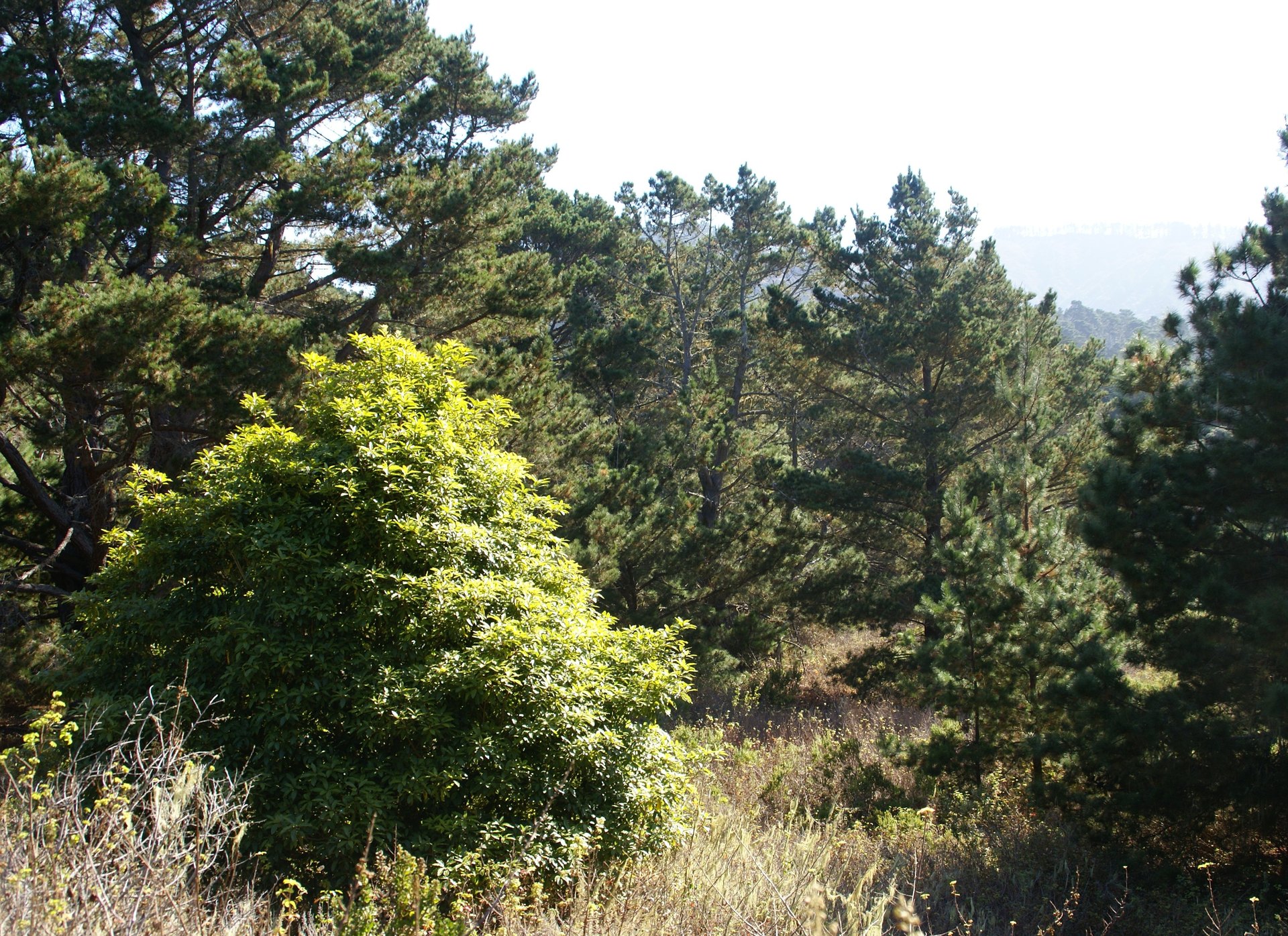
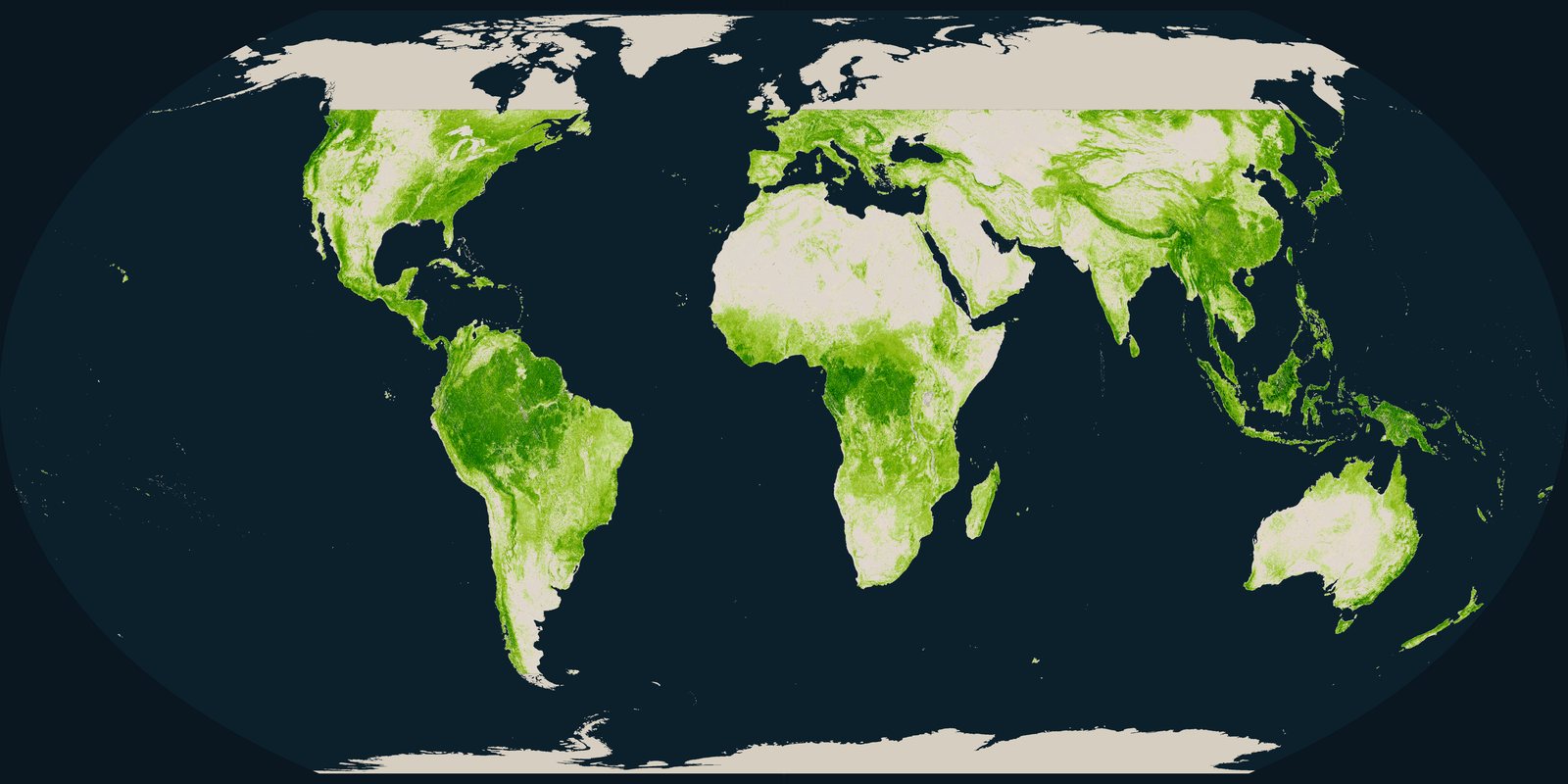
Canopy height
How tall the forest canopy is, measured by spaceborne lidar as a mean top height on a grid of about 1 kilometre.
Open the layerThe Food and Agriculture Organization of the United Nations reports at least 1.18 billion hectares of primary forest, 29 percent of all forest: naturally regenerating forest of native tree species with no clearly visible signs of human activity.
Global Forest Resources Assessment 2025 · at least 1.18 billion hectares · 29 percent of forest
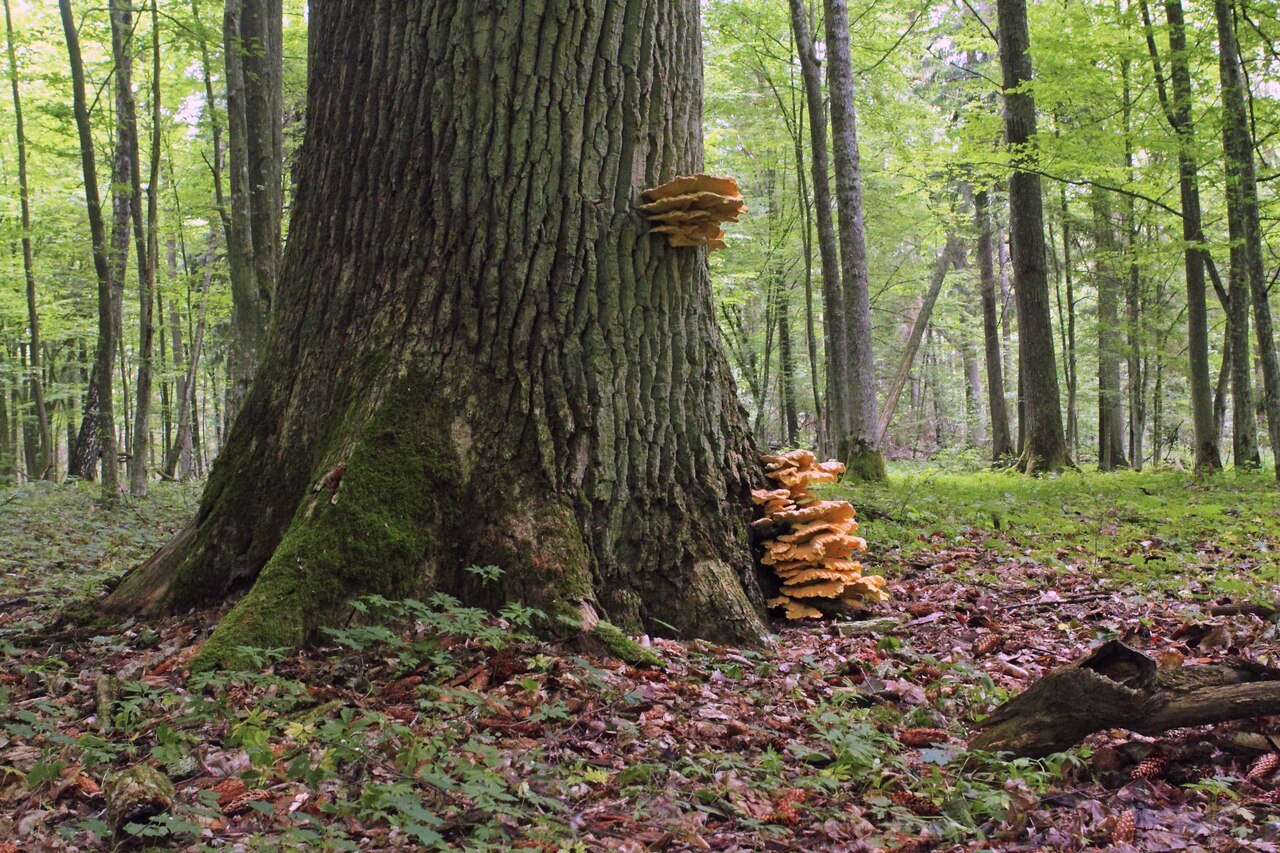
Old-growth oak, linden and hornbeam forest in the Białowieża Forest, Podlaskie, Poland, with a large tree trunk carrying orange bracket fungi and moss at its base.
Photo: Bouke ten Cate, via Wikimedia Commons, licence Creative Commons Attribution 4.0. ( https://creativecommons.org/licenses/by/4.0/ )
The Global Forest Resources Assessment 2025 of the Food and Agriculture Organization of the United Nations reports that primary forests cover at least 1.18 billion hectares, which is 29 percent of the total forest area. The assessment defines primary forest as naturally regenerating forest of native tree species with no clearly visible indications of human activities and with ecological processes that are largely undisturbed. The definition includes forests where Indigenous Peoples and local communities carry out traditional stewardship, and forests that show the effects of natural disturbances such as storms, drought, wildfire or insect outbreaks.
The assessment says that primary forests, especially primary tropical moist forests, are highly species-rich, diverse ecosystems and that their extent is an important environmental indicator. Primary forest accounts for 49 percent of the total forest area in South America, 38 percent in Africa, 37 percent in North and Central America, 32 percent in Europe, 21 percent in Oceania and 15 percent in Asia.
By region, Europe has the largest primary forest area, 311 million hectares, followed by South America with 299 million and North and Central America with 280 million. Africa has an estimated 163 million hectares, Asia 85.2 million and Oceania 38.3 million. The Europe figure includes the Russian Federation; without it, Europe has 4.32 million hectares. The area of primary forest worldwide decreased by 110 million hectares between 1990 and 2025. The average annual rate of net loss was 3.48 million hectares in 1990 to 2000, 3.92 million in 2000 to 2015 and 1.61 million in 2015 to 2025, less than half the rate of 2000 to 2015.
The 1.18 billion hectares is a minimum. In all, 168 countries and areas, representing 85 percent of the world forest area, reported primary forest for 2025, and among those reporting countries and areas primary forest is 33 percent of the forest area. The assessment names inconsistent interpretation and application of definitions as the biggest obstacle to reporting, which raises concerns about how well the data compare between countries. The data record the net change in area, so a decrease can come from deforestation or from conversion to other forest types such as naturally regenerating or planted forest.
How tall the forest canopy is, measured by spaceborne lidar as a mean top height on a grid of about 1 kilometre.
Open the layer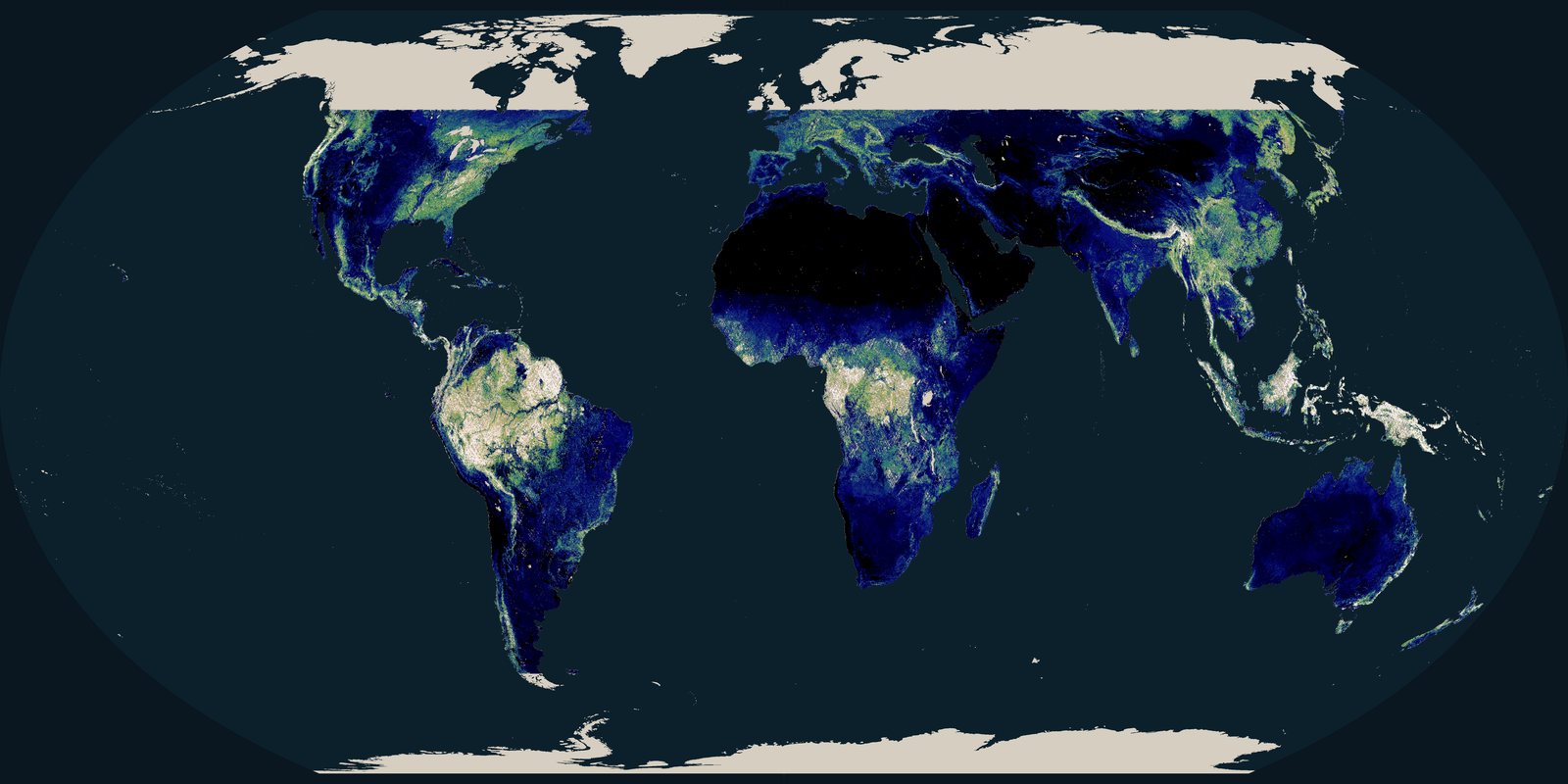
Aboveground biomass density from spaceborne lidar, mapped in tonnes per hectare.
Open the layer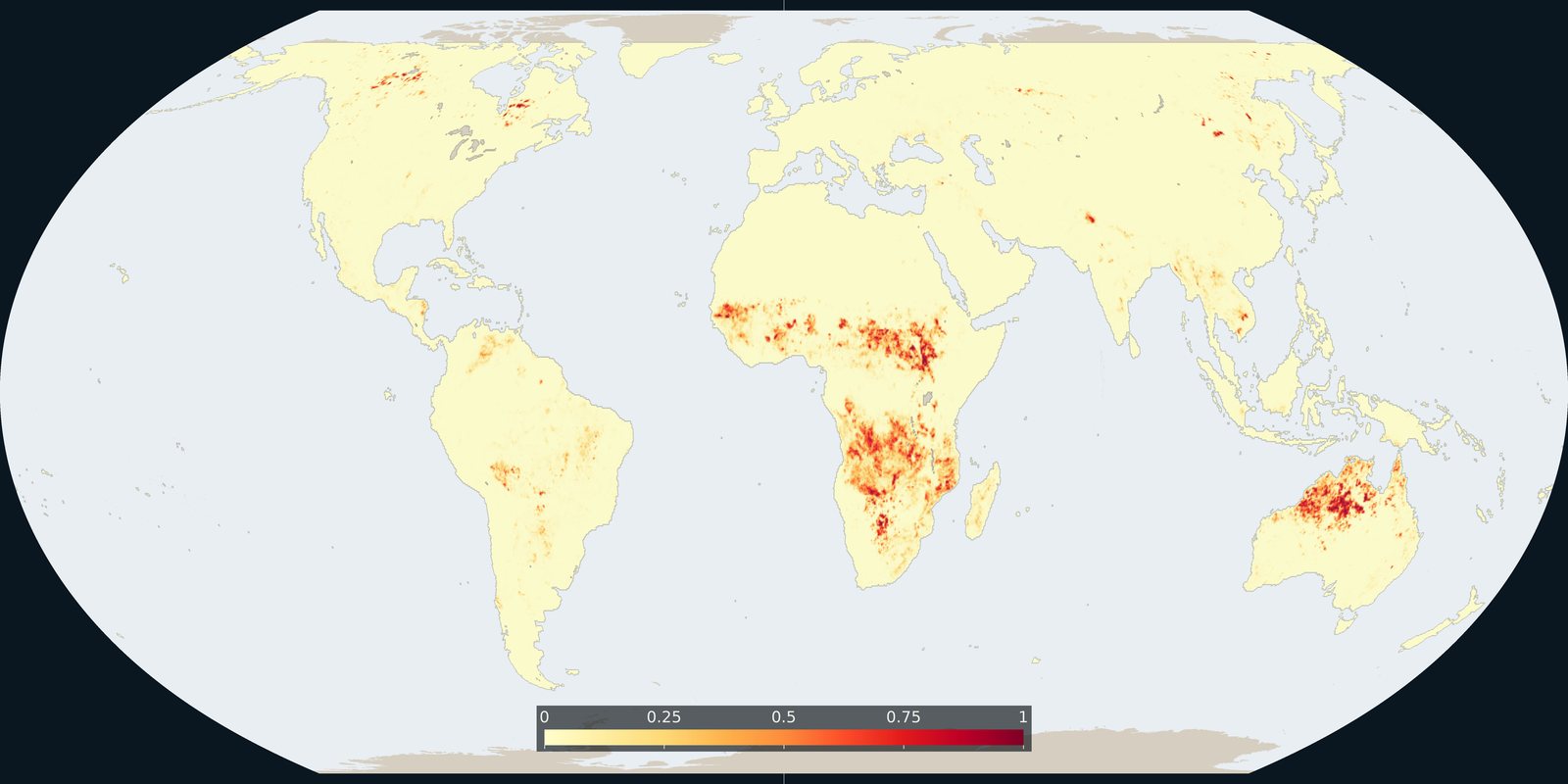
Where fire burned in 2023, as the annual burned fraction on a quarter-degree grid.
Open the layer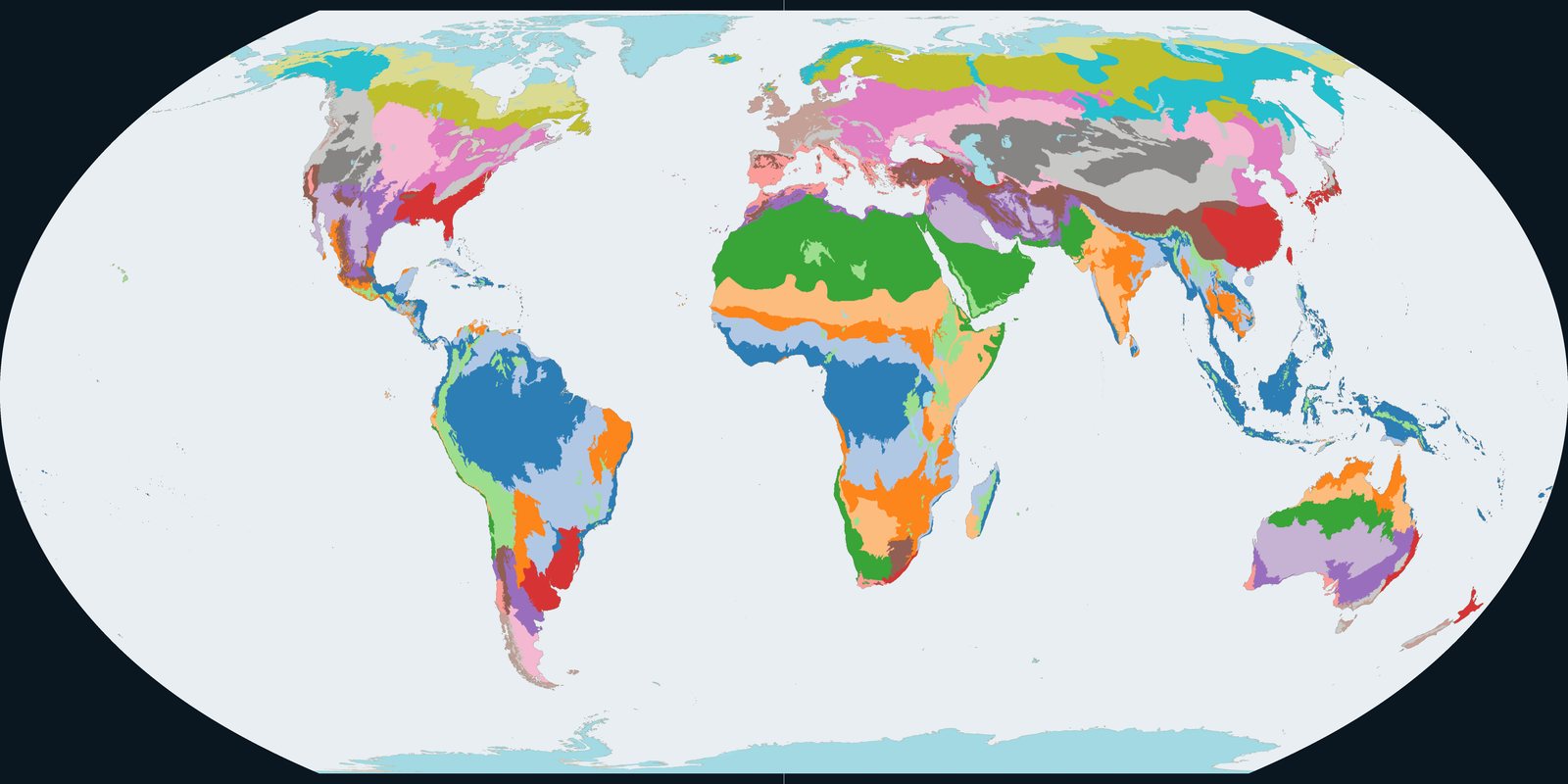
Climatic and ecological zones used for forest reporting: a zoning of land by climate and ecology.
Open the layer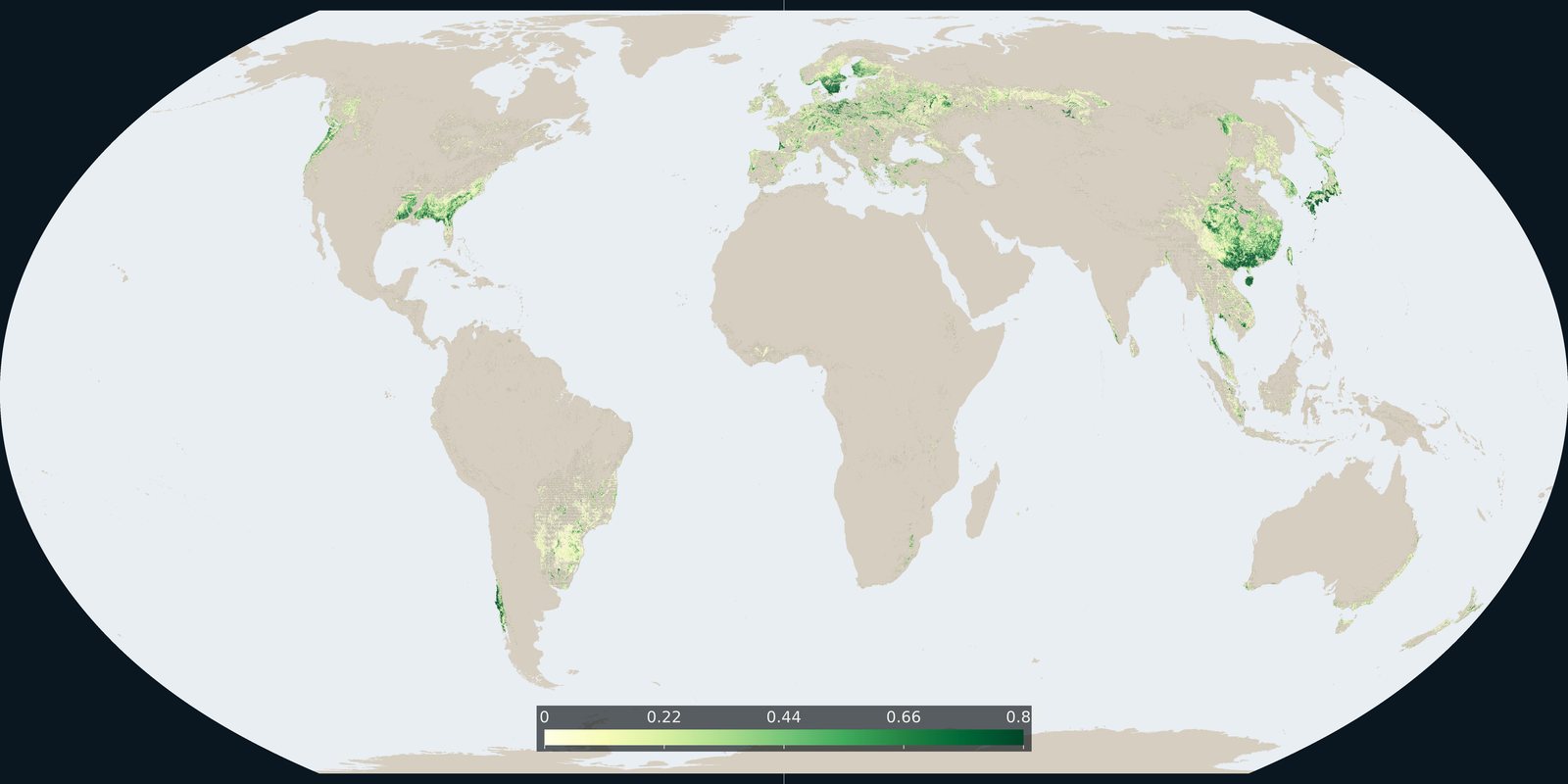
Where the 2015 forest-management map marks planted forest and short-rotation timber plantation, with the reported total of about 312 million hectares.
Open the layer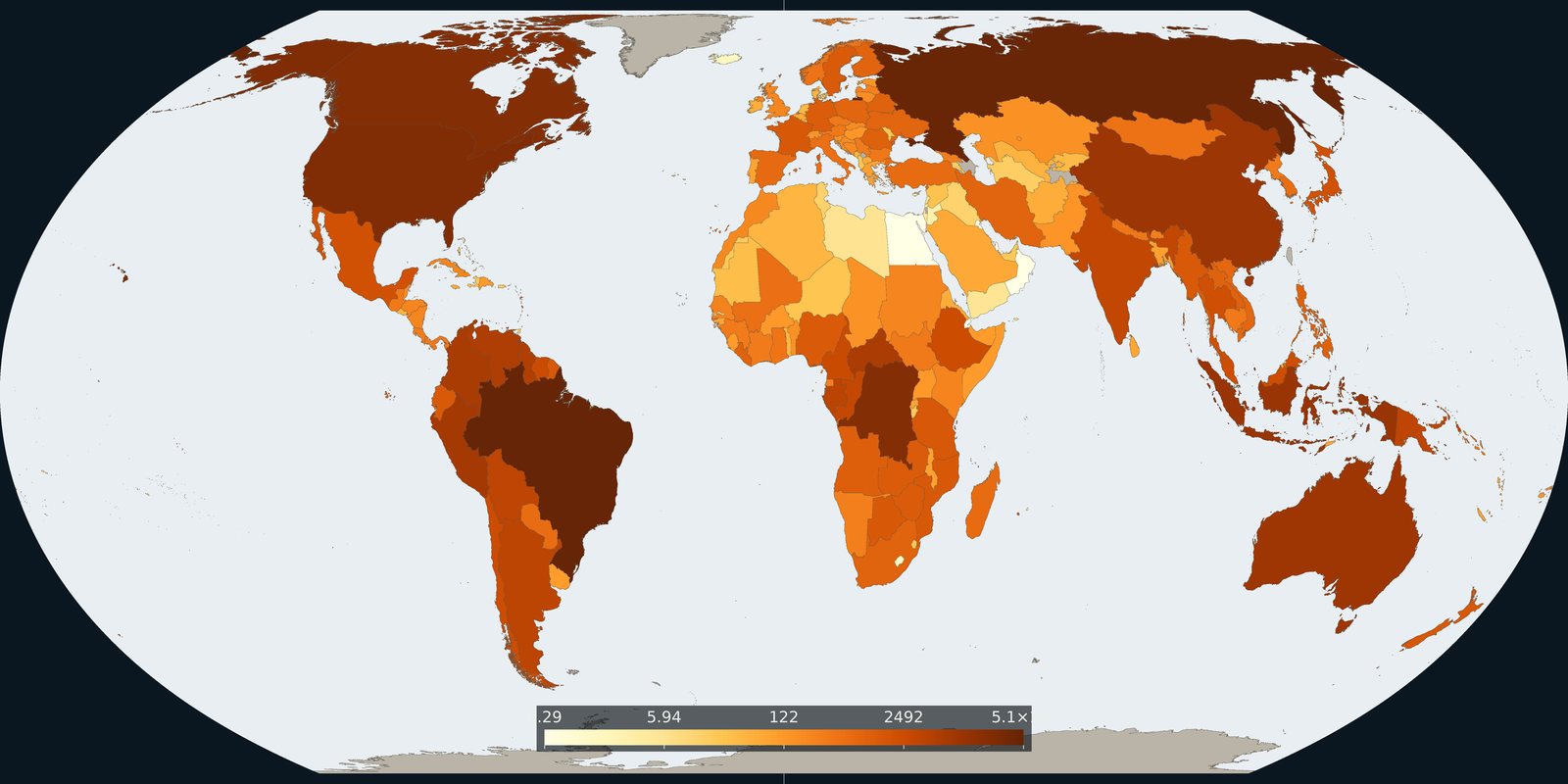
Country totals of living-biomass carbon in 2025, aboveground plus belowground, from the forest assessment, with the five-pool global total alongside.
Open the layer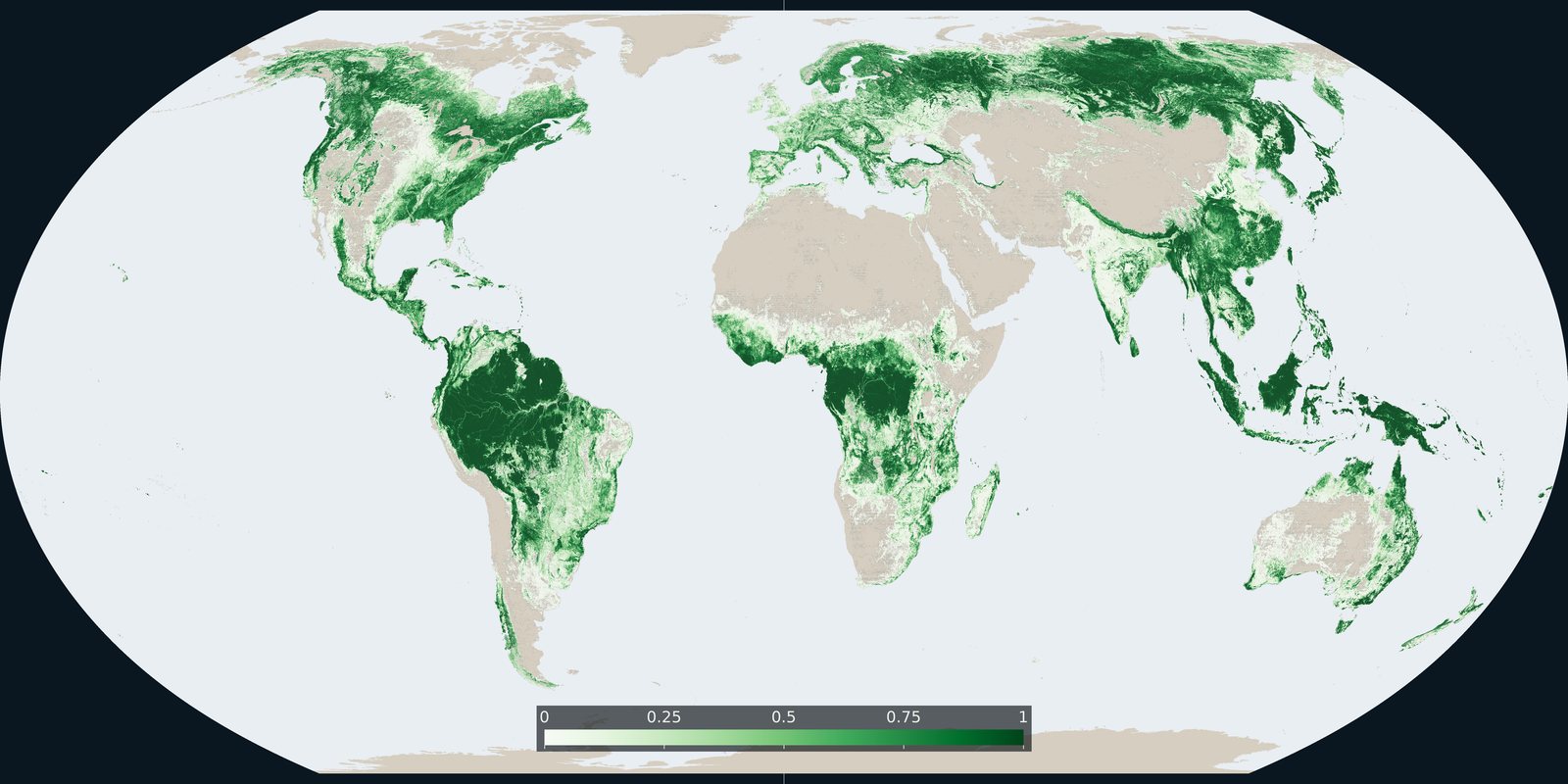
Where the 2021 land-cover map assigns the tree-cover class, counted as the share of each cell.
Open the layer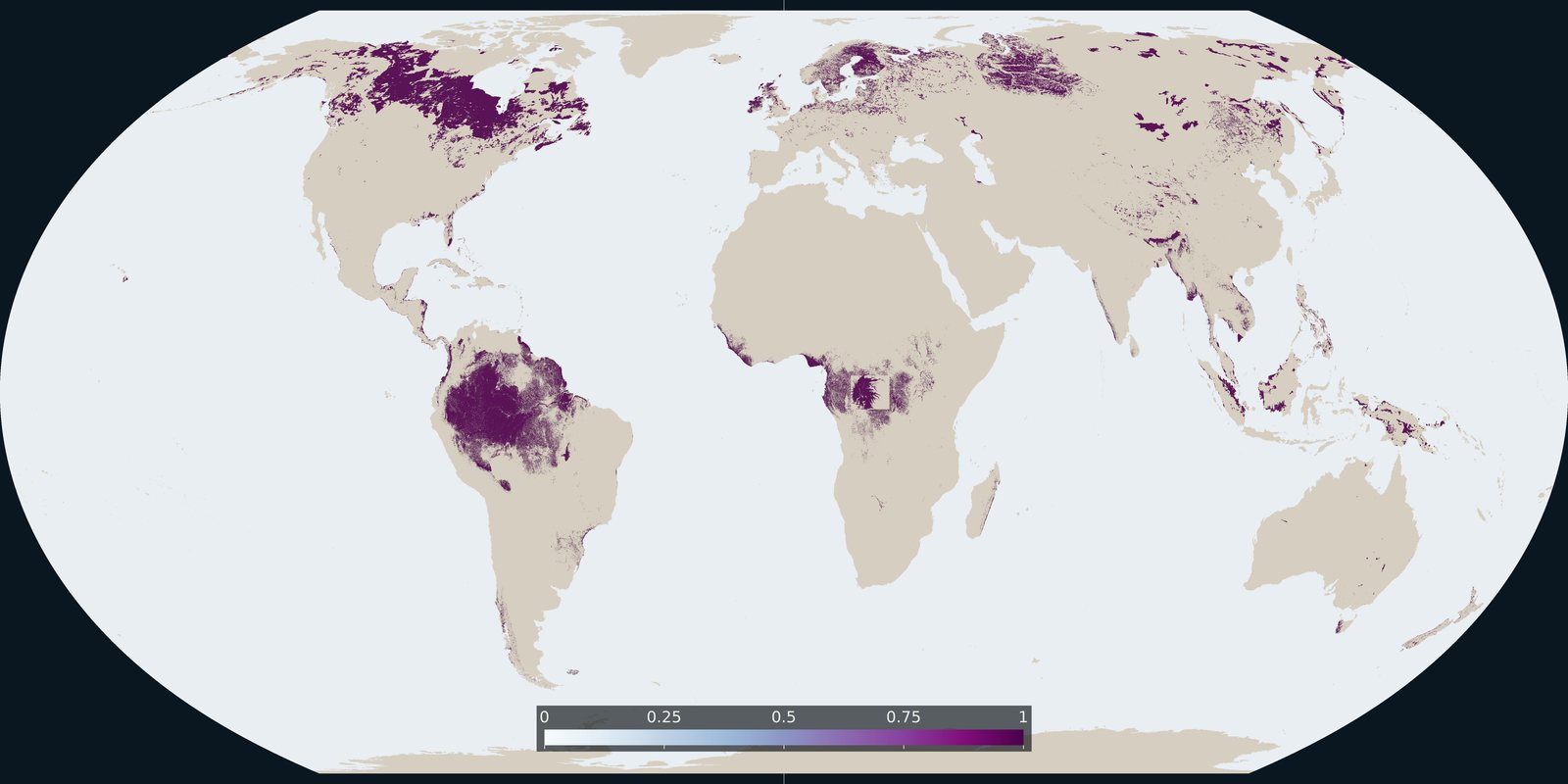
Where the peat map records peat: a global extent of organic soils.
Open the layer
The Food and Agriculture Organization of the United Nations reports that forests cover 4.14 billion hectares, 32 percent of the world land, based on reports from 236 countries and areas.
Open the layer
The Food and Agriculture Organization of the United Nations reports that the world forest area shrank by a net 4.12 million hectares a year in 2015 to 2025, down from 10.7 million hectares a year in 1990 to 2000.
Open the layer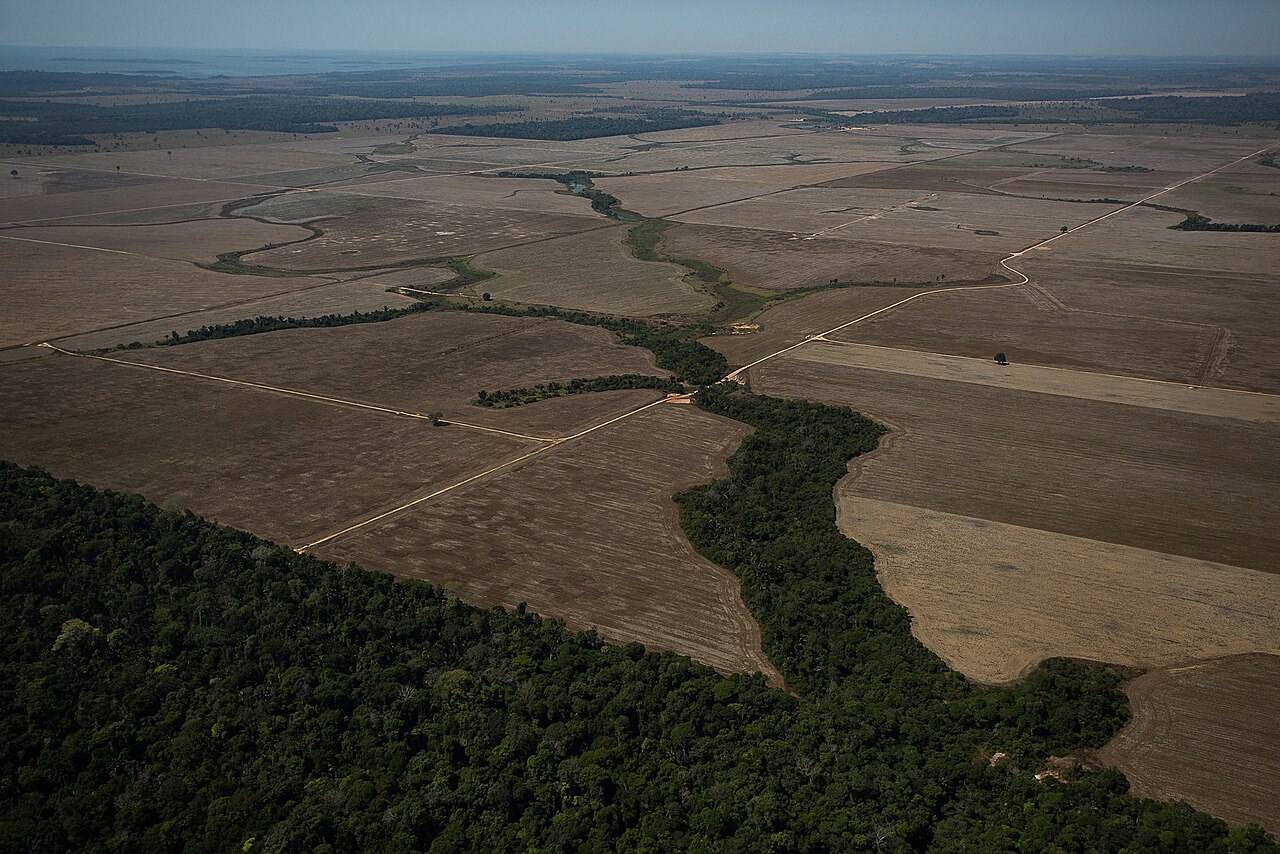
The World Resources Institute reports that the world lost 4.3 million hectares of tropical primary rainforest in 2025, 36 percent less than in the record year 2024.
Open the layerSource: World Resources Institute, Global Forest Review analysis of tropical forest loss in 2025
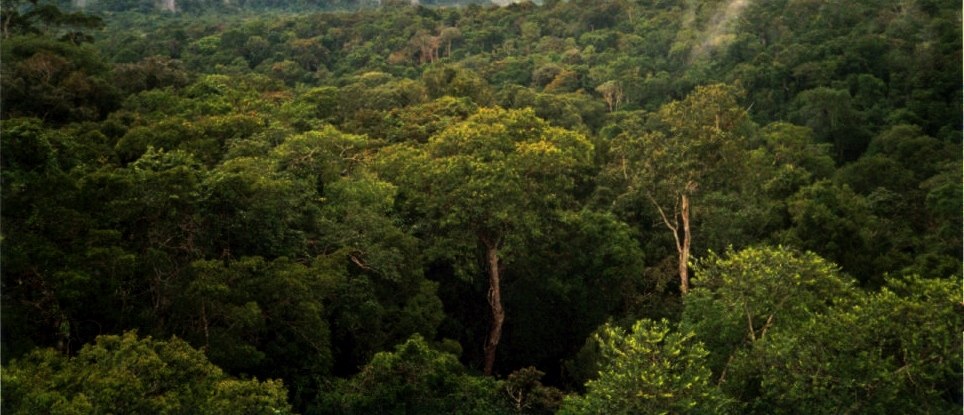
A 2015 study in the journal Nature combined 429,775 forest plot measurements with remote sensing and mapping layers and estimated that there are about 3.04 trillion trees on Earth.
Open the layerSource: Nature, Mapping tree density at a global scale (2015)
Definitions, sources, and the rest of the published set.
Open the layer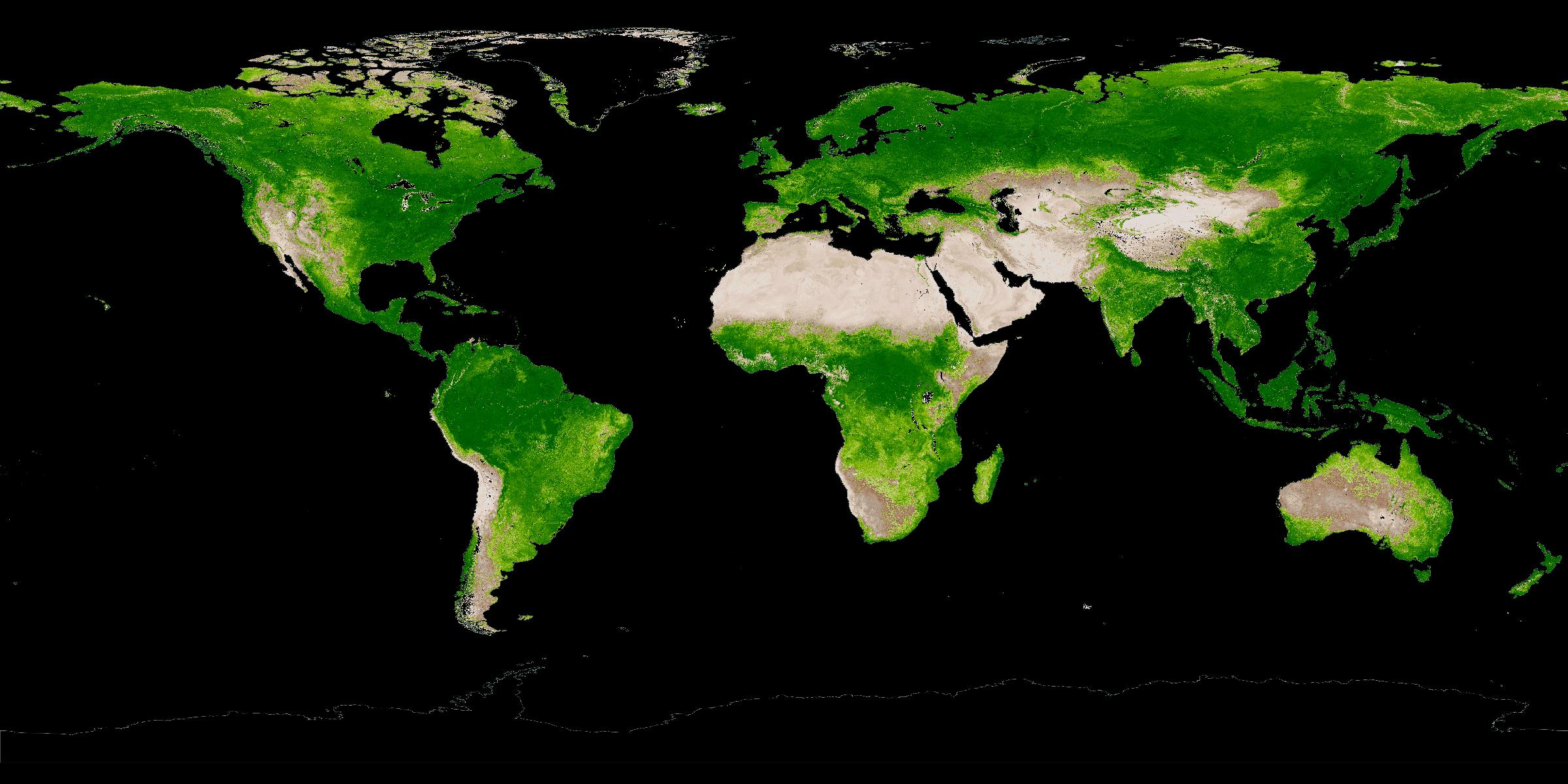
July canopy greenness from space, 2001-2025.
Open the layer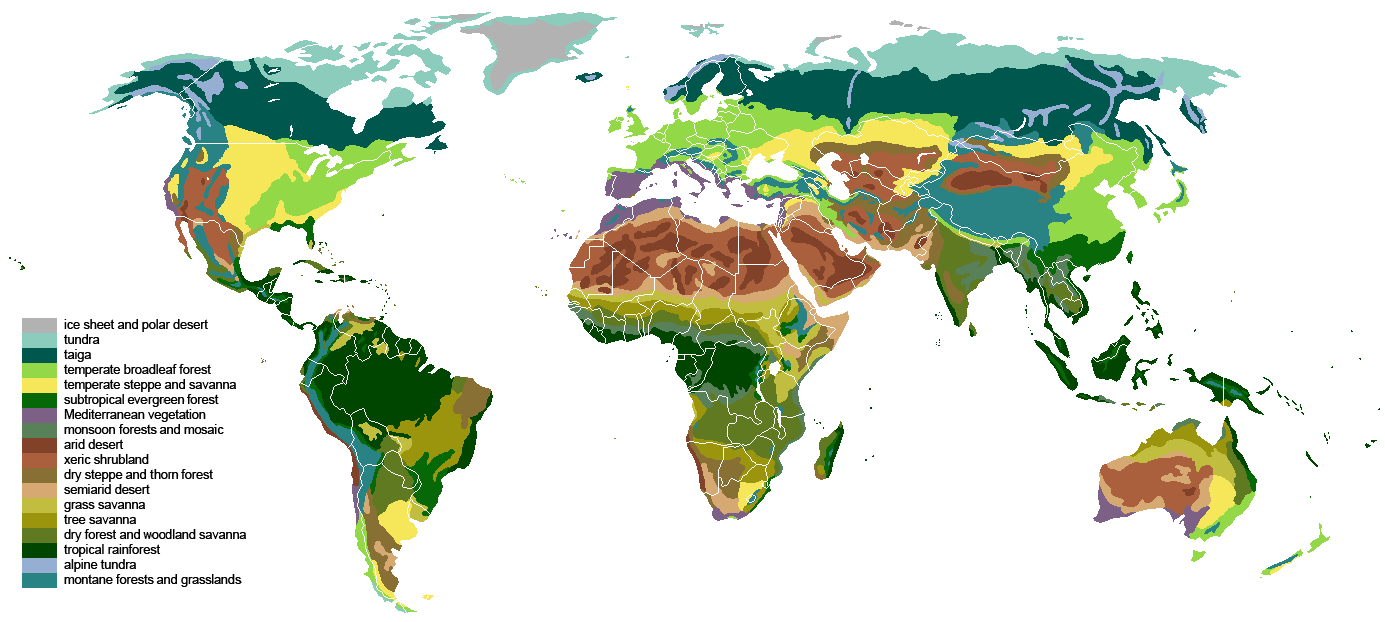
Ice-age vegetation, biomes, and land after people.
Open the layer
The long view, the years we can measure, and three possible paths.
Open the layer