
Lithium-ion battery recycling
Recycling lithium-ion batteries recovers lithium, nickel, cobalt and copper, first from manufacturing scrap and later from packs that leave vehicles and storage systems. The International Energy Agency finds that recycling capacity today exceeds the feedstock available.
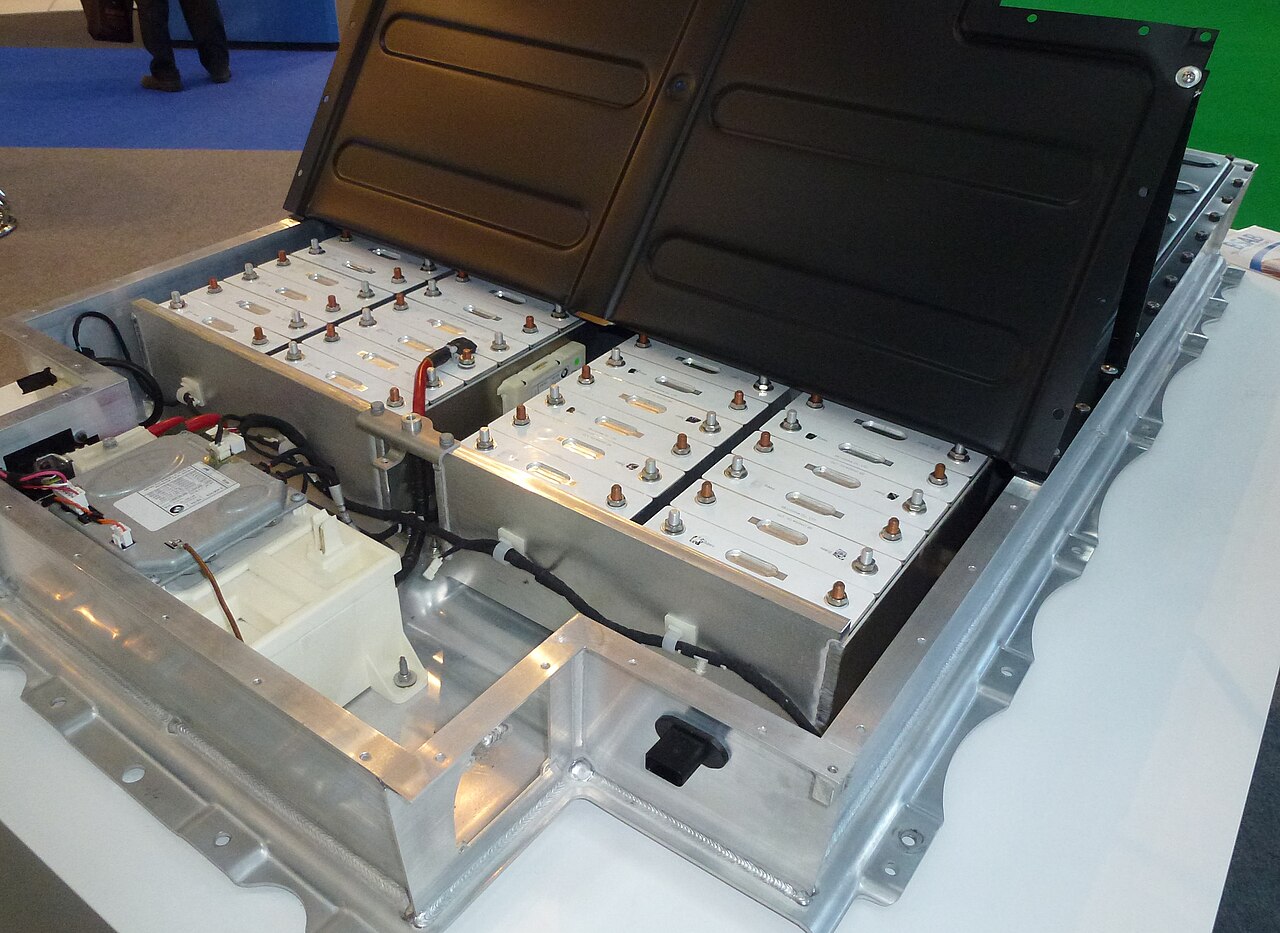
An open lithium-ion battery pack for an electric car on show at a trade fair in Munich, with its modules and control electronics exposed.
Photo: RudolfSimon, via Wikimedia Commons, licence Creative Commons Attribution-ShareAlike 3.0 (https://creativecommons.org/licenses/by-sa/3.0/). File page: https://commons.wikimedia.org/wiki/File:Lithium-Ion_Battery_for_BMW_i3_-_Battery_Pack.JPG

What it is
Lithium-ion battery recycling processes used cells and packs to recover metals for new batteries and other uses. Today recycling relies mainly on production scrap generated while making battery cells and components. Batteries from electric vehicles and storage systems will take the lead only around 2035, because nearly all those deployed in recent years remain in use, which creates a time lag of roughly 15 years.
Why it matters
The International Energy Agency reports that China hosts over 85 percent of global recycling capacity, and that capacity globally is largely in excess of the feedstock available. Manufacturing scrap still accounts for two-thirds of available recycling feedstock in 2030. From 2035 onwards, end-of-life electric vehicle and storage batteries take over as the largest source and represent over 90 percent of available feedstock by 2050. In a scenario that meets national climate targets, scaled recycling can reduce lithium and nickel demand by 25 percent and cobalt demand by 40 percent in 2050. The European Commission says global demand for batteries is set to increase 14 times by 2030, and that the European Union could account for 17 percent of it.
How to read it
These figures describe flows of material: today most feedstock is scrap from factories, and only later does it come from batteries that have reached the end of their life. The European Union's Batteries Regulation entered into force on 17 August 2023 and applies from 18 February 2024, with phased requirements rolling out through 2031; it aims to make batteries sustainable throughout their life cycle, from sourcing to collection and recycling. Chemistries with lower material value, such as lithium iron phosphate, may need different business models and dedicated regulations to ensure that used batteries are properly collected and processed. In toll-based models the recycler is paid for the service and the customer keeps ownership of the recovered materials, which can be particularly effective together with policies that make automakers or battery makers responsible for end-of-life batteries.
Limits
The International Energy Agency calls the contribution of recycling to meeting battery mineral needs limited today, and the scenario figures for 2050 depend on scaling up recycling facilities and raising collection rates of end-of-life batteries. Until August 2025 imports of black mass, the metal-rich powder from battery recycling, were banned in China; since then high-grade black mass has been allowed, and regulations elsewhere may limit how much of it flows there. Second-hand electric vehicles need adequate end-of-life strategies as they move between countries.
Sources
Links are for verification. The article stays on Fix Planet.
- International Energy Agency (IEA): Electric vehicle batteries, Global EV Outlook 2026 : https://www.iea.org/reports/global-ev-outlook-2026/electric-vehicle-batteries
- International Energy Agency (IEA): Recycling of Critical Minerals, executive summary : https://www.iea.org/reports/recycling-of-critical-minerals/executive-summary
- International Energy Agency (IEA): EV Battery Supply Chain Sustainability : https://www.iea.org/reports/ev-battery-supply-chain-sustainability
- European Commission: Batteries : https://environment.ec.europa.eu/topics/waste-and-recycling/batteries_en