

Food-waste reduction
Cutting food waste keeps meals in the human food chain and saves the farm resources already spent on them. In 2022 the world wasted 1.05 billion tonnes of food, which is 19 percent of the food available to consumers.
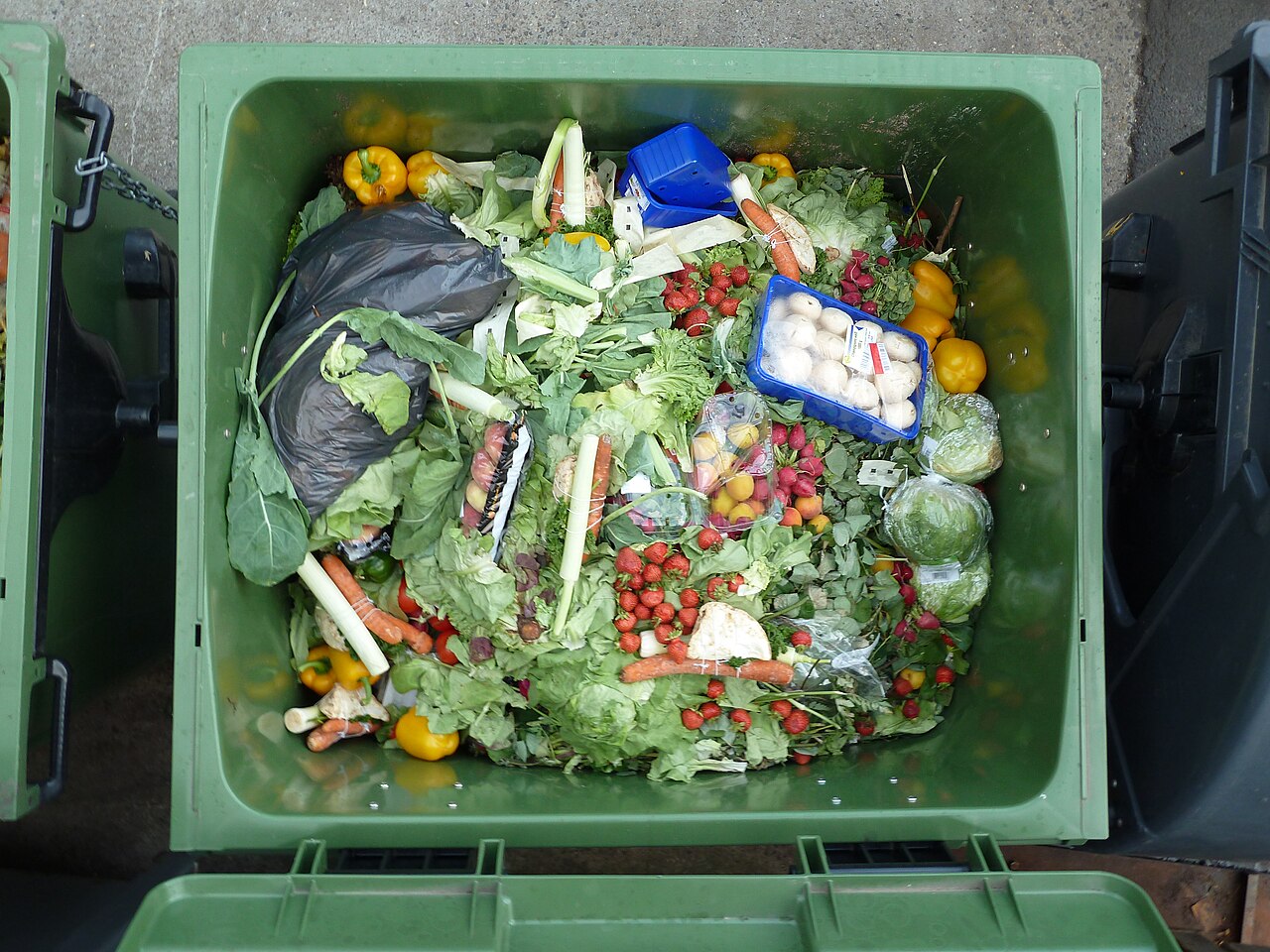
Fresh vegetables and fruit discarded from a hypermarket after one or two days on the shelves.
Photo: Foerster, via Wikimedia Commons, Creative Commons Zero public domain dedication (https://creativecommons.org/publicdomain/zero/1.0/). File page: https://commons.wikimedia.org/wiki/File:Treasure_trove_of_wasted_food.JPG

What it is
Food-waste reduction means keeping edible food from being thrown away in shops, restaurants and homes, and sending only unavoidable scraps to other uses. The United Nations Environment Programme tracks food waste at retail, food service and household level in its Food Waste Index. The target of the Sustainable Development Goals is to halve per capita global food waste at the retail and consumer levels by 2030. The United States Environmental Protection Agency ranks the options on its Wasted Food Scale: preventing wasted food, donating it and upcycling it are the most preferred, and landfilling, incineration and sending food down the drain are the least preferred.
Why it matters
In 2022 the world wasted an estimated 1.05 billion tonnes of food at retail, food service and household level, which is 19 percent of the food available to consumers. Households wasted 631 million tonnes (60 percent), food service 290 million tonnes and retail 131 million tonnes. Per person this amounts to 132 kg a year, of which 79 kg is wasted in households. If even a quarter of household food waste was edible, which the report calls a very conservative assessment, that is the equivalent of 1 billion meals thrown away every day. Food waste generates an estimated 8 to 10 percent of global greenhouse gas emissions, counting both loss and waste. In the United States, 30 to 40 percent of the food supply goes uneaten, and the national goal is to cut food loss and waste in half by 2030.
How to read it
The Wasted Food Scale arranges the options from most to least preferred: prevention, donation and upcycling keep food as food, while composting and anaerobic digestion recover nutrients and energy from leftover scraps. The 1.05 billion tonnes include the inedible parts that go with food, and cover only retail, food service and households. They come on top of the estimated 13 percent of the world's food lost in the supply chain before it reaches retail.
Limits
Household data have improved the most: 194 data points from 93 countries, and 85 percent of the world's population lives in a country with at least some household data. Data for retail and food service have changed little, and accurate nationwide data outside high-income countries are still lacking, so the global figure is an estimate. The Sustainable Development Goal target covers retail and consumers, while the 13 percent lost earlier in the supply chain is tracked separately.
Sources
Links are for verification. The article stays on Fix Planet.
- United Nations Environment Programme (UNEP): Food Waste Index Report 2024 : https://www.unep.org/resources/publication/food-waste-index-report-2024
- United Nations Environment Programme (UNEP): Food Waste Index Report 2024 (PDF) : https://wedocs.unep.org/bitstream/handle/20.500.11822/45230/food_waste_index_report_2024.pdf?sequence=1&isAllowed=y
- United Nations Environment Programme (UNEP): Food Waste Index Report 2024, Key messages (PDF) : https://wedocs.unep.org/bitstream/handle/20.500.11822/45275/Food-Waste-Index-2024-key-messages.pdf?sequence=8&isAllowed=y
- United States Environmental Protection Agency (EPA): Wasted Food Scale : https://www.epa.gov/sustainable-management-food/wasted-food-scale
- United States Environmental Protection Agency (EPA): United States 2030 Food Loss and Waste Reduction Goal : https://www.epa.gov/sustainable-management-food/united-states-2030-food-loss-and-waste-reduction-goal