

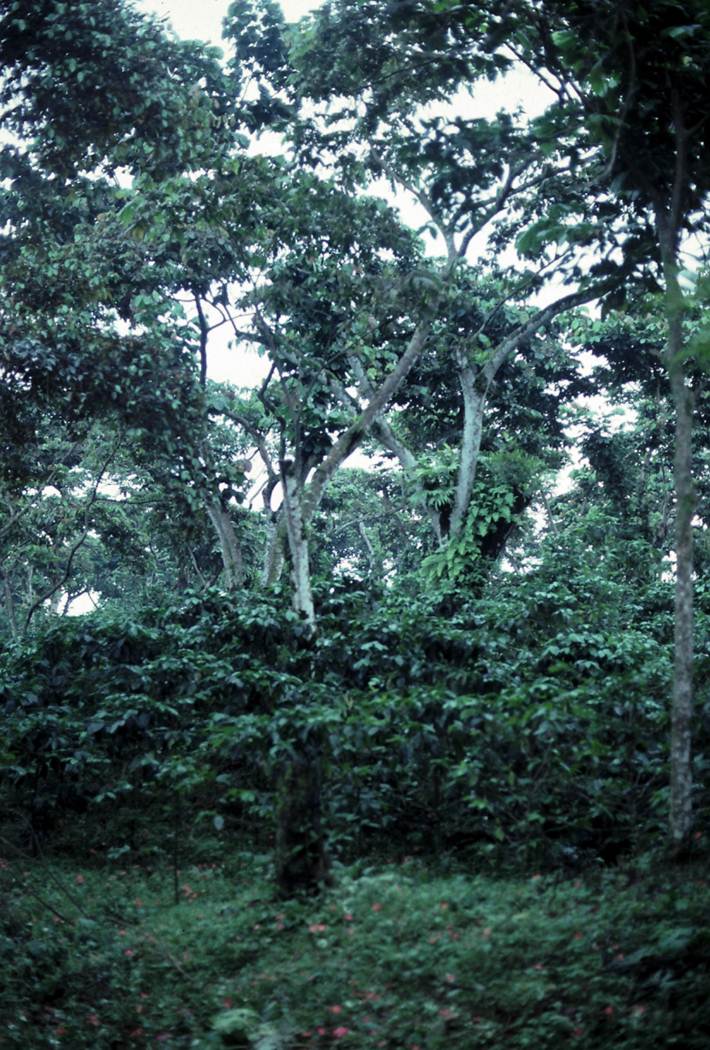
Image: John Blake, canopy of a traditional shade coffee plantation in Guatemala ( Public domain )

What it is
Shade coffee and shade cocoa are crops grown under a tree canopy. Full-sun blocks replace forest structure, cut habitat for migratory and resident birds, and often need more fertilizer and irrigation. Traditional and certified shade systems keep coffee or cocoa as the cash crop and keep trees as the roof.
Bird Friendly certification from the Smithsonian Migratory Bird Center is the science standard followed here. Certified farms are organic and keep existing forest standing. The 25-year account of the programme traces the research to shade-grown farms in Mexico and Guatemala: farms that keep a dense, diverse canopy over coffee can hold bird habitat closer to forest than a sun plantation. The norms document sets the measurable shade and tree-diversity rules used in audits. A traditional shade farm outside the certificate can still be this kind of agriculture. The Smithsonian pages are the published benchmark.
How it works
Coffee or cocoa stands in the understory. Shade trees, preferably a mix and under Bird Friendly rules mostly native, form a canopy above. The Smithsonian 25-year article states the agroforestry-pathway thresholds used in certification: an average of 40 percent shade over coffee and 30 percent over cocoa, ten tree species per hectare, and a majority of trees native. A separate forest-conservation pathway sets aside a share of the farm as forest. That is a different compliance route for the same crops. Organic rules keep insecticides from emptying the insect prey that birds eat.
The farm still has to pick cherries or pods, prune, and sell. Certification is an audit against the norms document. If the canopy is thinned to a single species of planted Grevillea, the bird result is a different stand from the Mexico and Guatemala research system. The programme measures canopy structure. Yield on a given farm stays in that farm’s own records.
Where it already runs
The research that launched Bird Friendly was done on shade coffee in Mexico and Guatemala. The photograph is a traditional shade-coffee canopy in Guatemala, the same class of farm. The programme later added cocoa and now certifies farms in Latin America and other coffee and cocoa regions under the same bird-habitat rules. The 25-year page is the published history.
Uncertified traditional shade systems remain ordinary agriculture in parts of Latin America and West Africa wherever they keep a real canopy over coffee or cocoa. A sun plantation with a few ornamental trees at the road is a different stand.
Limits
Prices can still push a new clearing at the forest edge. Certification is as honest as the audit. A Bird Friendly seal is a farm standard. Full-sun intensification can raise short-term yield on a given hectare. The sources here give the canopy rules, and they leave the size of that yield gap to the farm.
Shade coffee and cocoa are a commodity grown under a working canopy, with Smithsonian norms, researched for 25 years in Mexico and Guatemala. The Food and Agriculture Organization describes a wider set of tree-and-farm systems under agroforestry.