

Low-emission zones
Mapped city areas where the most polluting vehicles are banned or must pay to enter, so nitrogen dioxide and fine particles fall where people live and walk. European cities already run more than 320 such zones, and cities elsewhere are adopting the same rules to encourage cleaner vehicles and more public transport, walking and cycling.
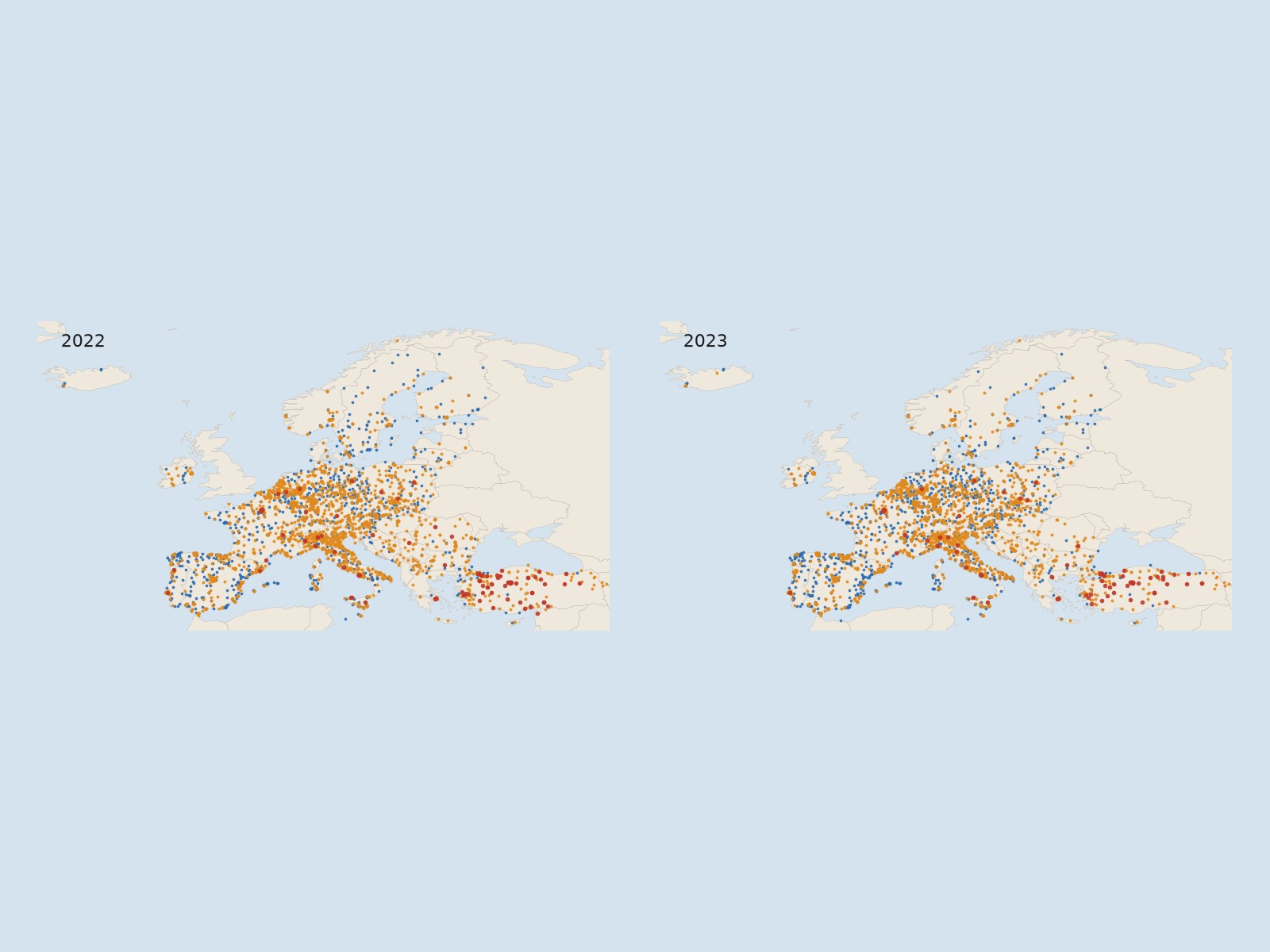
Annual mean nitrogen dioxide at reporting monitoring stations, from the data behind Map 4 of Europe’s air quality status 2024. The panel marked 2022 has 3,597 stations: 833 at or below 10 micrograms per cubic metre, 2,659 above 10 and up to 40, and 105 above 40. The panel marked 2023 has 3,477 stations: 952, 2,440 and 85 in those same classes. The frame runs from 25 degrees west to 45 degrees east and from 34 to 72 degrees north, so stations outside that frame are not drawn. Coastlines are Natural Earth.
- At or below 10 micrograms per cubic metre
- Above 10 and up to 40
- Above 40
Map redrawn from European Environment Agency air-quality e-reporting annual statistics, the measurements behind Map 4 in Europe’s air quality status 2024. Coastlines: Natural Earth, public domain. ( CC BY 4.0 )
What it is
A low-emission zone is an area where the most polluting vehicles are regulated. Usually vehicles with higher emissions may not enter, and in some zones they pay more to enter. In Europe, entry depends on the Euro emission standard a vehicle meets. Most zones cover buses, coaches and heavy lorries, some also cover vans, cars and motorcycles, and most operate 24 hours a day, every day of the year.
Why it matters
According to the European Environment Agency (EEA), road transport is the leading source of nitrogen dioxide and releases it close to the ground in densely populated areas, while 96% of the EU's urban population is exposed to fine-particle (PM2.5) levels above the World Health Organization guideline. The International Council on Clean Transportation (ICCT) counts more than 320 low-emission zones in European cities and points to studies finding that such zones have cut nitrogen dioxide emissions from road traffic by up to 46%.
How to read it
A zone works only as well as its rules and checks. Cities need data on which vehicles actually drive on their streets, and cameras that read number plates to enforce the entry rules. The ICCT also stresses that good public transport, walking and cycling help people leave polluting vehicles behind. More and more cities are tightening zones into zero-emission zones, which only battery-electric or hydrogen fuel-cell vehicles may enter.
Limits
It needs vehicle data, fair exemptions and enforcement cameras or checks. A zone that exists only on paper, without controls, does little for the air beside the road.
Sources
Links are for verification. The article stays on Fix Planet.