

Electric buses
Battery buses on city routes remove tailpipe exhaust at stops and along busy streets, and cities already buy them at scale. The International Energy Agency (IEA) counted almost 70,000 electric bus sales worldwide in 2025, up 12% on the year before, and the UN Environment Programme (UNEP) helps countries and cities plan cleaner bus fleets.
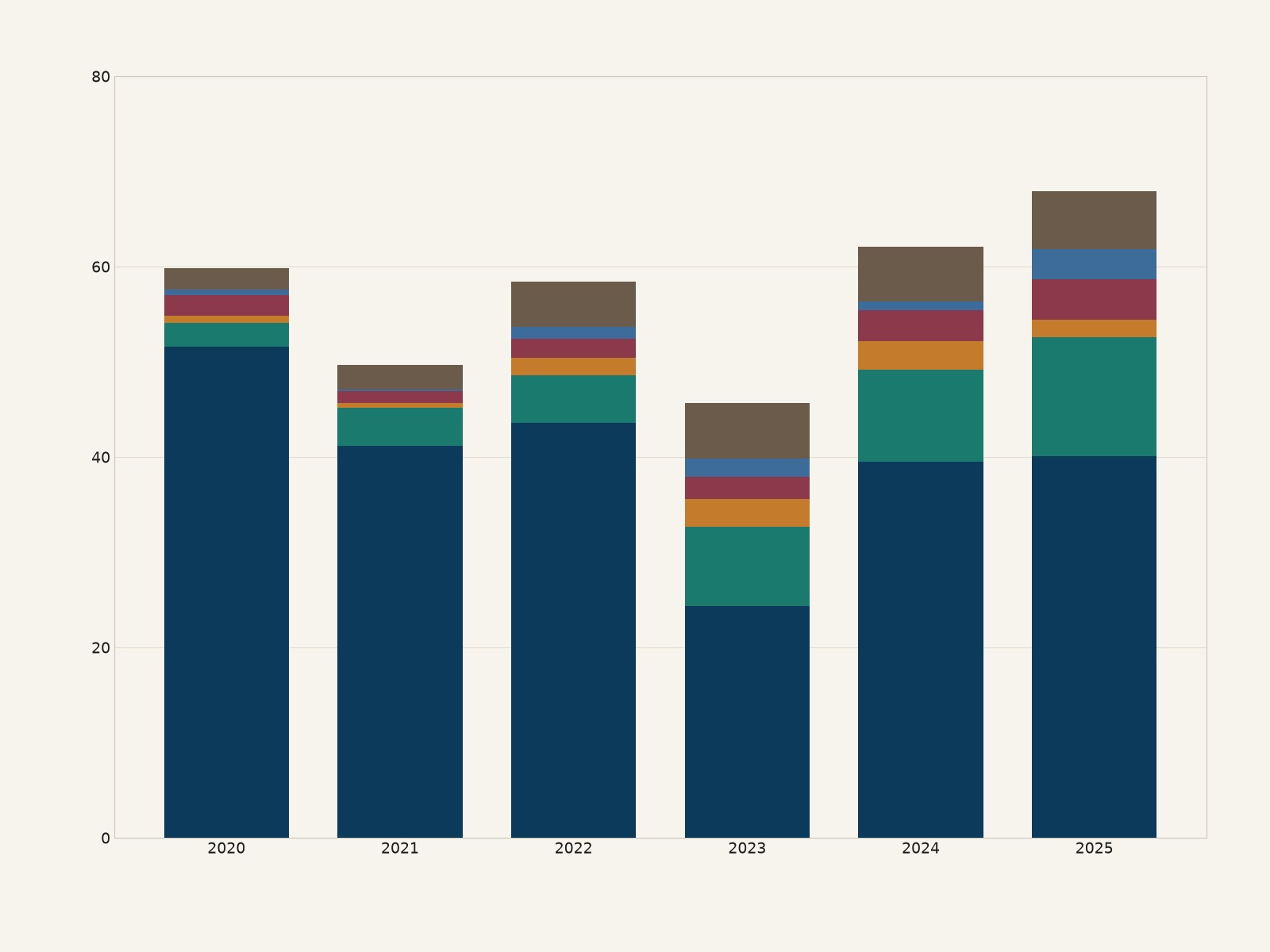
Electric bus sales by region, 2020-2025. China still sells the most, but its share of the column shrinks as other regions grow. Segments from the bottom are China, Europe, the United States, India, Latin America and the rest of the world. In 2025 they are 40.1, 12.5, 1.8, 4.3, 3.1 and 6.1 thousand buses (67.9 thousand in all). China’s share of the column is 86.3 percent in 2020 and 59.1 percent in 2025. The upright scale is thousands of buses.
- China
- Europe
- United States
- India
- Latin America
- Rest of world
Chart redrawn from IEA (2026), Electric bus sales by region, 2020-2025. The colour key on this page is an adaptation of that chart. ( CC BY 4.0 )
What it is
Electric buses run on batteries charged from the grid, largely at bus depots. According to the IEA's Global EV Outlook 2026, battery-electric models made up 98% of the electric buses sold worldwide in 2025. The average range of battery bus models has reached 360 km, enough for city buses, which typically travel 150-300 km a day.
Why it matters
City buses run the same crowded routes all day, so replacing diesel engines removes exhaust exactly where many people wait and walk. Sales reached almost 70,000 in 2025, up 12% on 2024. China accounted for about 60% of them, down from nearly 100% in 2018, and almost all new city buses sold there are electric. Europe sold more than 12,000, and in the European Union battery-electric models took over 55% of new city-bus sales. Santiago in Chile now has the largest electric bus fleet of any city outside China.
How to read it
Sales count the new buses bought in a year, including city and intercity buses with 10 or more seats, so they differ from the number of electric buses already on the road. Intercity coaches are harder to electrify: in China, zero-emission models made up only about 10% of coach sales in 2025. UNEP supports 16 countries and cities in Africa, Asia, Latin America and the Caribbean as they prepare for low-emission public transport, including electric buses.
Limits
It needs depot charging, reliable daily schedules and a financed fleet plan. A few pilot buses without a depot strategy stall when a city tries to scale up.
Sources
Links are for verification. The article stays on Fix Planet.