

Congestion charging
Drivers pay to use the busiest streets at the busiest times, which shortens queues and raises money for public transport. London, Stockholm and Singapore have run such charges for years. A World Bank review treats them as a way to manage how people travel as well as a source of revenue.
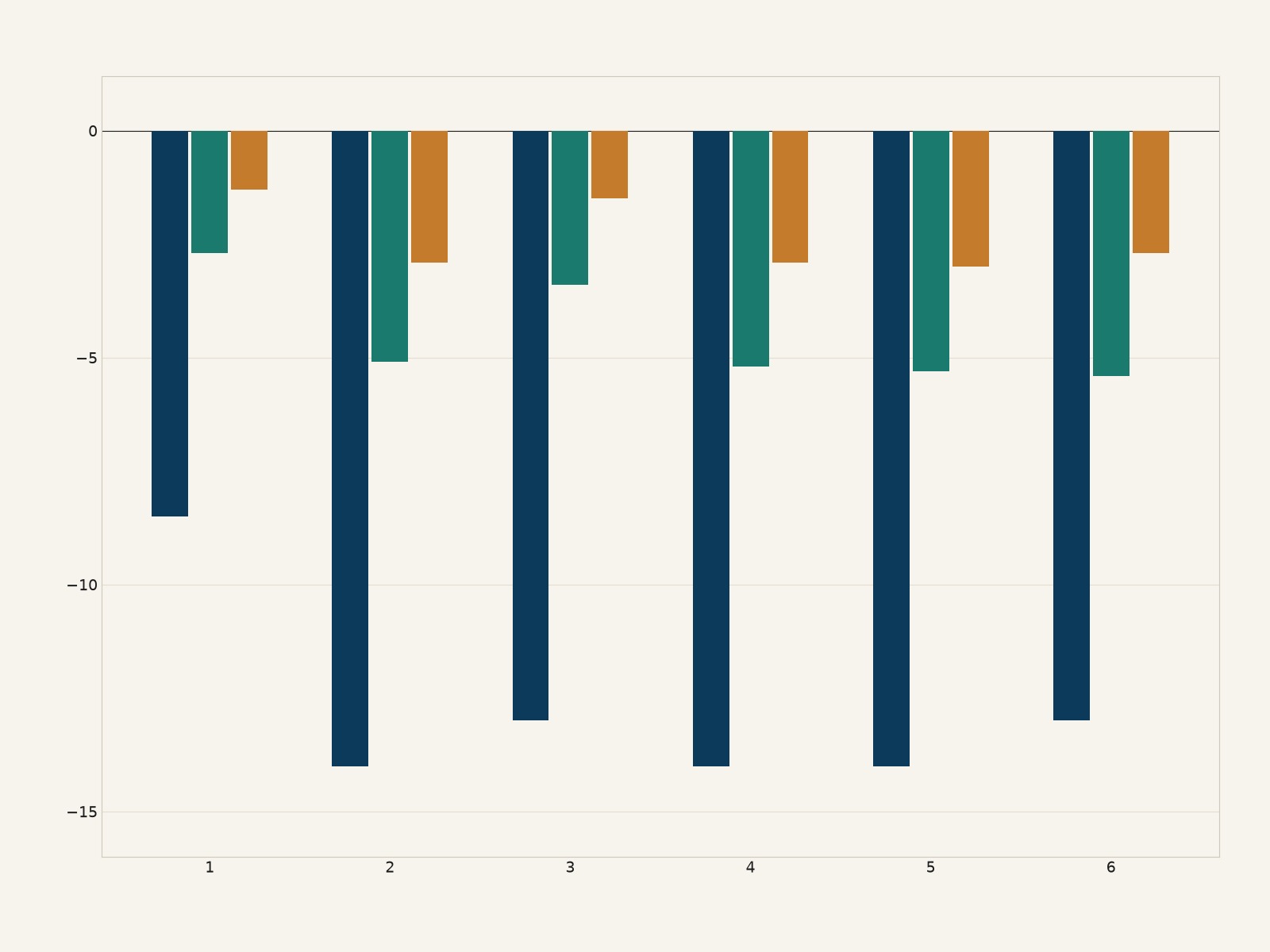
Percent change in emissions in Stockholm during the pricing trial, from Table 4.7. Numbers below zero are a fall. In each group the bars run from dark to light: the city centre, the municipality of Stockholm, and the 35 square kilometre area. Group 1 is nitrogen oxides (−8.5, −2.7, −1.3), 2 carbon monoxide (−14, −5.1, −2.9), 3 particles under 10 micrometres (−13, −3.4, −1.5), 4 volatile organic compounds (−14, −5.2, −2.9), 5 benzene (−14, −5.3, −3.0), and 6 carbon dioxide (−13, −5.4, −2.7). The table in the report credits Hugosson and Sjöberg (2006).
- City centre
- Municipality of Stockholm
- 35 km² area
- Nitrogen oxides
- Carbon monoxide
- Particles under 10 micrometres
- Volatile organic compounds
- Benzene
- Carbon dioxide
Chart redrawn from Table 4.7 of World Bank, Urban and Interurban Road Pricing: Navigating the Changing Landscape of Mobility Management and Infrastructure Financing (August 2023). This is an adaptation of an original work by the World Bank. Views and opinions expressed in the adaptation are the sole responsibility of the author of the adaptation and are not endorsed by the World Bank. ( CC BY 3.0 IGO )
What it is
A congestion charge is a fee for driving into a crowded zone, or across a ring around it, at set times. Cameras read number plates, so drivers do not have to stop to pay. London began charging on 17 February 2003, at £5 a day on weekdays. Stockholm tested a charge that varies by time of day from January to July 2006 and made it permanent in August 2007.
Why it matters
A World Bank review of road pricing reports that in London the number of cars on the streets fell by about a third in the first year, and delays caused by congestion fell by 30%. During the Stockholm trial, traffic into and out of the city centre fell by 20% and public transport use rose by 7%; in the referendum that followed, 53% of voters backed the charge. Singapore's area licence scheme of 1975 cut traffic in the charged zone by 45%.
How to read it
Results depend on what the money pays for and on the choices drivers have. In London's 2007-08 financial year, £112 million of the £137 million net revenue from the charge went to better bus services. Early gains can fade: average speeds in central London rose from 14.6 to 17.6 km/h after the charge began, then fell back to about 15 km/h by 2006. The review estimates that without the charge they would have been around 11 km/h.
Limits
It needs clear exemptions, working enforcement and visible reinvestment in public transport. A charge with no alternatives only pushes the problem to the edge of the zone.
Sources
Links are for verification. The article stays on Fix Planet.