

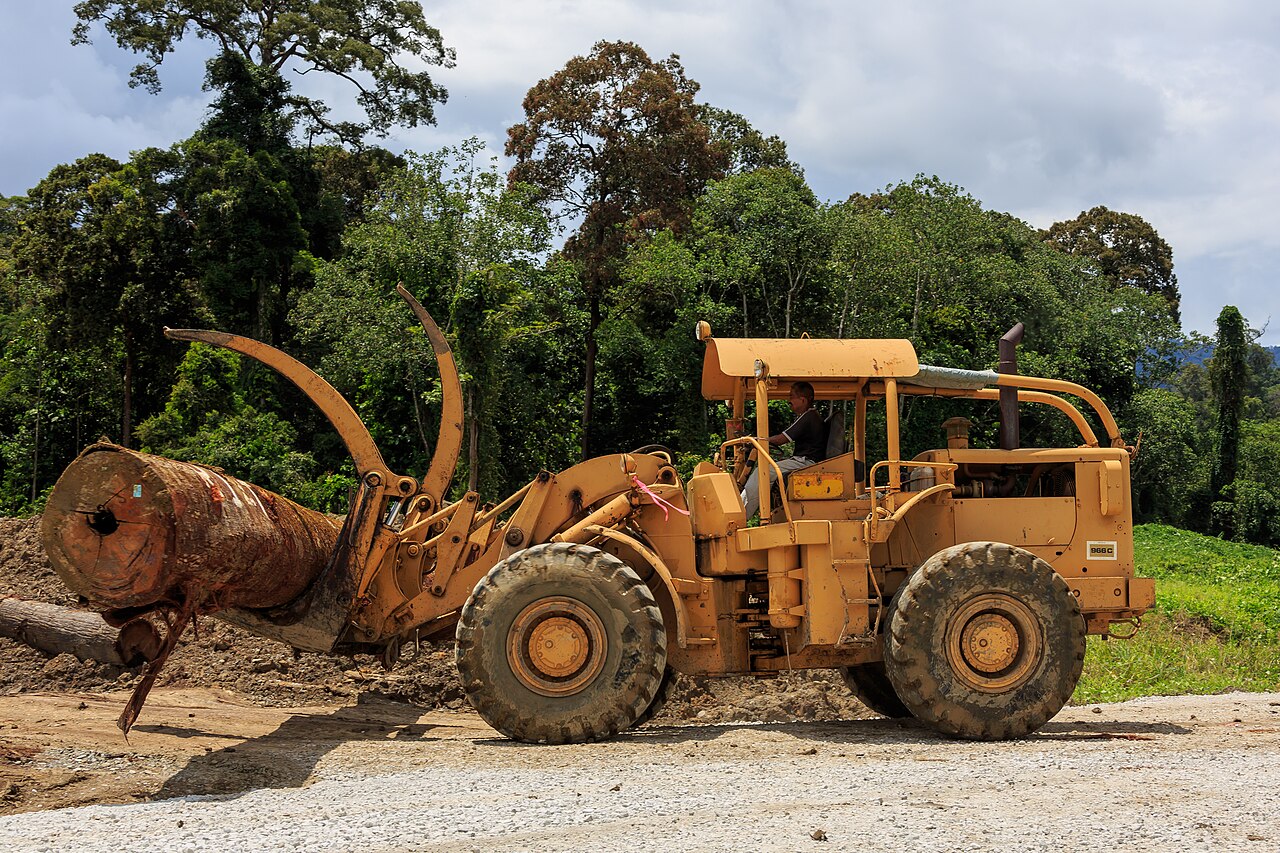
Image: CEphoto, Uwe Aranas, logging camp, Tawau District, Sabah ( CC BY-SA 3.0 )

What it is
Reduced-impact logging is timber harvesting planned and carried out so damage to the remaining forest stays down: map the crop trees, lay out roads and skid trails, fell in a chosen direction, and keep machines on the planned trails. Dennis Dykstra’s paper for the Food and Agriculture Organization of the United Nations treats it as the application of known harvesting engineering, including inventory, supervision, directional felling, and vine cutting where crowns are tied, transferred into tropical forests where only a few commercial trees stand on a hectare. Conventional tropical harvest often means poorly planned skid trails, trees hung in climbers, and damage to the next crop. The residual stand and the soil pay first.
W. B. J. Jonkers’s paper for the same organization traces the first full system for tropical rainforest to late-1970s Sarawak, then to later work in Suriname, Guyana, and Cameroon. Pinard and others used the name reduced-impact logging in 1995. Dykstra notes that the term stuck because it was more acceptable than older phrasing from the organization. It is a harvesting method. The photograph is a logging landing in Tawau District, Sabah, the industry setting.
How it works
Dykstra’s checklist is the usual sequence. Pre-harvest inventory and mapping of crop trees. Planning of roads, skid trails, and landings to reach those trees while protecting streams. Vine cutting around trees that would otherwise pull neighbours down. Directional felling and careful bucking. Machines stay on marked trails. Logs are winched rather than hunted by a skidder wandering the stand. A post-harvest assessment tells the crew what they damaged. Almost all of that is ordinary in temperate industrial forest. The tropical additions are mapping scattered crop trees and cutting vines.
Jonkers shows why the same ideas look different on the ground. Sarawak’s late-1970s method used terrain and tree maps, herringbone felling toward pre-opened main trails, and the same machines as conventional logging. Costs per cubic metre fell, and trees destroyed were almost halved, even though damage reduction was outside the original terms of reference. Guyana and Cameroon adapted trail spacing, vine cutting, and felling aims to poorer stands, clumped species, and, in Cameroon, people living in the forest. The method is planning and supervision.
Where it already runs
The named cases are Sarawak (the first full system, late 1970s), then Suriname, Guyana (including the Tropenbos work near Mabura Hill), and Cameroon (Tropenbos in the southwest). Other 1990s studies Jonkers lists, in Indonesia, Sabah, and Brazil, sit in the same research wave. Dykstra’s paper is the concepts piece: codes of practice, training, and why tropical operations disturb more ground per cubic metre than a Pacific Northwest clearcut of hundreds of cubic metres on a hectare.
Research in those papers found lower damage and, in several trials, costs that were no higher, or were lower, than conventional logging, because less wood was wasted and skidding was shorter. Jonkers and Dykstra also say that many firms still leave the practice unchanged. The sourced fact is that the method exists, was tested in those countries, and is adopted only where crews are trained and supervised.
Limits
A planned harvest still removes trees, opens canopy, and builds roads that can invite settlement. Dykstra notes the extra kilometres of tropical road per cubic metre. If the inventory is a fiction or the skidder leaves the trail, the label is paint on the landing.
Training and daily supervision are the constraint both papers name. Without skilled fallers and a supervisor on the ground, the checklist stays on paper. The method is planned tropical harvesting: Jonkers’s cases in Sarawak, Guyana, and Cameroon, and Dykstra’s concepts.