

Enrichment planting
The Food and Agriculture Organization of the United Nations (FAO) describes enrichment planting as transplanting nursery-grown seedlings or wildlings, which are young trees taken from the forest floor, into natural forest openings, gaps created by tree felling, or lines or strips opened for the purpose.
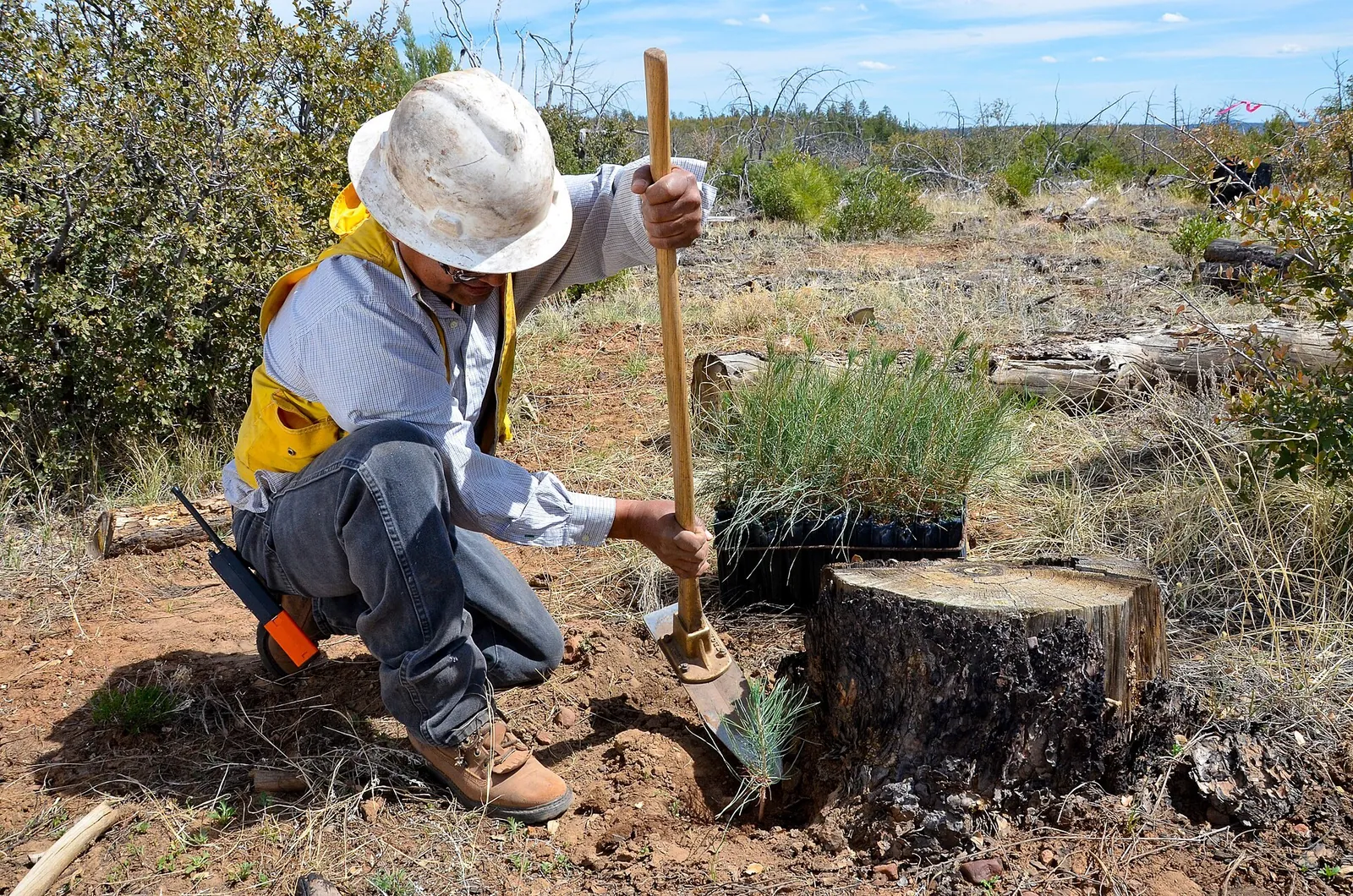
A forestry worker of the White Mountain Apache Tribe plants a ponderosa pine seedling with a hand tool in Arizona.
Photo: Beverly Moseley, U.S. Department of Agriculture Natural Resources Conservation Service, public domain, via Wikimedia Commons.

What it is
The Food and Agriculture Organization of the United Nations (FAO) describes enrichment planting as transplanting nursery-grown seedlings or wildlings, which are young trees taken from the forest floor, into natural forest openings, gaps created by tree felling, or lines or strips opened for the purpose. It may be appropriate where natural regeneration of the desired species is insufficient or unevenly distributed, or to favour particular species, usually of high value, that regenerate poorly. The two most common options are line plantings and gap plantings. The choice depends mainly on the condition of the forest stand, and gap planting is generally recommended for overlogged forests, where planting lines are harder to open and maintain.
Why it matters
FAO notes that enrichment planting has commonly been used to restore logged primary forests and to raise the wood volume and economic value of secondary forests. Degraded primary forests are becoming a predominant forest type in many countries and are increasingly asked to perform the productive and environmental functions of primary forests.
How to read it
FAO lists what success requires: adequate light, proper supervision, and follow-up maintenance, especially to manage light and reduce competition from other plants. The condition of the seedlings at planting is a major factor, and FAO calls it crucial to use high-quality planting stock. Suitable species are likely to produce high-value timber, grow rapidly, flower and fruit regularly, tolerate a wide range of conditions and moisture stress, and be free of significant pests. An FAO example from Malaysia shows the range of methods. In Sabah, experimental enrichment planting has covered 10,000 hectares of logged-over forest. It began with trees planted 3 metres apart in rows 10 metres apart, each row cut as a strip 2 metres wide, and weeding can continue for up to six years after planting. In Peninsular Malaysia, where more large canopy trees remain and shade slows seedling growth, a trial uses seedlings up to 2 metres tall planted in holes dug by a small tractor with an auger.
Limits
FAO's companion publication on secondary forests states that the economic advantages of enrichment planting are still unclear, although some promising results are being obtained in experimental conditions. It also reports that no single prescription suits all situations. In Sabah the economics were helped by payments for the carbon sequestration taking place as the forest recovers, and the Peninsular Malaysia trials were still at an early stage.
Sources
- Food and Agriculture Organization of the United Nations: Silviculture in Natural Forests, module of the Sustainable Forest Management Toolbox
- Food and Agriculture Organization of the United Nations: Silviculture in Natural Forests, Basic knowledge (PDF)
- Food and Agriculture Organization of the United Nations: Helping forests take cover, Secondary forest management: the unrecognised opportunities
- Wikimedia Commons: White Mountain Apache Arizona-105 (photo)