

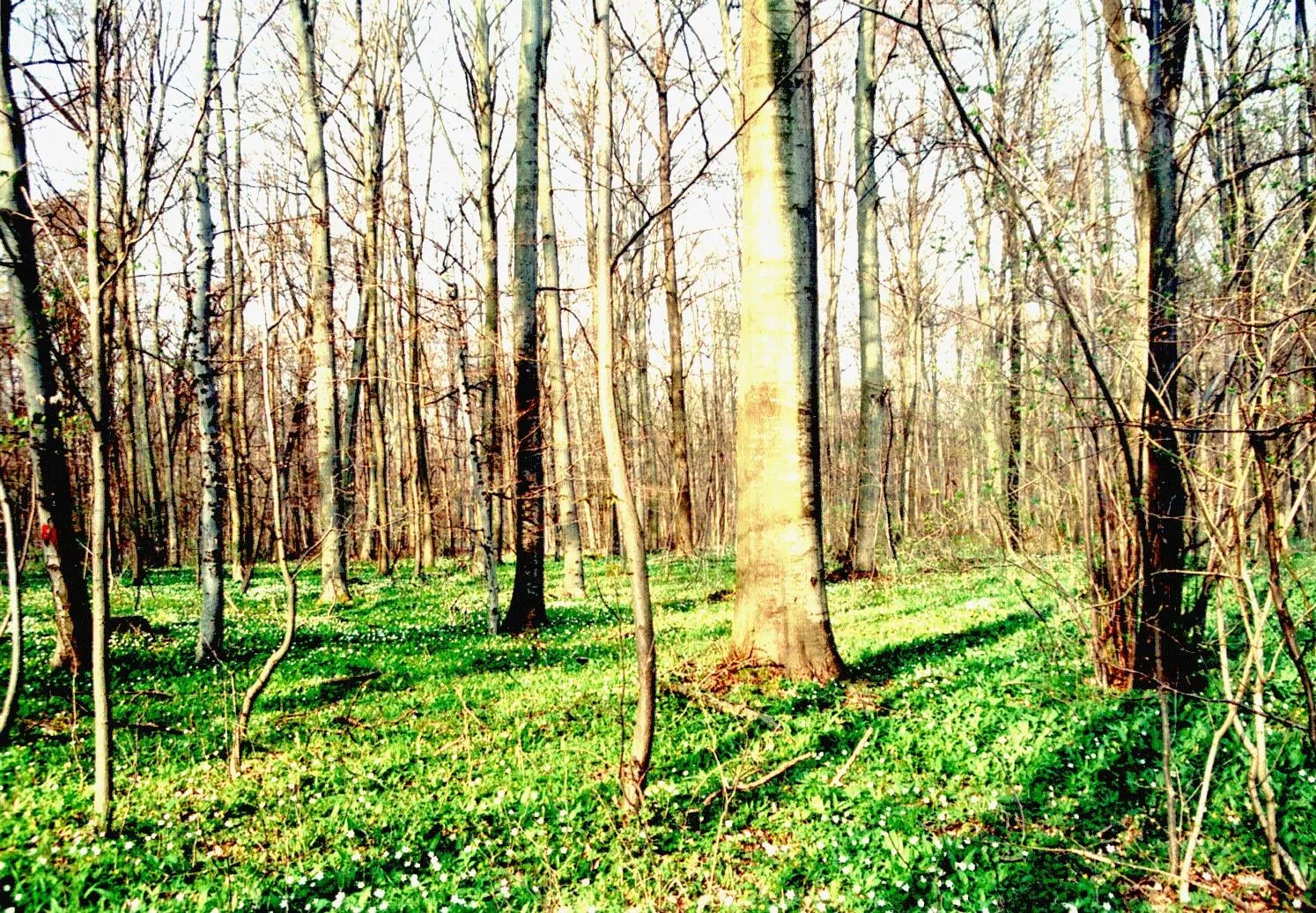
Beech selection forest in the Mühlhausen city forest, Thuringia, Germany, in spring.
Photo: Michael Fiegle, via Wikimedia Commons, Creative Commons Attribution-ShareAlike 3.0 Unported licence.
What it is
The European Union's forest strategy for 2030 defines closer-to-nature forest management as practices that ensure multifunctional forests by combining biodiversity goals, carbon stock preservation and timber revenues. On 27 July 2023 the European Commission published guidelines on the approach in a staff working document that it also sent to the Council of the European Union. The guidelines are for forests with a commercial use for timber and other forest products, outside designated protected areas. Their general principles are learning from and permitting natural processes to develop, maintaining the variety and complexity of forest structures, integrating forest functions at different scales, using a variety of silvicultural systems based on the natural disturbance patterns of the region, and low-impact harvesting that pays equal attention to what stays in the forest and what is removed.
Why it matters
The guidelines name two main objectives: increasing structural complexity and promoting natural forest dynamics. They describe forests made more diverse in height, diameter, age and species. Stands with a diversified species structure are more resistant and adaptable to climate change and disturbances, and if one species is hit by a pest, other species can still survive and bring an economic return. The guidelines say that clear-cuts reduce environmental complexity, alter natural ecosystem processes and diminish habitat variety. Interest in continuous-cover forestry, in which the forest keeps a tree canopy after harvesting, has been increasing in Denmark, Germany, Ireland and the Netherlands, and some member states have introduced related principles or mandatory legislation.
How to read it
The harvesting technique the guidelines propose is partial harvesting: single-tree selection, group selection, or gap cuts of at most 0.2 to 0.5 hectares, which imitate natural disturbance instead of clear-cutting larger areas. Practice differs across Europe. The guidelines report that continuous-cover forestry is mostly used in western Europe, that the Pro Silva approach and others prevail in central and eastern Europe, and that in the north-east the idea of mimicking natural disturbances and keeping natural structures such as dead wood is prominent. In the Alps, clear-cuts larger than 0.5 hectares are rare and even prohibited in some countries because of the risk of soil erosion, landslides and avalanches. The European Forest Institute proposed a definition, seven guiding principles and a checklist for the concept in a 2022 report.
Limits
The guidelines describe themselves as entirely voluntary and say they place no binding conditions on, for example, state aid or European Union funding for forest management. Their authors note that the main barrier reported by questionnaire respondents was economic: a perception that biodiversity-friendly practices reduce the return from forests, at least in the short term. Where natural disturbance regimes have been reduced or eliminated, the guidelines say small clear-cuts might be needed as part of restorative management to imitate natural disturbance temporarily.
Sources
- European Commission, Directorate-General for Environment: Guidelines on Closer-to-Nature Forest Management
- Council of the European Union: Commission staff working document, Guidelines on Closer-to-Nature Forest Management
- European Forest Institute: Closer-to-Nature Forest Management (From Science to Policy 12)
- Wikimedia Commons: Plenterwald April 2004 (photo)
