

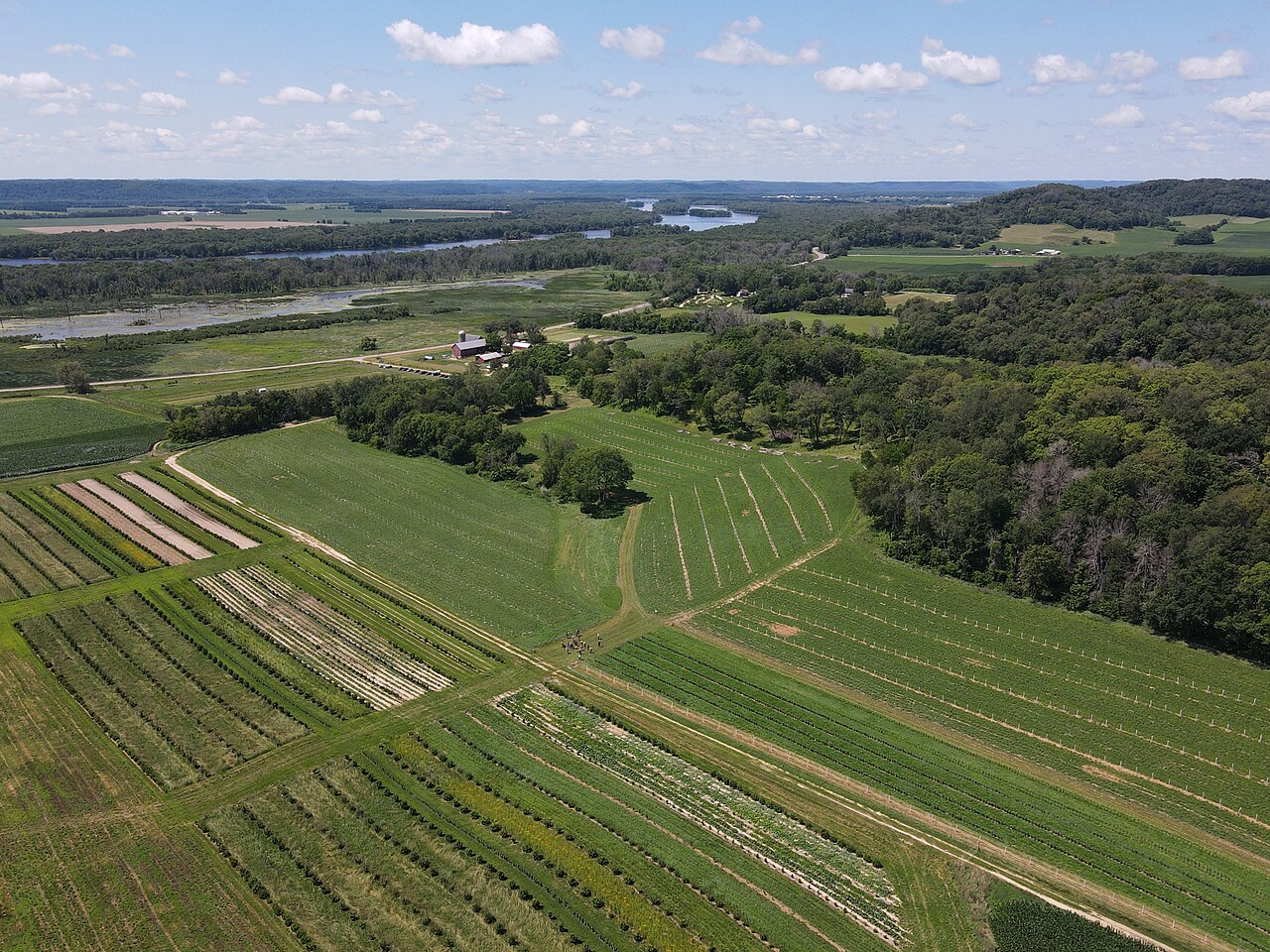
Image: Savanna Institute, alley cropping beside the Wisconsin River, Savanna Institute farm, 2024 ( CC BY-SA 4.0 )

What it is
Agroforestry is a collective name for land-use systems in which woody perennials, including trees, shrubs, palms, and bamboos, are deliberately grown with agricultural crops, with animals, or with both, in space or in time, so the parts interact. The overview from the Food and Agriculture Organization of the United Nations is the definition used here. Clearing trees from cropland and pasture leaves soil, shade, and fodder thinner. Farms then lean harder on fertilizer, irrigation, and feed brought from elsewhere. Putting trees back with the farm is the practice.
The organization names three main types. Agrisilvicultural systems combine trees and crops, including alley cropping and homegardens. Silvopastoral systems combine trees and grazing animals, including on rangeland. Agrosilvopastoral systems combine trees, animals, and crops. Shade coffee and cocoa are one commodity grown under a canopy, with their own published bird-habitat rules from the Smithsonian Institution.
How it works
Design is local. Species, spacing, and sequence have to fit the climate, the household, and the market. Alley cropping puts rows of trees between strips of annual crop. A homegarden stacks fruit, timber, and vegetables on a small plot. Silvopasture keeps grass and browse under a tree layer so livestock have shade and the trees have a second product. The organization’s questions-and-answers and its agroforestry module treat those arrangements as ordinary rural practice that still needs advice from more than one trade: the wrong tree on a crop field competes with the crop for light and water.
Tenure and time are part of the method. A tree that will be browsed or cut by someone else will go untended. A seedling row that is never pruned or protected stays a row of seedlings. The organization stresses that agroforestry should be tailored to the farmer and the place. The account here describes the three system types and the named example below.
Where it already runs
The organization says agroforestry is a significant feature of agriculture in all regions, more prevalent in Southeast Asia, Central America, and South America, and estimates that about 78 percent of the global area under agroforestry is in the tropics and about 22 percent in temperate regions. Those are figures from its overview. Temperate alley cropping, the class of plot in the Wisconsin River farm photograph, is the same family in a different climate.
The named traditional system in the organization’s own article is the Amazonian Chakra of Napo Province, Ecuador: a multi-storey system managed by Indigenous communities, recognised in its work on Globally Important Agricultural Heritage Systems. The Chakra is trees, crops, and community management in Amazonian Ecuador, one documented instance of the wider family.
Limits
A row of seedlings is a planting on a farm. Agroforestry leaves a primary forest as a different stand, and a frontier still moves where the next hectare is cheaper to clear than to tend. Trees compete with crops for light and water when the design is wrong. Livestock that are left unherded eat the future canopy.
The three types, plus the Napo Chakra, are the scope of this account. Shade coffee and cocoa keep their own bird-habitat standard. Community-forestry counts from Mexico and Tanzania belong with the laws of those countries. Agroforestry here is trees with farms: alley, pasture, homegarden, and Chakra.