

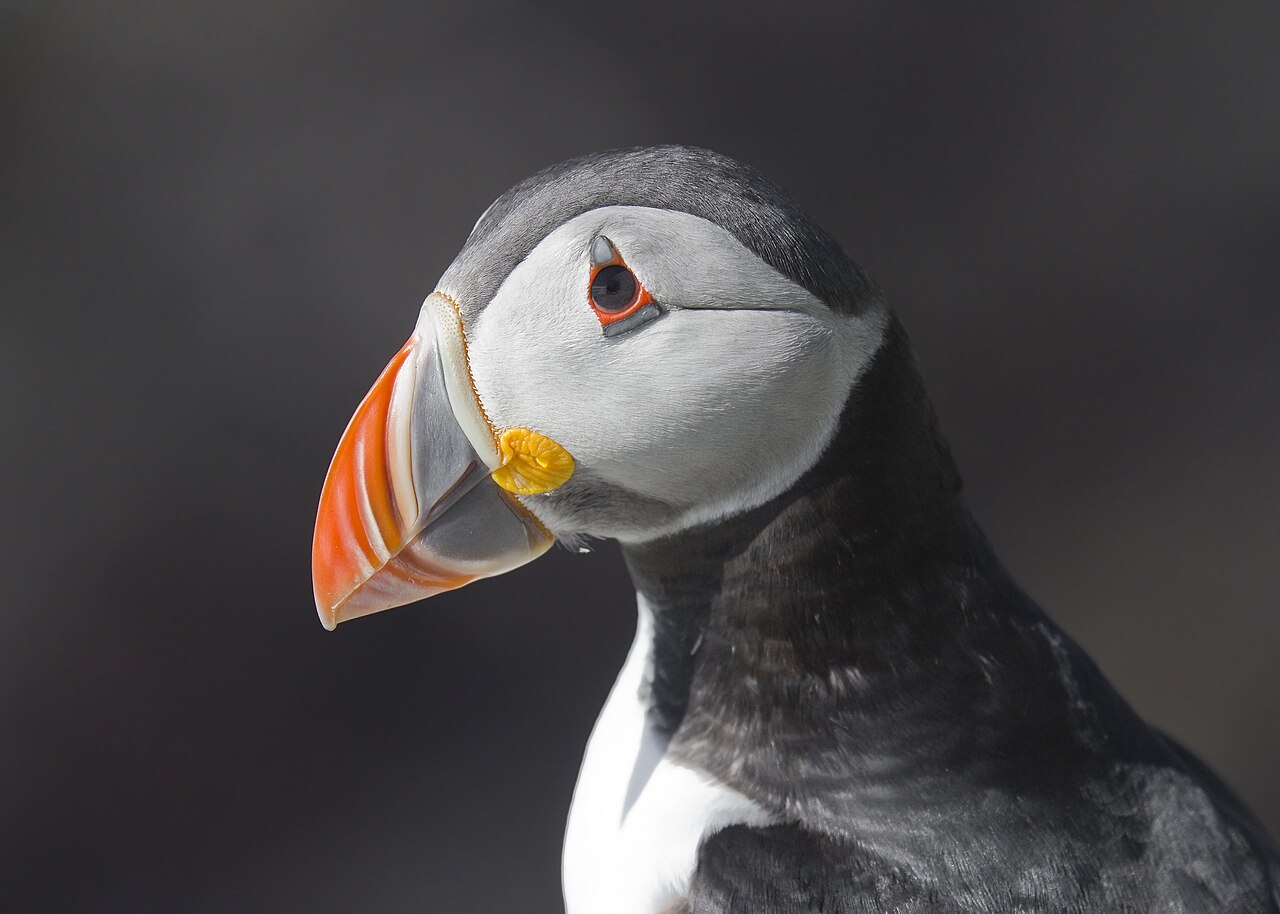
An Atlantic puffin in profile, showing the orange, yellow and blue-grey bill and the white face.
Photo: Andreas Trepte, via Wikimedia Commons, licence Creative Commons Attribution-ShareAlike 2.5. File page: https://commons.wikimedia.org/wiki/File:Atlantic_Puffin_Fratercula_arctica.jpg

What it is
The Atlantic puffin (Fratercula arctica) is a seabird of the colder waters of the North Atlantic, with a wingspan of 47 to 63 cm. Its Latin name means "little brother of the north". It nests on grassy slopes of steep sea cliffs, in burrows dug in the ground or between rocks, and lays one egg. While feeding, a puffin can stay under water for up to one minute and dive as deep as 40 m. It can hold several small fish in its beak in one dive, and the average catch is about 10 fish per trip.
Range
Puffins breed mainly in Europe: on the coast of Brittany in France, in Ireland, the United Kingdom, Iceland, Greenland, Norway, the Faroe Islands and northern Russia. Iceland holds about 60 percent of the population. Away from the colonies they spend the months from August to early spring on the open ocean far from land, and some go as far south as the Mediterranean Sea. They hunt 100 km or more from the nesting site, and usually closer while feeding chicks.
What happened
BirdLife International, a global partnership of bird conservation organisations, gives a global population of 7.4 to 8.24 million mature individuals and describes it as decreasing. In Europe the population is estimated to have fallen by 68 percent over the past 50 years. Its main threats are climate change, overfishing, marine pollution and oil spills, invasive predators, offshore energy construction, accidental catch in fishing gear and hunting for food. The guidance for the species describes climate change as the primary pressure, working on a population already stressed by overexploited prey stocks such as sand eels, sprats, herring and capelin.
Status today
The International Union for Conservation of Nature lists the Atlantic puffin as Vulnerable worldwide and as Endangered in Europe. The population is still decreasing.
Human role
The guidance, prepared for the Agreement on the Conservation of African-Eurasian Migratory Waterbirds, recommends managing fisheries so that enough prey is left for the birds, protecting prey habitat such as sandbanks and adding marine protected areas, including in international waters. It also recommends continuing to remove invasive predators from breeding colonies where feasible, and counting colonies and beached birds to follow how many adults survive.