

Solar still / passive solar desalination
A solar still evaporates saline water under a transparent cover and condenses the vapour as freshwater. The 2020 MIT-Shanghai Jiao Tong device is a research prototype, not a municipal plant.

What it is
A solar still evaporates saline water under a transparent cover and condenses the vapour as freshwater: an old, small-scale method. Coastal and island households can have seawater and sunlight but no power for a reverse-osmosis plant. Hauling or boiling water is the daily fallback.
USGS’s desalination page uses a portable inflatable solar still as the teaching picture: evaporation and condensation, the same process as rain. Distillation is one of the oldest water treatments. It is not reverse osmosis. It needs sun and area. It does not need a high-pressure pump.
How it works
Sunlight heats a dark tray of saline water. Vapour rises, hits a cooler transparent cover, condenses, and runs to a trough. A simple pit still: a sheet over a hole with a cup in the middle: is the survival version USGS also describes. Output follows the sun and the area of the evaporator.
In 2020 MIT and Shanghai Jiao Tong University demonstrated a multi-stage passive still on an MIT rooftop that reused condensation heat between layers. MIT News (6-7 February 2020) reported a 10-stage proof-of-concept that delivered 5.78 litres per square metre of collecting area: more than 1.5 gallons per hour per square metre in the team’s equivalent rate, and water that exceeded city drinking-water standards. The paper is in Energy & Environmental Science. That work is a research prototype, not a municipal plant.
Where it already runs
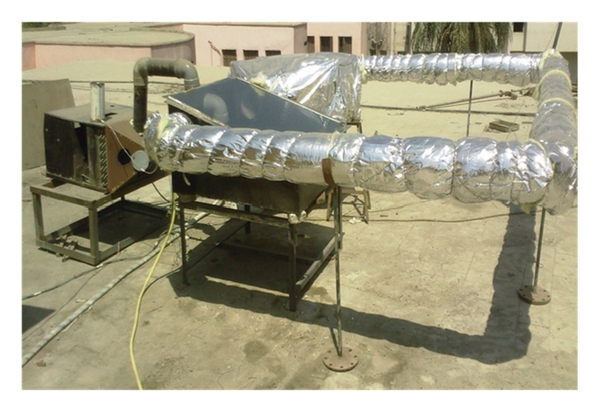
Simple stills appear on boats, in survival kits, and as household or village experiments wherever sun and saline water meet and the grid does not. USGS teaches the method as distillation anyone can picture. The Cairo rooftop still in the card photograph is that everyday class of device: a box and a cover: not the MIT stack.
The MIT-SJTU 2020 still was tested on an MIT building rooftop. The team included researchers at Shanghai Jiao Tong University. They described a possible floating or household configuration and estimated that about one square metre could meet one person’s daily drinking need in their framework. That is a lab estimate, not a city contract.
Limits: what it does not fix
Still output follows sun and area; it does not replace membrane desalination for a city. Night, cloud, and a small roof mean a small bottle. A municipal reverse-osmosis plant is a different machine: pressure, membranes, brine outfalls, and megawatt pumps. Do not advertise a rooftop prototype as Perth or Carlsbad.
Stills are not municipal. They do not irrigate a farm. Salt and scale still accumulate in many tray designs; the MIT team argued their wicking configuration could shed salt at night, which is a research claim to watch, not a finished product. Treat the solar still as off-grid drinking water under a clear sky: not as a substitute for a desalination works.
Sources
Links are for verification. The article stays on Fix Planet.