

Drip irrigation
In dry regions most irrigation water never reaches the root: it evaporates or runs off. Drip lines deliver water at the root zone, so less is lost and yields can rise.
What it is
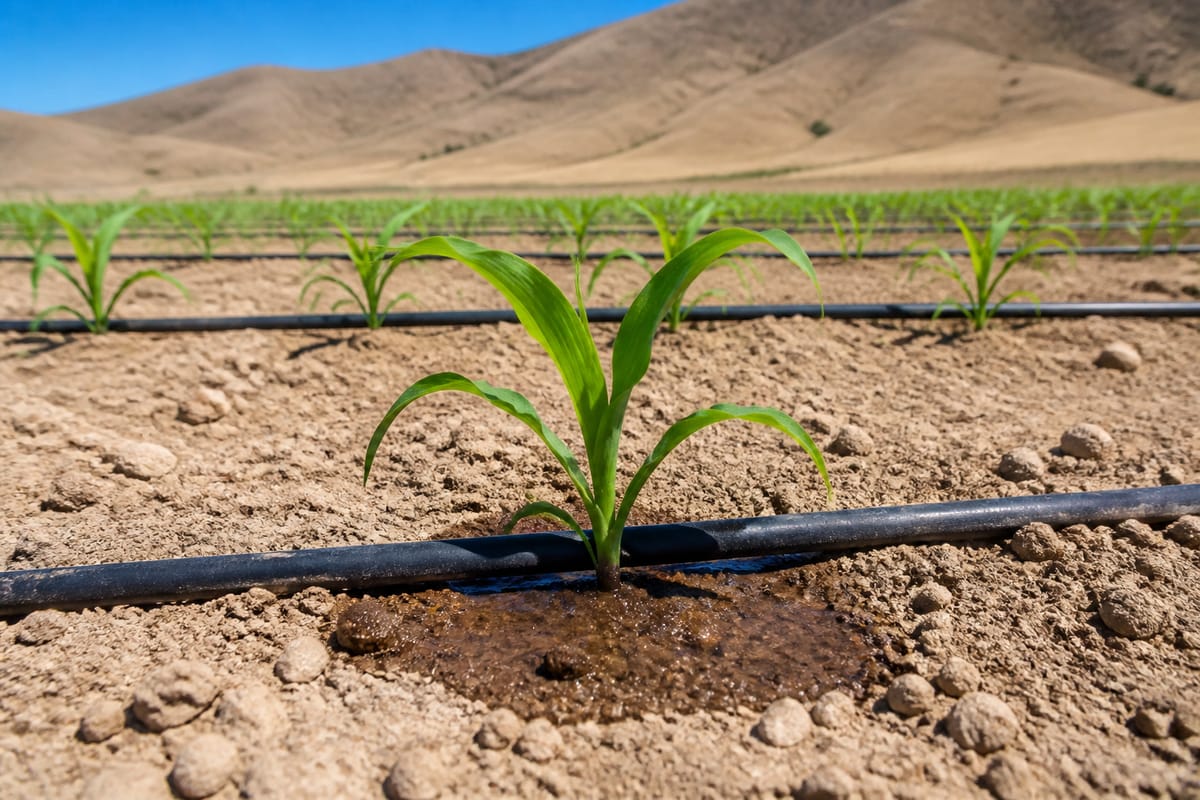
Drip irrigation: also called trickle irrigation or microirrigation: is a way of watering crops through pipes and emitters that wet the root zone instead of the whole field. In dry regions most irrigation water never reaches the root: it evaporates or runs off. Drip lines deliver water at the root zone, so less is lost and yields can rise.
The U.S. Geological Survey’s Water Science School treats drip as the most common form of microirrigation. Water runs through pipes with holes in them, buried or lying slightly above the ground next to the crop. Water slowly drips onto roots and stems. Unlike spray irrigation, very little is lost to the air, and the water can be directed only to the plants that need it.
FAO’s irrigation-methods chapter describes drip as a low-pressure, frequent application of water through a network of laterals and emitters. It is ordinary farm kit, not a laboratory idea. The same family of hardware is used in orchards, vineyards, vegetables, and some field crops. Fertilizer can be injected with the water: fertigation: because the emitters already sit at the plant.
How it works
A typical system has a pump or gravity head, filtration, a main and laterals, and emitters rated in litres per hour. Filters matter: grit and algae clog small orifices. Pressure must stay in a narrow band so the first emitter and the last one deliver similar amounts. On a slope the designer uses pressure-compensating emitters or breaks the line into zones.
USGS notes the usual advantages when the system is managed properly: water and soluble fertilizer go to individual plants, only a fraction of the soil surface is wetted, and labour can fall. Microirrigation can water sloping or irregular land that cannot be flood-irrigated. It is a low-pressure, low-volume method often used on high-value fruit and vegetables. It is not magic pipe: a clogged emitter is a dry plant, and a leaky main is a wasted well.
Where it already runs
Israel made drip a national irrigation method. From the 1960s onward, farms there replaced much flood and sprinkler water with laterals and emitters in orchards, vegetables, and field crops. The same hardware later spread through the Mediterranean, California, India, China, and other dry farming regions. FAO’s drip chapter is written for that worldwide use, not for one country.
In the United States, USGS water-use estimates for 2015 put irrigation withdrawals at about 118,000 million gallons a day. About 63,500 thousand acres were irrigated that year; of those, about 5,490 thousand acres used drip or microirrigation. That is a real share, not the majority. Flood and sprinkler still water most U.S. irrigated land. Drip is common where water is dear and the crop can pay for tubing.
Limits: what it does not fix
Drip does not make a new river. It cuts the water that never reached the plant. If the “saved” water is used to expand the irrigated area: the rebound effect: the basin can be as dry as before. A more efficient farm is not automatically a wetter aquifer.
Emitters clog. Cheap tape tears. Plastic laterals become waste. The method needs filtration, flushing, and someone who walks the line. It does not treat saline irrigation water, and it does not replace a right to the well. Treat drip as a way to put a known volume at the root: not as a licence to plant more desert.
Sources
Links are for verification. The article stays on Fix Planet.