

Constructed wetlands
Nutrients and sewage in rivers feed algal blooms that starve fish of oxygen. Constructed wetlands treat water as a living filter: reeds, microbes, and shallow flow.
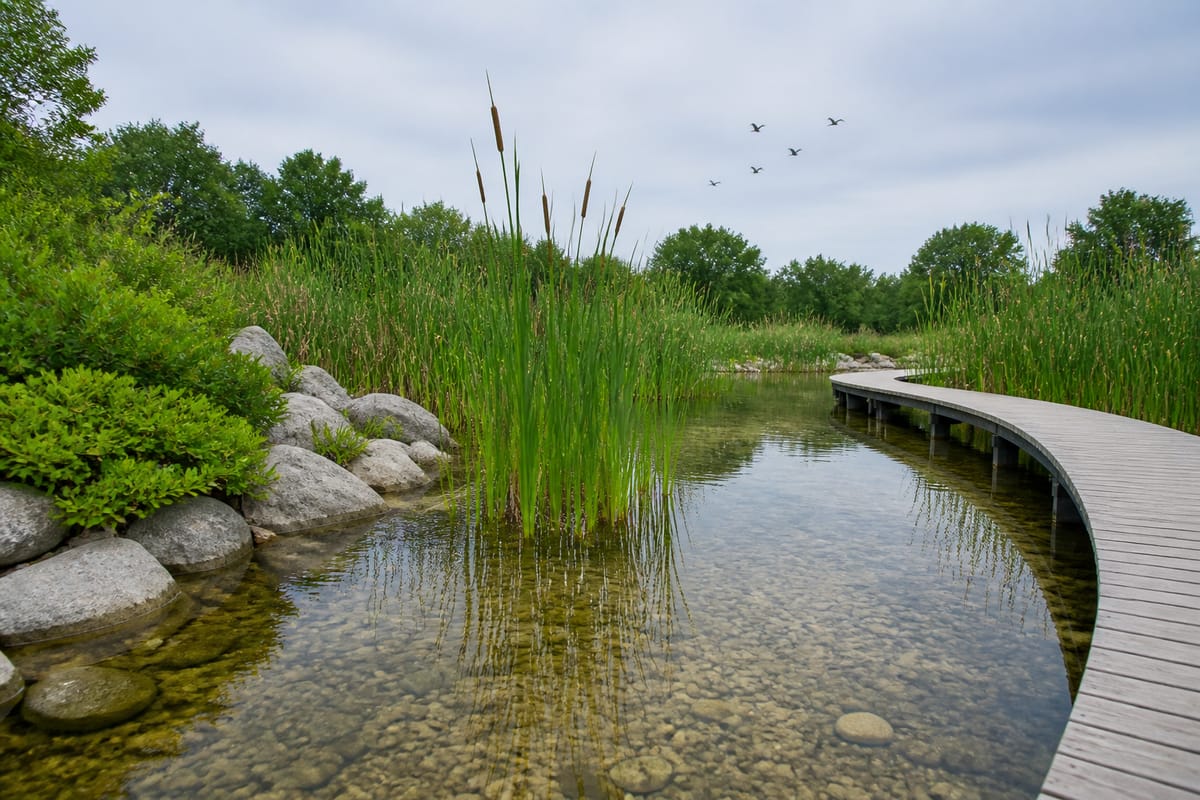
What it is
A constructed wetland is a built shallow basin planted with wetland vegetation and used to treat wastewater, stormwater, or agricultural runoff. It is not a restored wild marsh, and it is not a concrete tank. The U.S. Environmental Protection Agency describes constructed wetlands as treatment systems that use natural processes involving wetland plants, soils, and associated microbial assemblages to improve water quality.
Nutrients and sewage in rivers feed algal blooms that starve fish of oxygen. Constructed wetlands treat water as a living filter: reeds, microbes, and shallow flow. EPA’s handbook is written for operators who already run these systems: free-water-surface wetlands, vegetated submerged-bed (horizontal subsurface-flow) wetlands, and related hybrids. The plants are a working crop of stems and roots, not landscaping.
How it works
In a free-water-surface wetland, water stands or moves slowly among emergent plants. Solids settle. Biofilms on stems and litter take up organic matter and some nitrogen. In a subsurface-flow bed, water stays under a gravel or sand media; roots and microbes work in the pores, and mosquitoes have less open water. Both types need a liner or tight soil if the site must not leak into groundwater, an inlet that spreads the flow, and an outlet that holds a set water level.
EPA’s handbook walks through sizing, media, vegetation, and the pollutants these beds can and cannot take. They are good at settling solids and cutting biochemical oxygen demand when loaded as designed. Nitrogen and phosphorus removal depend on oxygen, residence time, plants, and harvest. Pathogens fall but are not guaranteed to drinking-water standards. Metals and some industrial wastes need a different plant.
Where it already runs
Constructed wetlands are ordinary municipal and farm kit in the United States, Europe, China, and many other places. EPA’s wetlands pages and the 2000 handbook collect U.S. practice: small-community sewage, stormwater basins, acid-mine drainage, and agricultural runoff. Free-water-surface beds need more land; subsurface beds are used where open water is a nuisance or a climate problem.
The same idea appears as reed beds after septic tanks, as polishing wetlands after a mechanical plant, and as treatment marshes on farm drains. They already run. They are not a new invention waiting for a pilot.
Limits: what it does not fix
Land area is the honest constraint. A wetland that treats a town’s sewage needs hectares, not a flower box. In winter, cold water slows the microbes. In summer, mosquitoes and odour appear if the water goes stagnant. Plants must be managed; a clogged bed is a failed filter.
A constructed wetland does not replace a drinking-water plant, and it does not clean every industrial waste. It does not restore a lost estuary just because reeds are planted in a lined cell. Treat it as a living treatment process with a footprint: not as a wild wetland created by pouring effluent on a field.
Sources
Links are for verification. The article stays on Fix Planet.