

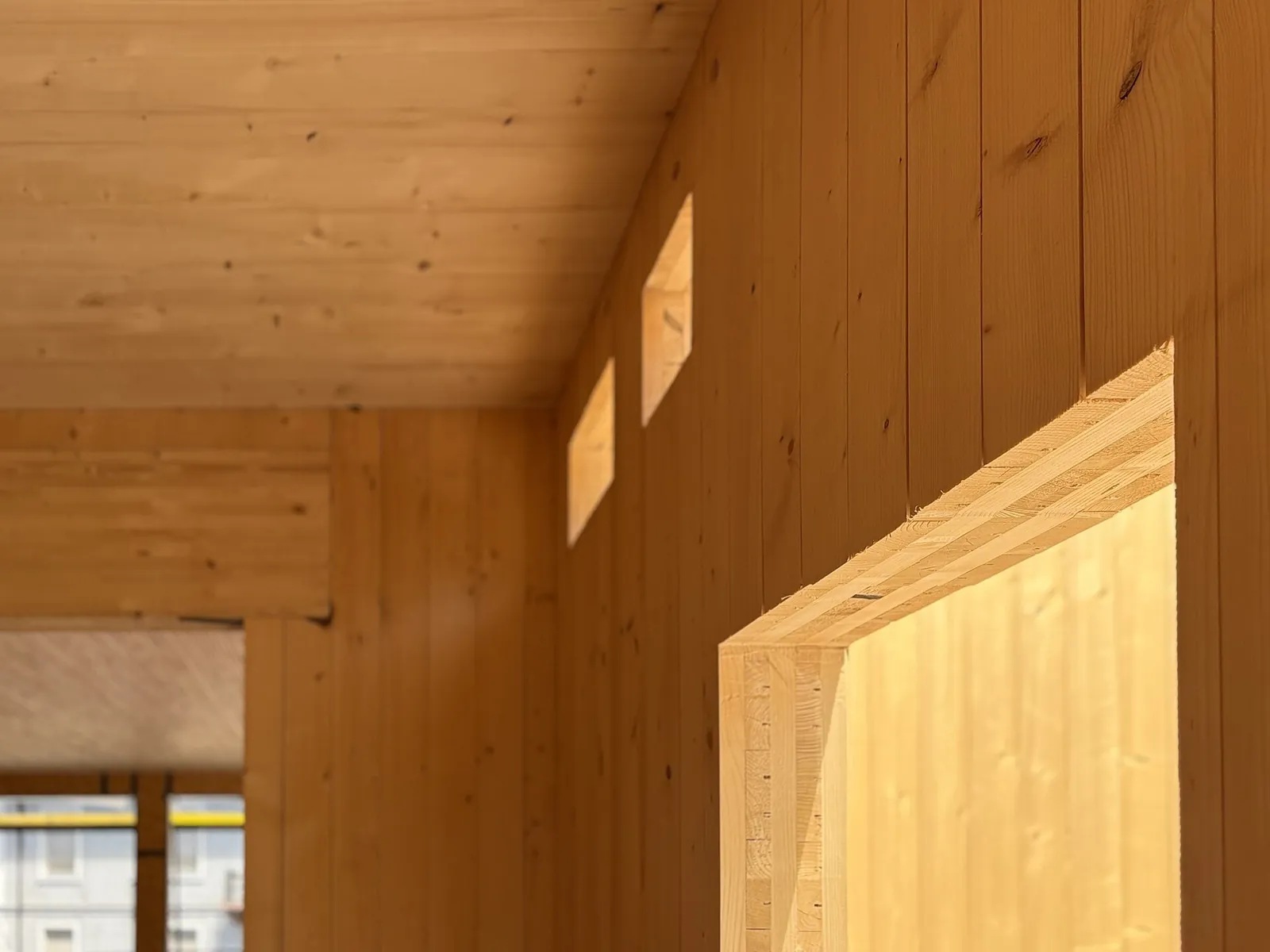
Interior of a building constructed from cross-laminated timber panels.
Photo: RoterRolf, via Wikimedia Commons, CC0 1.0 Universal public domain dedication.
What it is
Mass timber is a family of engineered wood products used for structural building parts. Cross-laminated timber panels consist of several layers of lumber boards stacked crosswise, typically at 90 degrees, and glued together on their wide faces. A panel has at least three layers, usually an odd number, and three to seven layers is common. Glued laminated timber is an engineered, stress-rated product made of two or more layers of lumber glued together with the grain of all layers running parallel to the length. These definitions come from the U.S. Department of Agriculture Forest Service, in a chapter of its handbook on cross-laminated timber and in its Wood Handbook.
Why it matters
The U.S. Department of Agriculture Forest Service says that cross-laminated timber and glued laminated timber offer a carbon-storing, renewable alternative to conventional building materials, with strength, fire resistance and design flexibility. The Wood Handbook adds that cross-laminated timber panels are an alternative to some building applications that currently use concrete, masonry or steel. The agency says a gap in domestic manufacturing has slowed adoption, and that scaling up supply helps drive down costs for developers. Its Wood Innovation Grants Program, launched in 2015, lists mass timber among its national focus areas.
How to read it
Brian Brashaw, Wood Innovations Assistant Director at the Forest Service, said in 2025 that since 2015 the United States has gained 13 new mass timber plants serving commercial, institutional and multifamily building markets. The figure is his statement in a Forest Service feature. The agency says its grants support manufacturers who source sustainable wood, reduce waste and create jobs in rural communities. When you meet a claim about a mass timber building, look for what the product is made of, where the wood was grown, and what the source says about carbon.
Limits
The Forest Service sources used here describe the carbon-storing benefit in general terms and give no carbon figure for any single building. The Forest Service handbook on cross-laminated timber says these panels have a relatively high capacity to store moisture but relatively low vapor permeability, so panels exposed to excessive wetting during construction may absorb a large amount of moisture and dry slowly, and it recommends an additional air barrier. The count of 13 new plants covers the United States only.
Sources
- U.S. Department of Agriculture Forest Service: Scaling up mass timber: Closing gaps, fueling innovation
- U.S. Department of Agriculture Forest Service: Wood Innovations
- U.S. Department of Agriculture Forest Service Research and Development: Chapter 1, Introduction to cross-laminated timber, in the CLT Handbook (2013)
- U.S. Department of Agriculture Forest Service Research and Development: Chapter 12, Mechanical properties of wood-based composite materials, in the Wood Handbook (2021)
- Wikimedia Commons: Brettsperrholzkonstruktion (photo)
