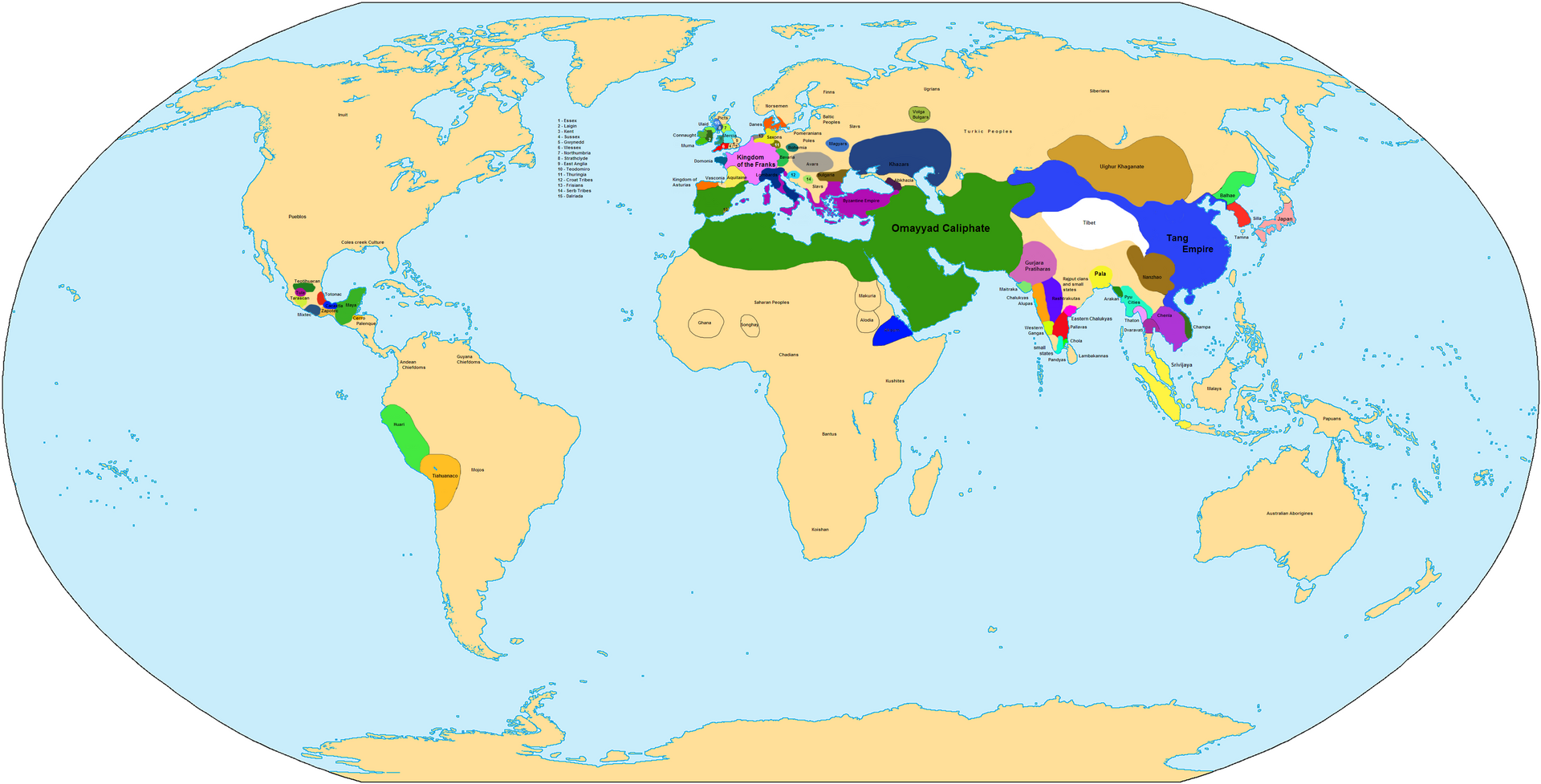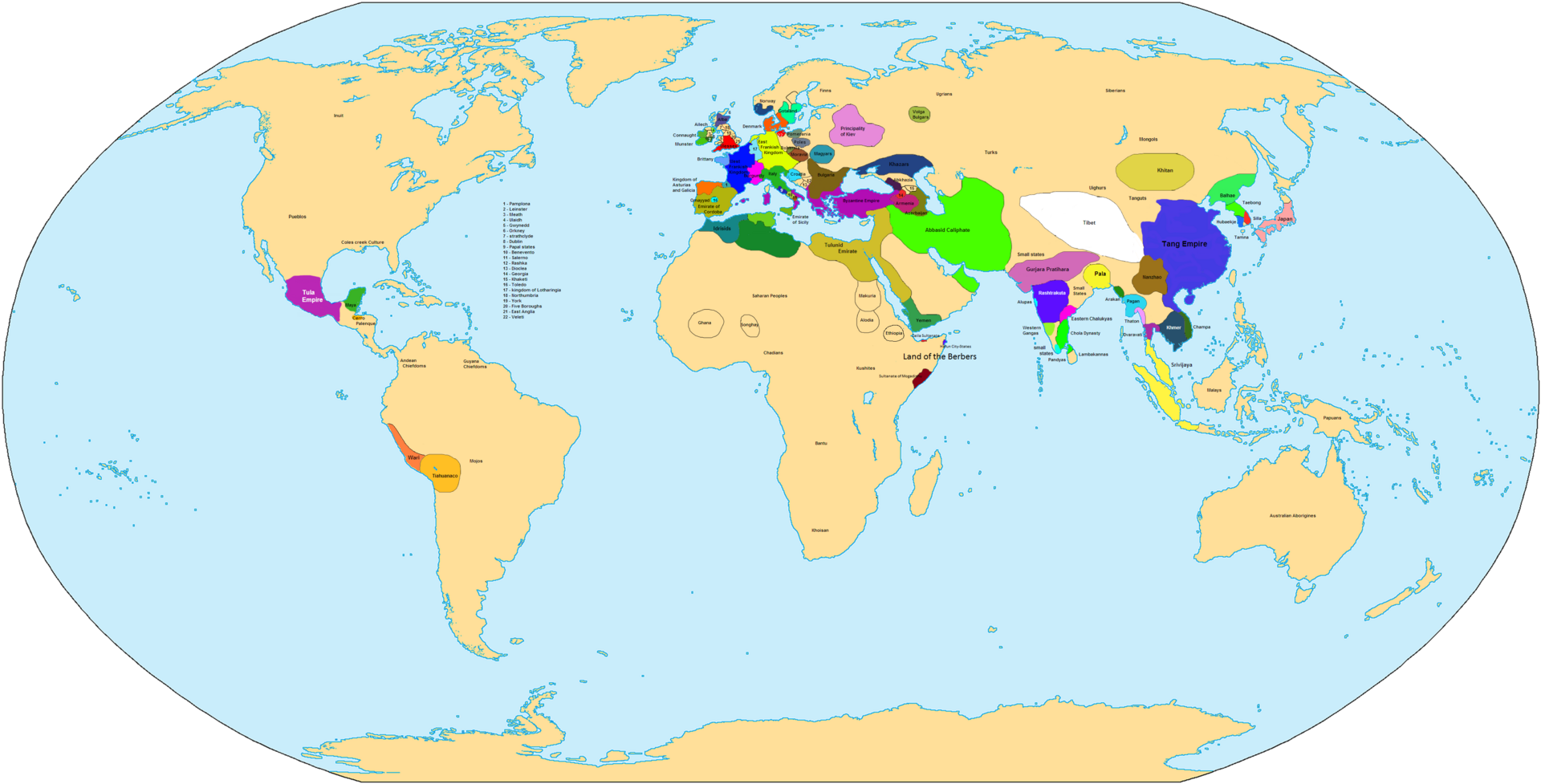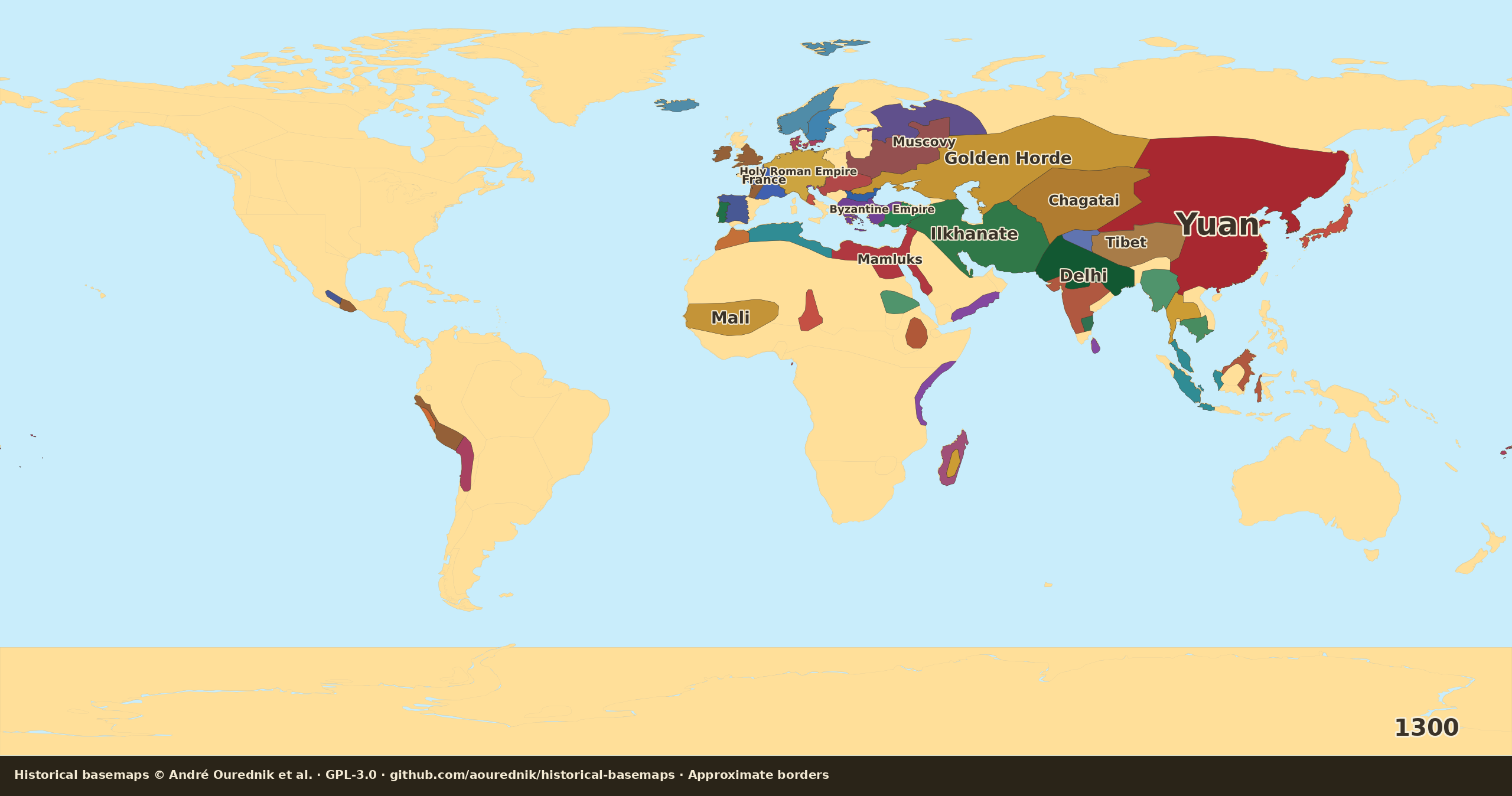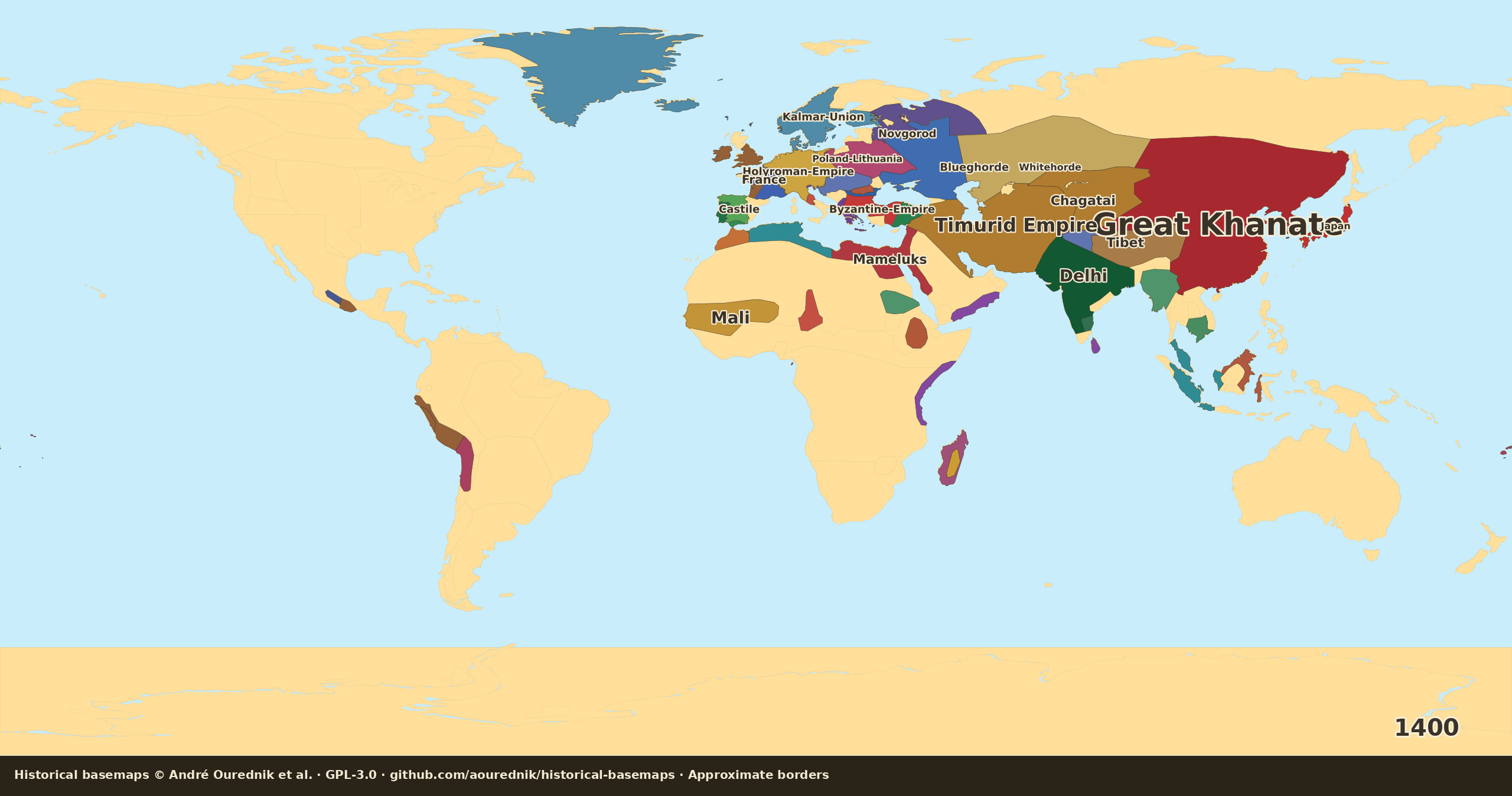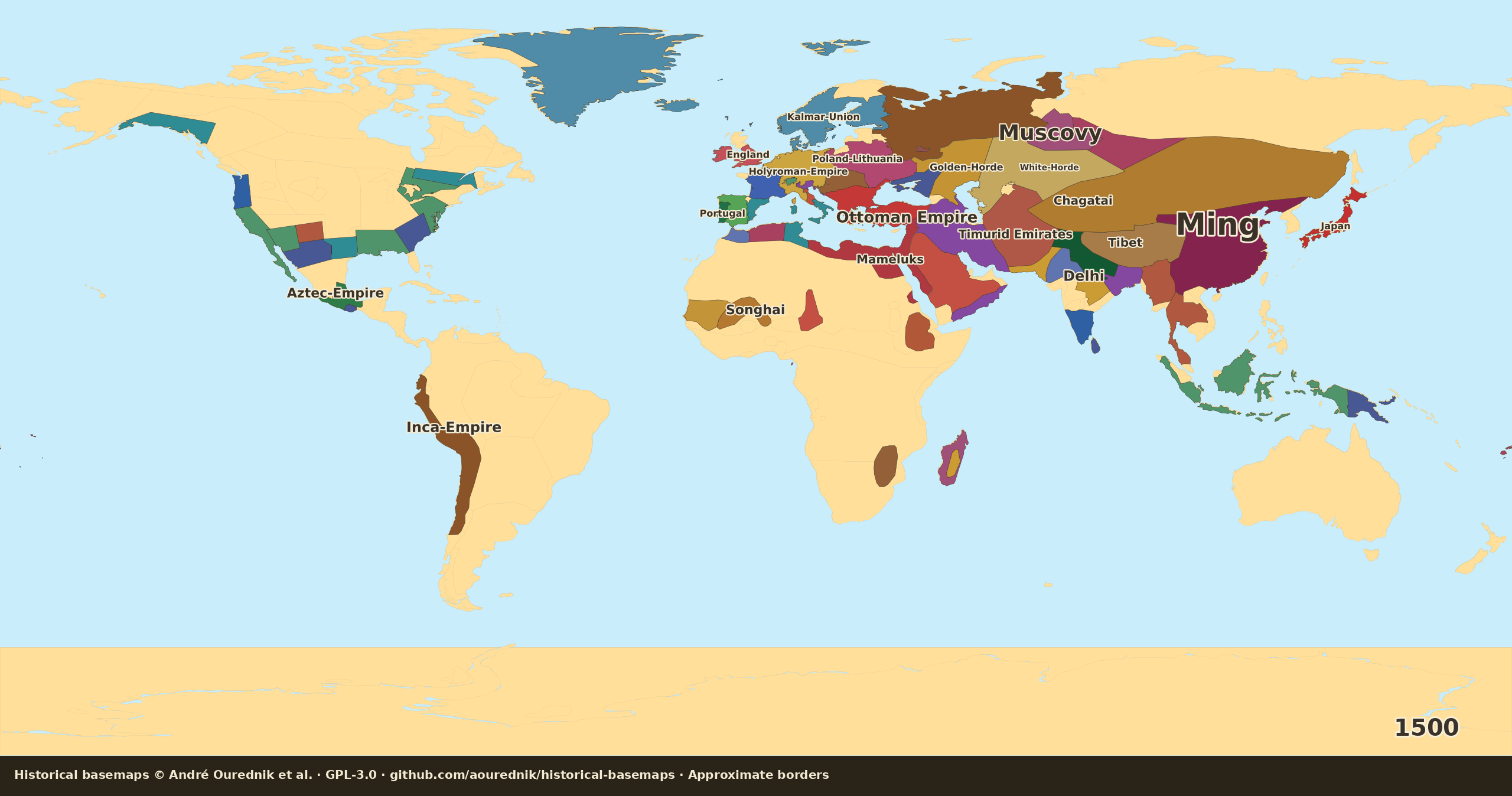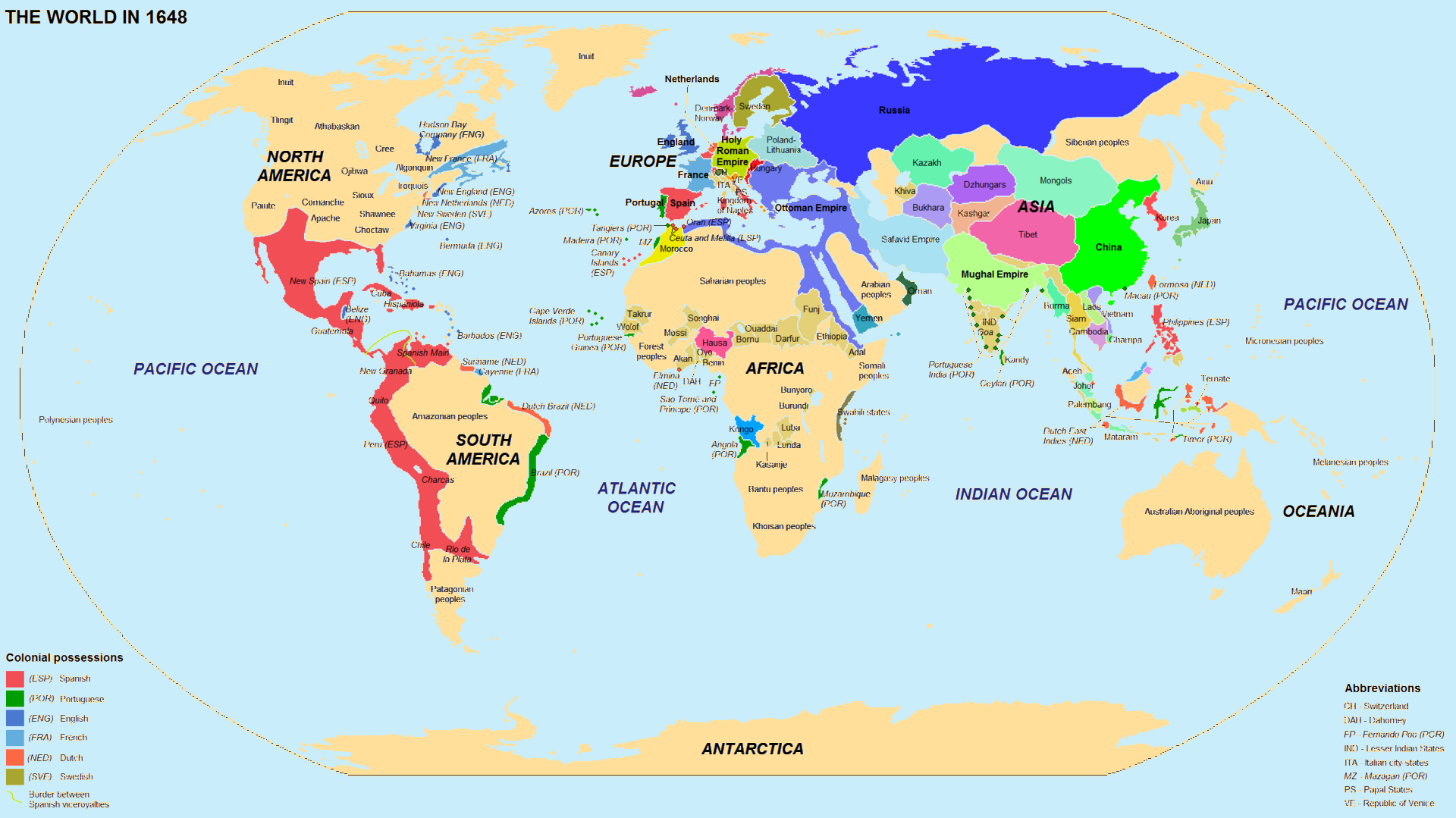
← Maps

Map room

History of borders

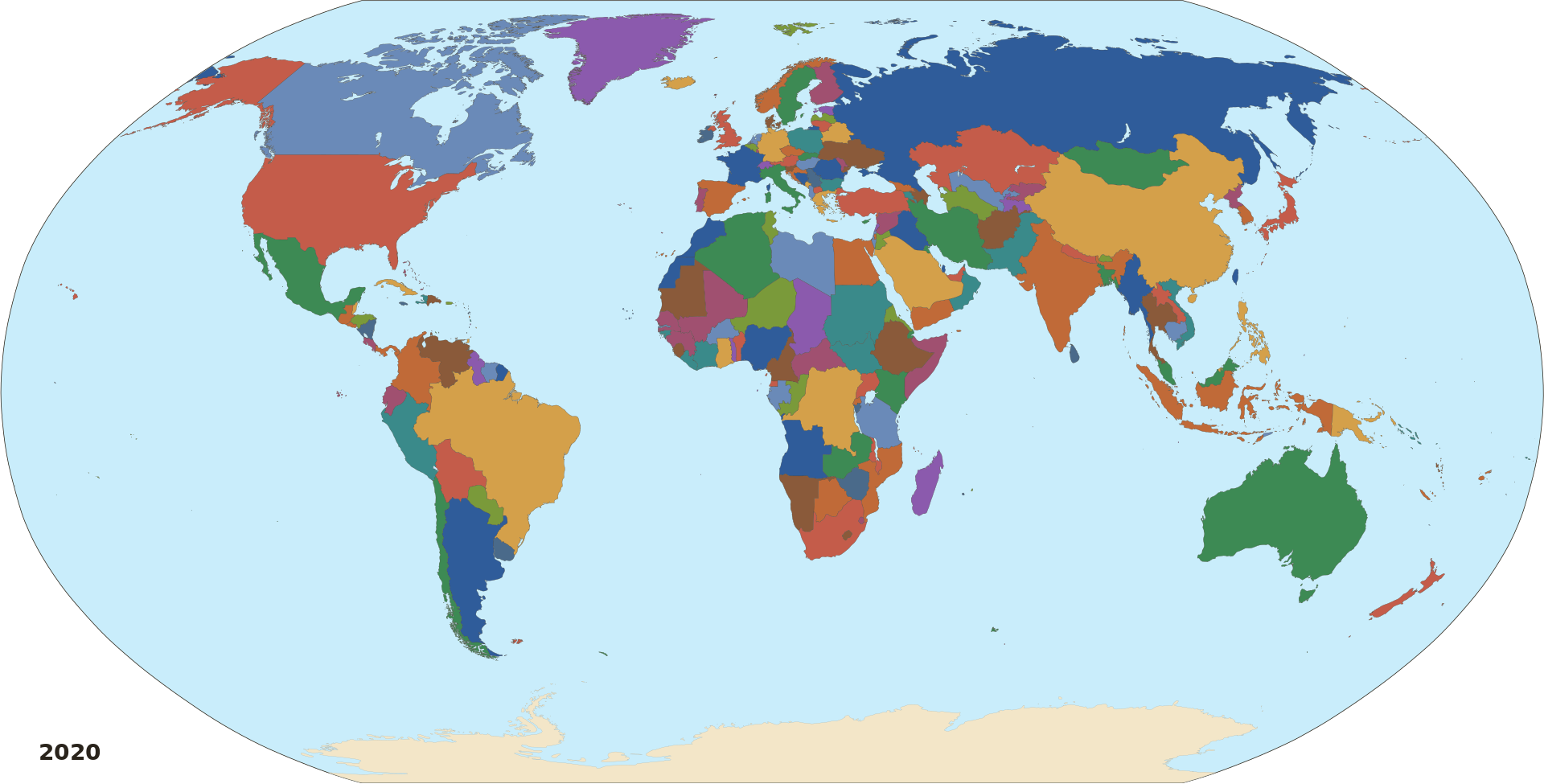
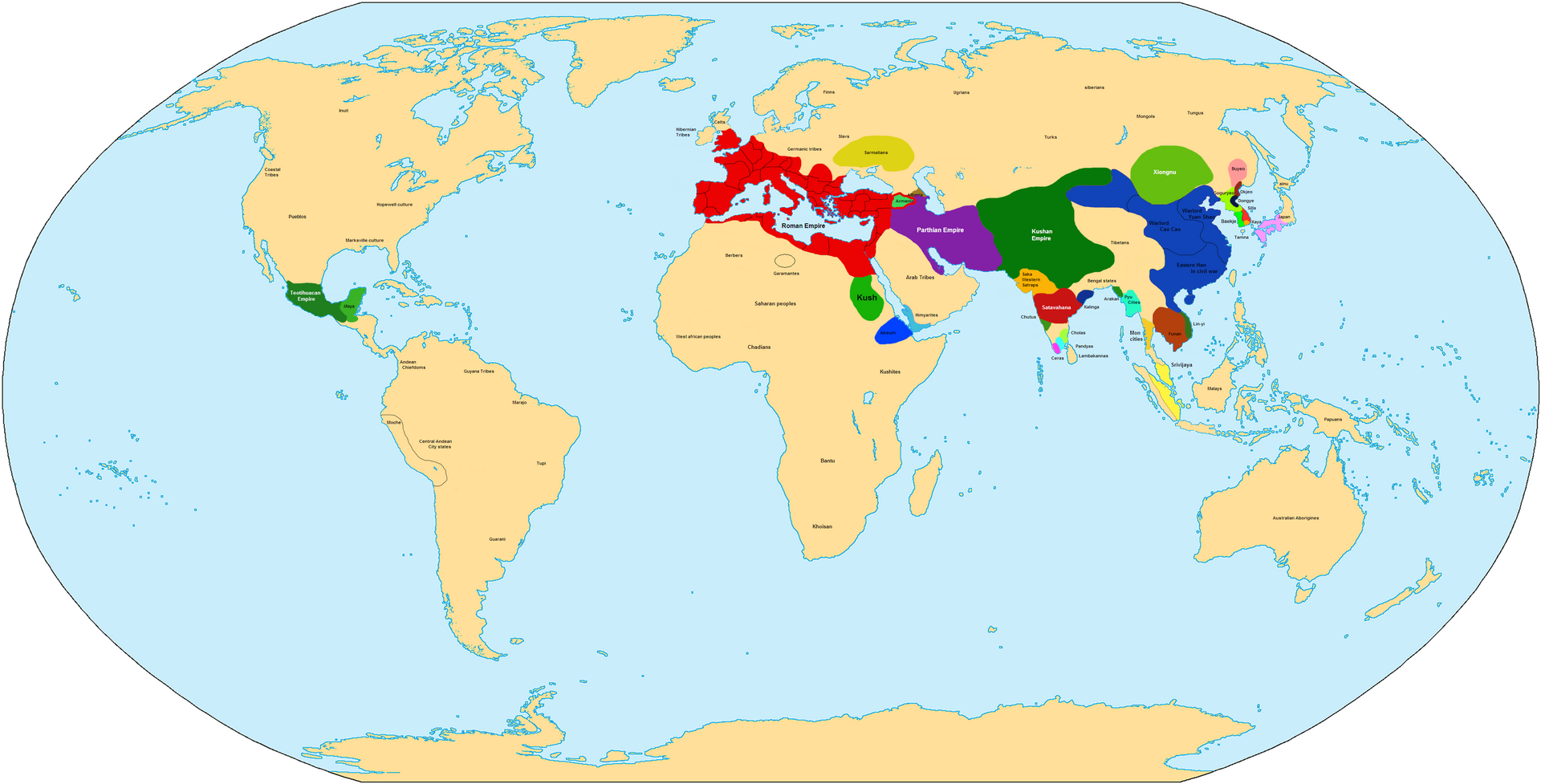
Political maps, one century at a time: year 1 of the Common Era through the present. Each frame is a published reconstruction or a dated government sheet. Early borders are estimates.

There is no single “true” world border for antiquity. States, tribute zones, and nomadic ranges overlap. Several steps use the nearest openly licensed plate in this atlas family, not an invented year. Contested lines stay contested.

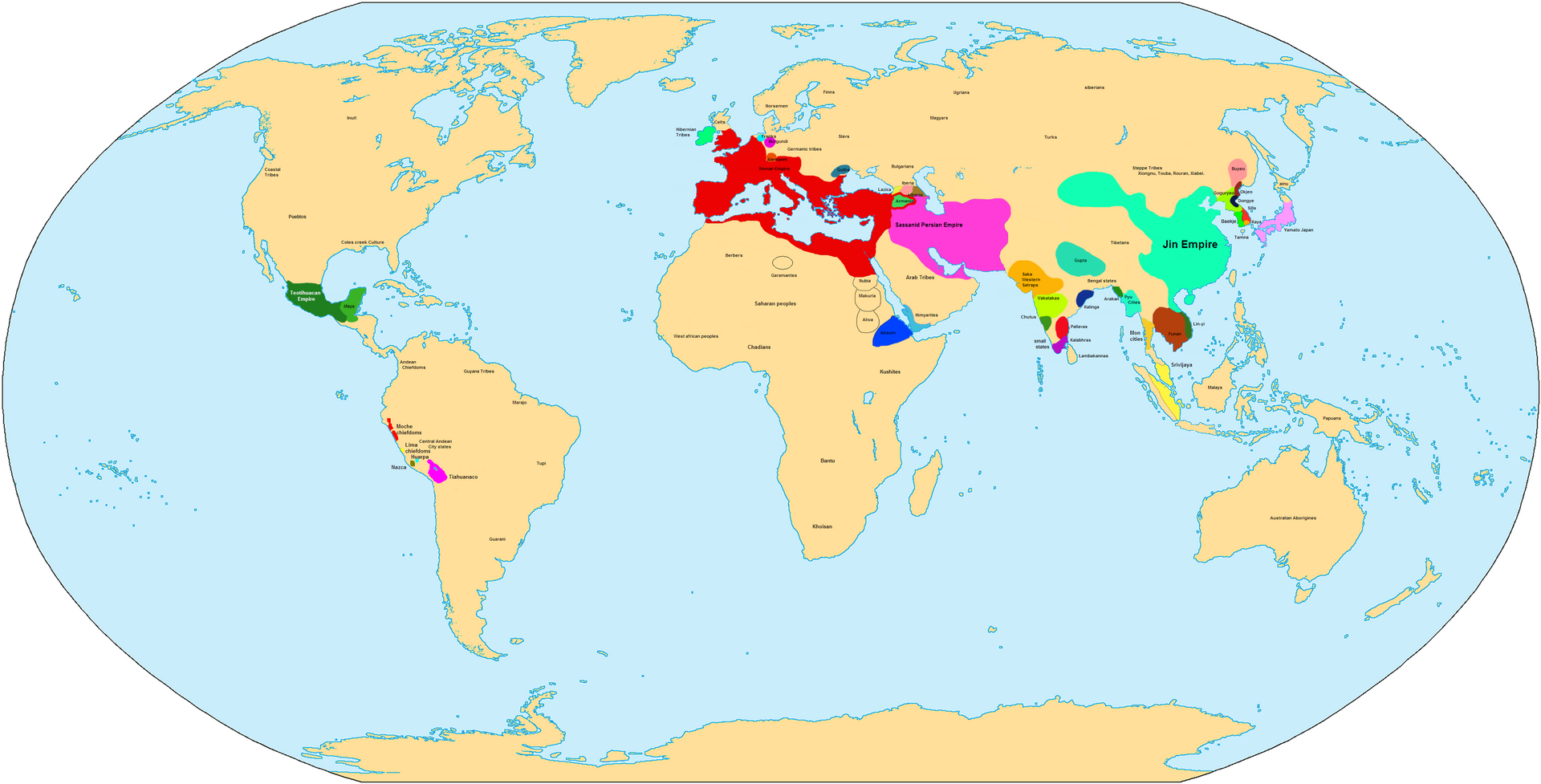
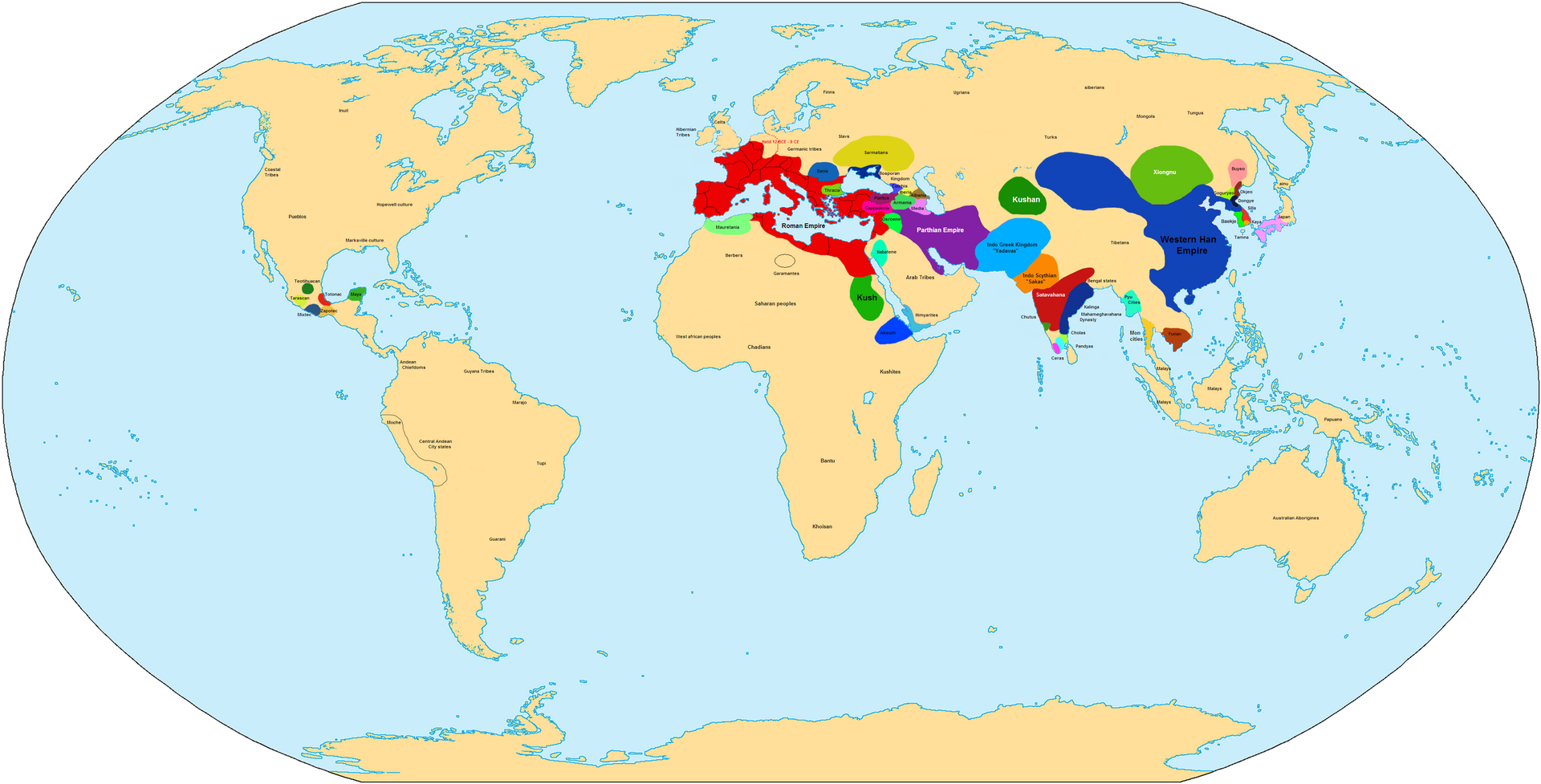
Reconstructed world political map for 1 CE, public-domain Wikimedia sheet
Javierfv1212, Wikimedia Commons. Map dated: 1 CE.
Century step: 1 Javierfv1212

1 CE: start of the Common Era

Year 1 CE: for people then, just another year from Rome's founding and the year of Emperor Ping; Augustus holds the Mediterranean, Han holds the Middle Kingdom; between them, silk and Parthia.

Year 1 of the Common Era. Nobody then counts a "Common Era." A monk, Dionysius Exiguus, will invent the number five hundred years later, and it will spread later still. For people of that day it is just another year from the founding of Rome, the 754th, if you trust Roman counters. In China: a year of Emperor Ping's reign. The East has its own calendar; Judea has its own.

Christmas, which later gets tied to this point, most likely happened a few years earlier. In the "first year" itself the infant Jesus is no longer in the manger. There is Rome, which seems eternal. There is China, which seems central. Between them: Parthia, the steppe, and roads that carry caravans, not calendar ideas.

Rome and the Mediterranean

Rome is ruled by Octavian Augustus. The Republic still lives on paper: the Senate sits, consuls are elected. In practice one man holds the army, the provinces, and the right to say "no." The civil wars are over. They call it the peace of Augustus: Pax Romana. For a resident of Italy the peace really is quieter than under Caesar and Antony. For a resident of conquered Gaul or Judea, peace looks like taxes, a garrison, and someone else's law.

The empire rings the sea: Spain, Gaul, Italy, Greece, Asia Minor, Syria, Egypt, Africa. The Rhine and the Danube are almost the edge. Britain has not been taken seriously yet (that is Claudius, forty years on). Beyond the Rhine: Germans. Recently, in 9 BCE and around then, Romans pushed into Germany. Eight years after the "first year," in the Teutoburg Forest, three legions will fall. In year 1 that has not happened yet. It seems the eagles go wherever they want.

In Rome they write. Livy pulls his enormous history of the City. Ovid writes light and dangerous verse. Soon Augustus will exile him to the Black Sea. Virgil is already dead, but the Aeneid has become the empire's schoolbook: Rome as if appointed by the gods.

Judea is a client kingdom under Rome. Herod the Great died around 4 BCE. His sons divide the land. In Jerusalem, the Temple, high priests, different schools: Pharisees, Sadducees, radicals in the desert. There is tension. No big explosion yet. Jesus, if you follow the usual historians' chronology, is a child or adolescent somewhere in Galilee. Official Rome has not heard of him.

Egypt is Augustus's personal granary: grain for Rome. Alexandria is still a smart city: the library is no longer what it was under the Ptolemies, but Greek language and science are alive.

Parthia and east of the Euphrates

Rome's main equal enemy is Parthia. Cavalry, heavy horsemen, capital sometimes Ctesiphon, sometimes other courts. The border runs along the Euphrates. Sometimes they make peace, sometimes they fight. Nobody wins for good. Between them a buffer: Armenia, small kingdoms, quarrels over princes.

For a merchant, war matters less: silk from the east already reaches Rome. Not Chinese caravans in person, but a chain: China, Central Asia, Parthia, Syria. Romans pay in gold and glass. Chinese get horses and curiosities. Each side thinks the center of the world is theirs.

China

The dynasty is Western Han. Emperor Ping is a teenager. Behind him Wang Mang gathers strength, a relative on the female line, a man of order and reforms. In eight years he will overthrow Han and proclaim a new Xin dynasty. It will go badly. For now the court in Chang'an pretends the Middle Kingdom is eternal.

Han is enormous. Population in the tens of millions. Paper is already invented (Cai Lun is still ahead as the "official" hero, but people already try writing on thin material). Silk, iron, census, canals, Confucian officials. To the north, the Xiongnu, a steppe people: now peace, now war, now a silk bribe.

China knows that far to the west there is some Daqin: Rome. Knows it vaguely. Rome knows Serica, the silk country, vaguely too. No direct embassy in year 1.

India and beyond

Northern India has long been fragmented after the fall of the Mauryas. In the northwest the trail of Greco-Bactrians and Sakas is still felt. The Kushan Empire as a great bridge between China and Rome will form a little later. In the south, their own kingdoms; sea trade with Egypt is already running: they know the monsoon, pepper sails into the Red Sea.

In Southeast Asia: early states, Indian influence, not empires on the Han scale.

Japan is in the Yayoi world: rice, bronze, not yet a "mikado country" in our sense.

The north and the "barbarians"

Beyond the Rhine and Danube: tribes Romans lump together as Germans. They have their own chiefs, their own gods, no wish to become a province. Scythians and Sarmatians on the steppe. On the future Russian lands: forest, hillforts, a wholly different rhythm. No Kiev, no Novgorod. Almost nine centuries until the Varangians.

In Africa south of Egypt: Kush/Meroë. The Sahara is not empty: gold and caravans already draw the road that later great kingdoms will follow.

In the Americas, their own worlds: in Mesoamerica the late Olmecs are already past; cultures like the beginnings of Teotihuacan are rising. The Mediterranean knows nothing of this.

What it feels like

The first year of the Common Era is a year without the name "first."

A Roman thinks: the world is ordered, Augustus fixed it, the gods are for the City. A Chinese thinks: the emperor is the thread between Heaven and people; barbarians should bring tribute. A Parthian thinks: Romans are heavy to get moving; the steppe and the horse are ours. A Judean thinks of the Law, the Temple, and when foreign rule will end.

Nobody marks the "start of an era." An ordinary year is born: tax, wedding, sea wind, a rumor of a legion on the border.

What follows:

  • year 9: Teutoburg; Rome forever backs off from deep Germany;
  • around year 14: death of Augustus, Emperor Tiberius;
  • years 9-23: Wang Mang and the collapse of his reforms;
  • the 30s: the execution of Jesus in Judea, which Rome will learn of much later as a "sect";
  • year 70: destruction of the Temple;
  • year 220: end of Han.

Year 1: silence at the peak of two empires. Rome and Han do not yet suspect how alike they are: both count themselves civilization, and the rest as the edge. Between them, silk. Over the silk they will later write a new era. In this year itself the ink still counts from the founding of the City and from Emperor Ping's accession.

World reconstruction

Source

Javierfv1212, Wikimedia Commons
Map dated: 1 CE
https://commons.wikimedia.org/wiki/File:World_in_1_CE.png
License

Public domain

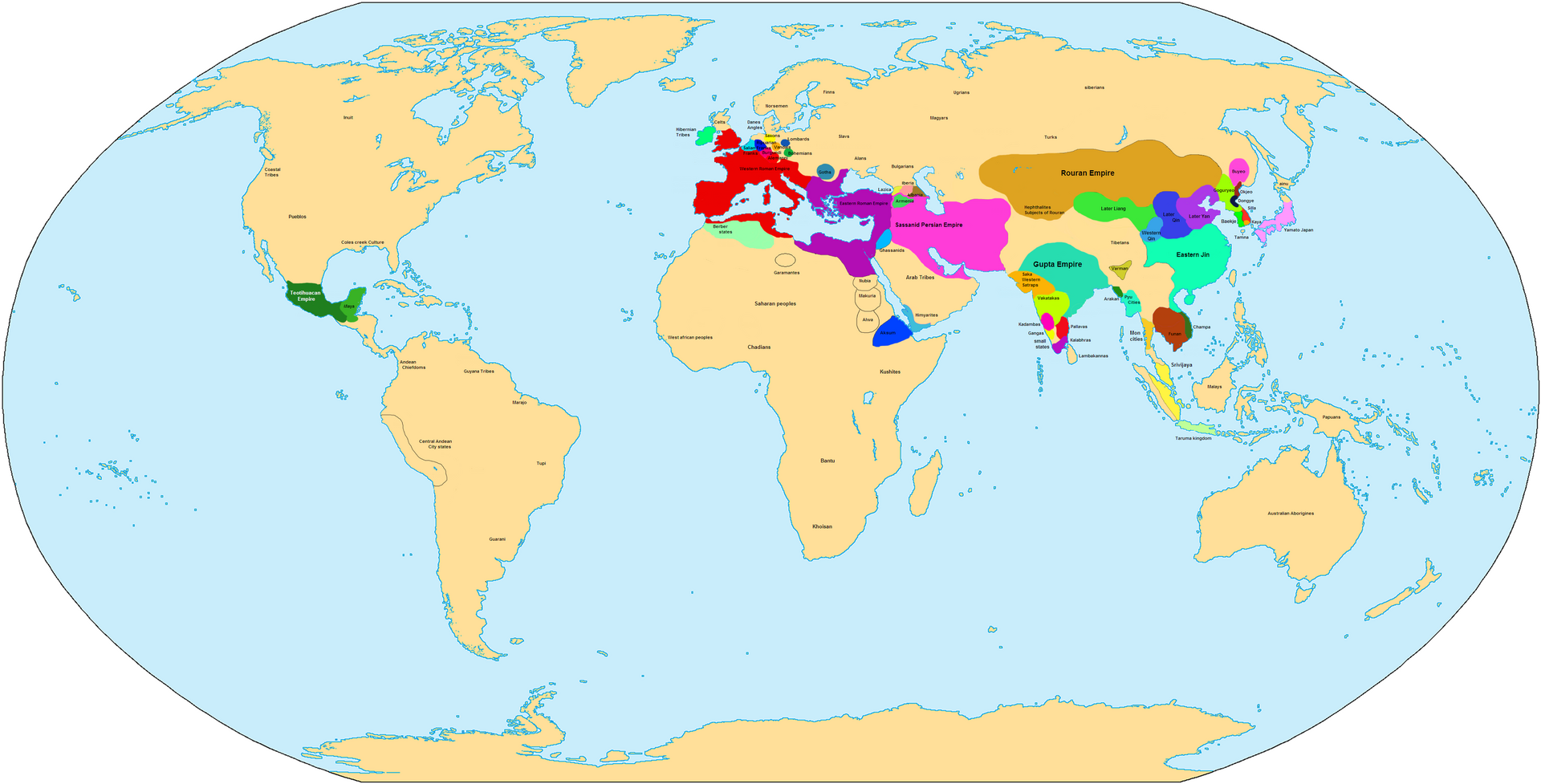
Reconstructed world political map for 100 CE
Javierfv1212, Wikimedia Commons. Map dated: 100 CE.
Century step: 100 Javierfv1212

100 CE

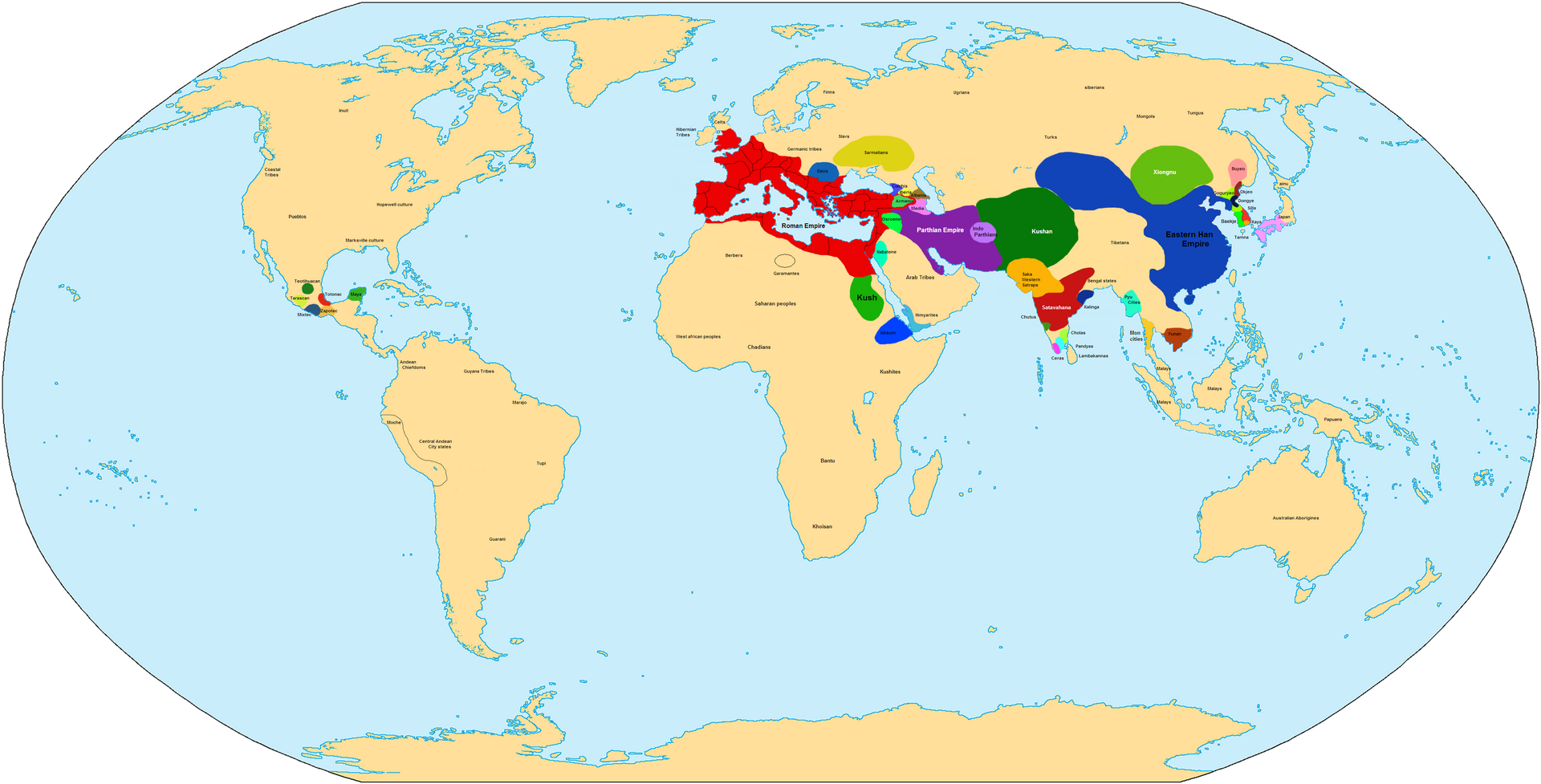
The 2nd century: Rome's "golden age" from Trajan to Marcus Aurelius and the break at Commodus; the Antonine Plague; in China Eastern Han cracks by the end (Yellow Turbans).

The 2nd century: roughly the years from 101 to 200. For Rome it looks like a "golden age" and the start of illness inside. For China: a century when great Han still stands at first, and by the end is already cracking. Christ was crucified in the previous century. Christians are still few; sometimes tolerated, sometimes executed; there is no great church empire. Nobody yet reckons an era "from the Nativity."

If the 1st century was the age of Augustus and the destruction of the Jerusalem Temple, the 2nd is the age of emperors later called "good," and of a plague that will show the world is not elastic.

Rome

After Domitian the Senate exhaled. On the throne a line of men the textbook will later arrange in a row: Trajan, Hadrian, Antoninus Pius, Marcus Aurelius. Then: Commodus. With Commodus the fairy tale ends.

Trajan (98-117): the last who seriously pushes the borders forward. Takes Dacia (today's Romania: gold, colonists, a bridge over the Danube). Then drives at Parthia, reaches the Persian Gulf. The empire at its maximum. The map is beautiful. Holding it is already hard.

Hadrian (117-138) understands this better. Gives back part of the eastern conquests, travels the provinces, builds a wall in Britain. Not "forward," but "close the perimeter." Soldier and official matter more to him than triumph.

Antoninus Pius (138-161), quiet: few wars, many courts and grain. Later Romans will remember this as the norm. It was not the norm. It was a pause.

Marcus Aurelius (161-180): an emperor with a notebook. Writes Meditations on campaign. On the Danube frontier Germans and Sarmatians push in waves. In the east, Parthia again. In the 165-180s the Antonine Plague walks the empire, most likely smallpox. Armies melt, cities empty, prices jump. The philosopher on the throne fights to death at Vindobona (Vienna).

His son Commodus (180-192) wants to be Hercules in the circus, not Marcus in the saddle. They kill him. Then a short nightmare: a year of several emperors, then Septimius Severus: a soldier from Africa. By 200 Rome is no longer "Senate and citizens." Rome is an army that chooses its master.

Law, roads, baths, amphitheaters: all of it works. In the provinces they speak Latin and Greek. A man from Spain can become emperor. A man from Syria: a senator. That is the Roman focus of the 2nd century: the empire is wider than Italy. Italy is no longer the only center, only the vainest.

Christians are sometimes persecuted (under Marcus Aurelius there were executions), sometimes ignored. For most people this is a strange sect without sacrifices and without statues. Judaism after the smash of 70 and the Bar Kokhba revolt (132-135) has lost the Temple and Jerusalem as a Jewish city: Hadrian rebuilds it as Aelia Capitolina. Diaspora becomes the main form of life.

Parthia and the east

Parthia is still the main neighbor. Wars with Trajan and with Lucius Verus under Marcus Aurelius are hard on both sides. The Parthian court itself is in feuds. By the end of the century a new Persian force will begin to sprout from this mess, the Sasanians. They will take the stage in the 3rd century and hit harder than the Parthians.

The Kushan Empire at the junction of India, Central Asia, and the roads to China: the 2nd century is exactly its strength. Kanishka and his heirs. Buddhism rides these roads east. Gold of Roman coins turns up in Indian hoards: pepper, textiles, ivory go west.

China

The dynasty is Eastern Han. Court in Luoyang. On paper: continuation of the ancient empire. In practice eunuchs, empresses' clans, generals.

Until 184 you can still pretend the center holds the Middle Kingdom. In 184: the Yellow Turban rebellion. Religion, hunger, "Heaven has withdrawn from Han." The empire will not be eaten formally at once, but the spine is broken. By 200 the country is already in the hands of field commanders. Soon the "Three Kingdoms": Wei, Shu, Wu. The novel about it will be written a thousand years later. The blood is now.

To the north, the steppe. The Xiongnu are no longer the force they were under Western Han, but the border is alive. Silk still goes west. Paper and ink: Chinese everyday life, not a marvel.

India and beyond

Northern India after the Kushans and local dynasties. The south trades with Rome through the Red Sea: the monsoon is the timetable. In Southeast Asia Indian stories and Buddhism settle onto local kingdoms.

Japan is still pre-state by Han standards: rice, clans, burial mounds. Korea: early kingdoms, a strong Chinese cultural wind.

North of Rome and the "barbarians"

Beyond the Rhine and Danube the German world is denser and more organized than under Augustus. Marcomanni, Quadi; the Goths are not yet the Goths who will take Rome in two centuries, but the pressure is already constant. Rome answers with walls, rivers, subsidies, and war.

On the steppes: Sarmatians. On the lands of future Rus', forest cultures, no state. Slavic principalities are far off.

Roman Africa: a granary and cities along the shore. Farther south: their own kingdoms; Rome knows them poorly. America is still another humanity: Teotihuacan in Mexico is just rising, a giant city without a single "emperor" in the Roman sense.

Plague and numbers

The Antonine Plague is the main invisible character of the century's second half. Death tolls are argued, but armies and Mediterranean cities feel the blow. After this Rome finds it harder to raise legions "as before." The 3rd century will inherit a shortage of people and money.

On earth there are still a couple of hundred million people. China and India hold the lion's share. The Roman Empire: tens of millions, huge for the West, not the center of the planet's population.

What it feels like

The 2nd century: a century of good plaster over old cracks.

A Roman in Ephesus goes to the bath, argues in court, looks at the emperor's statue and thinks it will always be so. A soldier on the Danube knows that "always" is the next barbarian crossing. An official in Luoyang writes a report to the emperor and does not know which eunuch will burn him tomorrow. A merchant in Alexandria loads pepper and does not think of Jesus. A Christian in the catacombs (catacombs as an image a little later, but the meaning is that) thinks of the end of times and of how not to get caught.

The world is better connected than in year 1: ship, caravan, coin, letter. But connected fragilely. One epidemic, one bad heir, one "yellow" revolt, and the golden age turns out to be an intermission.

What follows, already in the 3rd century:

  • 212: citizenship for almost all free people of the empire (Caracalla);
  • 224-226: Sasanians instead of Parthia;
  • 235-284: the 3rd-century crisis in Rome: emperors for a year, breakaway Gaul and Palmyra;
  • 220: official end of Han;
  • 284: Diocletian will begin to glue Rome back together, already as a different machine.

The 2nd century is remembered for Trajan's Column, Hadrian's Wall, and Marcus Aurelius's little book. Worth remembering also the plague, and Commodus, and the Yellow Turbans. The plaster was excellent. The wall under it will not hold.

World reconstruction

Source

Javierfv1212, Wikimedia Commons
Map dated: 100 CE
https://commons.wikimedia.org/wiki/File:World_in_100_CE.PNG

License

Public domain

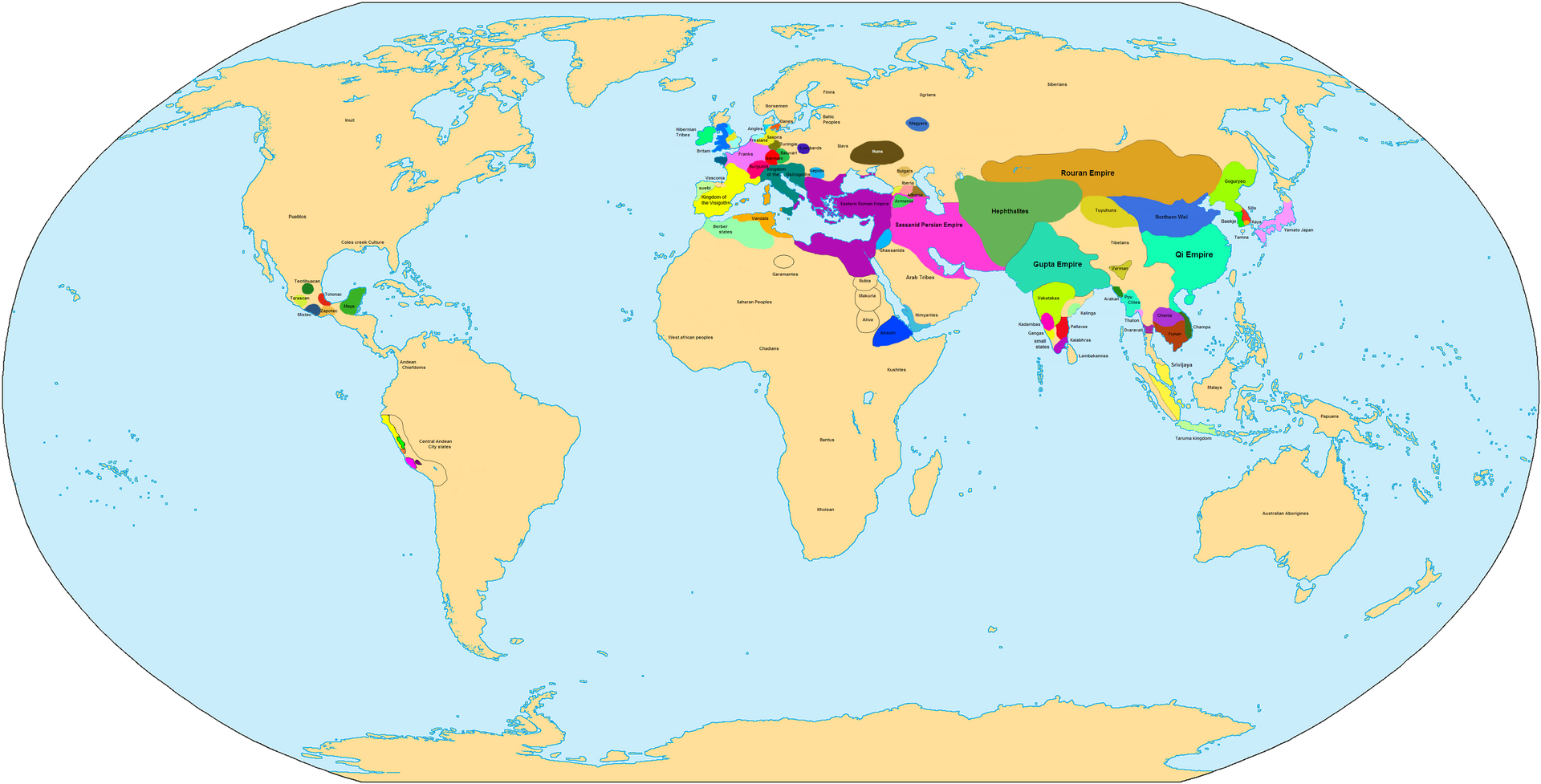
Reconstructed world political map for 200 CE
Javierfv1212, Wikimedia Commons. Map dated: 200 CE.
Century step: 200 Javierfv1212

200 CE

Year 200: no longer a calm antique noon: the empires still stand, but something creaks inside. Septimius Severus's Rome after Parthian campaigns and plague; China on the eve of the Three Kingdoms after Guandu; Parthia living out its days until the Sasanians. Quieter outside than it seems.

Year 200 is no longer a calm antique noon, as in 100. The empires still stand, but something creaks inside each of them. Earth's population: roughly 190-260 million.

Europe and Rome

  • The emperor is Septimius Severus. An African from Lepcis Magna, a soldier who won the civil war after Commodus's murder. The Severan dynasty: power rests on the army; the Senate is already decoration.
  • Parthian campaigns have just roared through. In 198 the Romans took Ctesiphon again. Severus made northern Mesopotamia a province. Hatra he never took: the fortress held.
  • In 200 itself he travels Syria, Palestine, and Arabia. Looks at what is left after wars and plague. He takes Numidia from the proconsul of Africa and makes it an imperial province: control closer to the throne.
  • After the Antonine Plague (from 165 and in waves after) there are fewer people, legions harder to fill, prices jump. The "good emperors" are over. Ahead: Severus's sons Caracalla and Geta, and that will be no fairy tale.
  • Christians are already noticeable. Severus in Judea seems to forbid new conversions to Judaism and Christianity. The cult of Mithras among soldiers is no less popular.
  • The Rhine and Danube frontier is tense. Germans press harder than a hundred years ago. Britain is still Roman; Hadrian's Wall stands.

Rome is still huge and rich. But this is already an empire tired of winning.

Asia

China: end of Han, start of chaos

  • Formally Emperor Xian. In fact the country is already with field commanders.
  • Autumn 200: the Battle of Guandu. Cao Cao with a smaller army smashes Yuan Shao. A turning point: northern China begins to gather into one pair of hands. In 20 years Han will fall; the Three Kingdoms begin (Wei, Shu, Wu).
  • In May Sun Ce is mortally wounded; power in the lower Yangtze passes to younger brother Sun Quan, future founder of the kingdom of Wu.
  • The Yellow Turban rebellion was back in 184. Since then central power has never got back on its feet. Officials steal, generals cut each other, peasants flee.
  • The Western Regions (Silk Road) Han barely holds anymore. Buddhism in China is already no rarity.

Parthia

  • After three Roman campaigns in a century (Trajan, Lucius Verus, Severus) the Arsacid realm wobbles. Courts quarrel, vassals act up.
  • A quarter-century left to the end: in 224-226 the Persian Ardashir will overthrow the last Parthians and found the Sasanian Empire, a far tougher enemy for Rome.

Kushans and India

  • The Kushan Empire after Kanishka is no longer what it was. Around this time Vasudeva is mentioned; the state fragments.
  • In Malwa, Rudrasena I of the Western Satraps (Sakas) is in power.
  • Hinduism takes on the form we recognize later; Buddhism lives, but northern India's political map is patchy.

Far East

  • In Japan tradition links this time with Himiko of Yamatai, a shaman-ruler who gathers the clans. Dates are conditional, but the direction is right: from a scatter of villages a proto-state is being molded.
  • Korea: Goguryeo, Baekje, Silla are already full kingdoms.

The rest of the world, briefly

  • In Mesoamerica around this time the Maya Classic period begins. Teotihuacan is already a huge city.
  • In the Andes the Paracas culture fades; other societies rise (including Moche a little earlier / around this).
  • Aksum in Africa strengthens and trades through the Red Sea.

What it feels like

Year 200: the moment when the old giants are still alive, but no longer young.

Rome has just beaten Parthia again and pretends everything is under control. China is formally still Han, but in truth already a war of all against all, and Cao Cao has just won the main round. Parthia is living out its days. The Kushans crumble. Along the roads silk, pepper, and glass still travel, but the states that guarded those roads begin to fall apart almost at once.

In 20 years there will be no Han. In 25: no Parthia. Rome will last longer, but no longer as in Trajan's century: ahead lie soldier-emperors, crises, and new Persians in the east.

Year 200: quiet outside, very loud inside.

World reconstruction

Source

Javierfv1212, Wikimedia Commons
Map dated: 200 CE
https://commons.wikimedia.org/wiki/File:World_in_200_CE.PNG

License

Public domain

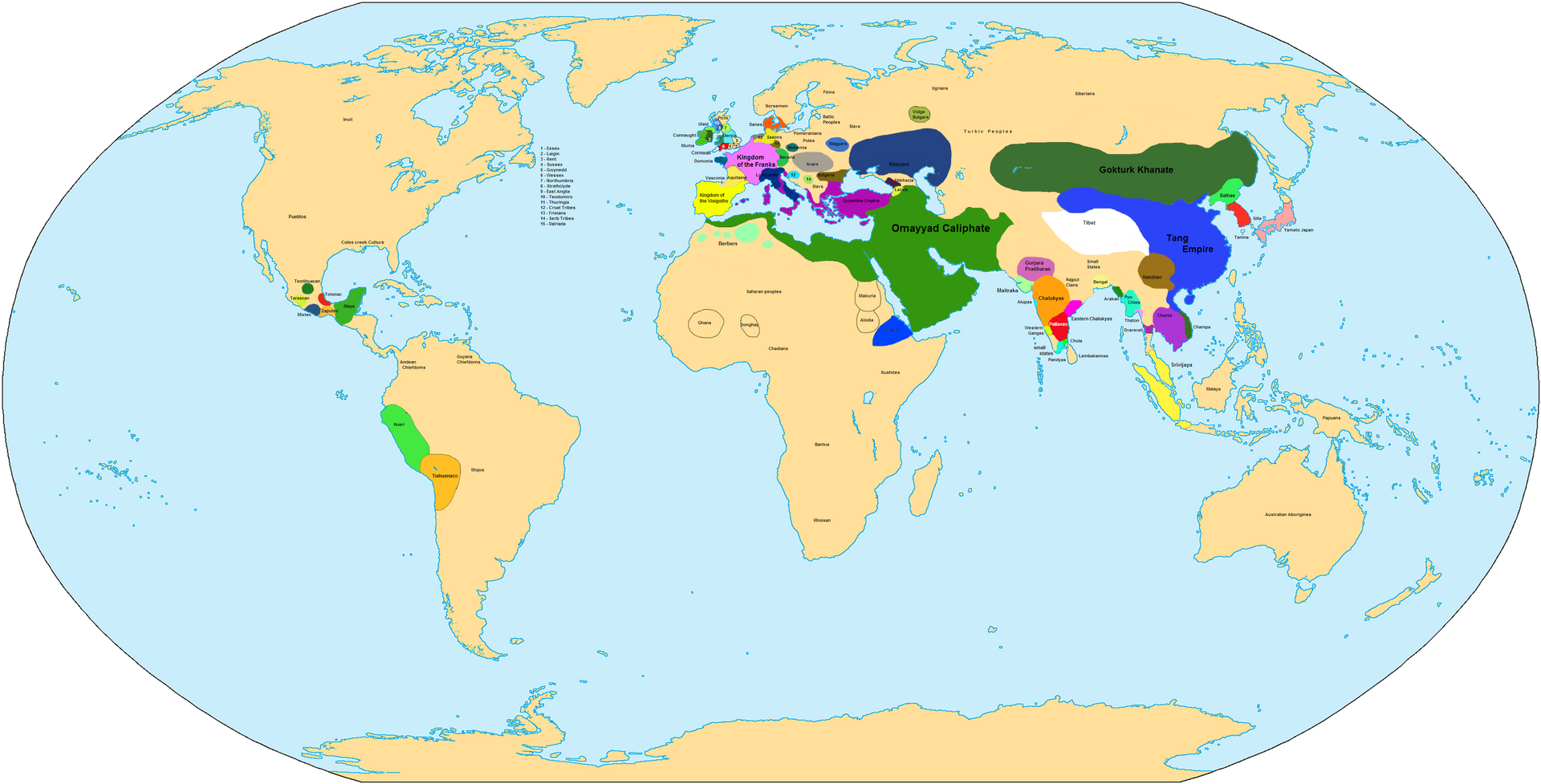
Reconstructed world political map for 300 CE
Javierfv1212, Wikimedia Commons. Map dated: 300 CE.
Century step: 300 Javierfv1212

300 CE

Year 300, Diocletian's tetrarchy; Sasanians in Persia; Jin in China already gnawing itself; Christians numerous, in three years the Great Persecution begins.

Year 300. Rome is almost 1,050 years from its founding. The empire is still huge, from Britain to Egypt, but one man no longer rules it. For almost ten years the tetrarchy scheme has stood: four rulers for one realm. In Persia sit the Sasanians, fiercer than the Parthians. In China the Jin dynasty has only just seemingly united the country after the Three Kingdoms, and at once begins to gnaw itself from within.

Christians are already many. In three years Diocletian will try to burn them out. It will not work.

Rome

The main man is Diocletian. Not a senatorial legend, but a soldier from the Balkans. He grasped a simple thing: the 3rd-century empire broke because one emperor could not make every war. The solution: cut power apart.

By 300 the tetrarchy already works:

  • two "Augusti": the seniors;
  • two "Caesars": the juniors, heirs and deputies.

Diocletian holds the East; residence more often Nicomedia (in Asia Minor, not Rome). The West: Maximian. The Caesars: Galerius and Constantius Chlorus, father of the future Constantine. The city of Rome is still sacred, but the capital in practice is wherever the staff and army are. The Senate is almost decoration.

Borders are held again: Rhine, Danube, East against the Persians. Inside, new bureaucracy, new taxes, an attempt to freeze prices by edict (works poorly: the market is smarter than a decree). The army is larger. Provinces smaller, so a governor cannot secede with his piece.

For a townsman in Antioch or Carthage life is still Roman: bath, court, coin with a profile. For a peasant: tax heavier than under the Antonines. The 3rd-century crisis is formally behind. The fear remains.

Christianity. No longer a handful in the catacombs. There are churches, bishops, their own disputes about the faith. Diocletian long looked the other way. In 303 the "Great Persecution" begins: tear down temples, burn books, purge Christian officials. This is the empire's last big attempt to stay pagan the old way. In ten years Constantine will see another calculation.

Nearby, a little after 300, in Armenia King Tiridates and Gregory the Illuminator will make Christianity the state religion, earlier than Rome itself.

Persia

The Sasanian dynasty. They call themselves heirs of the ancient Achaemenids; Zoroastrianism is the court's prop. For Rome this is a more serious enemy than Parthia: more regular, more ideological, hits harder.

The Mesopotamian border is forever hot. Captive Romans build Persian cities. Captive Persians: the reverse. A draw with pauses for slaughter.

China

The Three Kingdoms ended in 280: Jin united the map. By 300 unity is already rotting. The emperor is weak, the princes strong. Soon the "War of the Eight Princes", civil war of family against family. Nomadic peoples press the northern borders. Some of them are already inside the empire: settled as federates, serve and wait their hour.

In a few years northern China will start being carved up by "barbarian" kingdoms. Jin will flee south, beyond the Yangtze. The north and the south stay split for a long time. In 300 you can still not see this if you sit in Luoyang and trust the decrees.

Paper, official exams, scholarly disputes: culture has not died. The state is ill.

India and beyond

Northern India still without the Gupta Empire (they come a little later). The Kushans are no longer what they were. Trade with the West lives, but Rome buys less: after the 3rd century there is not as much money or people.

Aksum in East Africa is rising: Red Sea, ivory, gold, soon its own Christianity.

Japan: Yamato burial mounds, royal power taking shape. Korea: three kingdoms; Chinese writing and Buddhism on the way.

North and steppe

Beyond the Rhine Germans denser: Franks, Alemanni, Goths by the Black Sea. Rome sometimes beats them, sometimes hires them. Goths not yet in Italy. Until Adrianople (378) and the sack of Rome (410), a lifetime.

On the lands of future Rus', forest, hillforts, no Kiev. Slavs as a great force are not yet on Roman pages.

The steppe between China and the Black Sea lives by its own alliances. Xiongnu/Huns already history; other names on the stage. The Great Migration in the full European sense is not yet here, but people are already shifting.

America

Teotihuacan in Mexico: a huge city of pyramids and streets. Maya in Classic stride. Incas still far off. For Rome this continent does not exist.

What it feels like

Year 300: repair after a fire.

Diocletian thinks he has invented a perpetual-motion machine of power: four rule, two resign, two rise. In five years he will indeed leave for his garden in Split, a rare emperor who left of his own will. The system without him will quickly go off the rails. Constantine, son of Caesar Constantius, in 300 is still an officer in the East, not master of the world.

A Christian in Nicomedia can still serve in the army and hope it will blow over. In three years: a search. A pagan priest thinks Rome's gods and the emperor's edict are one bond. Both are wrong.

A Chinese prince thinks that after unification you can divide the spoils. Soon the capital itself will be the spoils.

The world of 300 is still Mediterranean-Chinese: two big machines for counting people and grain. Between them Persia and the trading seas. The "barbarian" north is larger than Rome is ready to admit.

What follows:

  • 303: Diocletian's persecution;
  • 305: his resignation;
  • 306: Constantine proclaimed at York;
  • 312: Milvian Bridge, "in this sign conquer";
  • 313: Edict of Milan, Christianity permitted;
  • 324-330: a new Rome on the Bosporus;
  • 376-378: Goths cross the Danube, Adrianople;
  • 316-420s: Jin loses northern China.

Year 300: the last year when you can seriously imagine a pagan empire as the forever norm. The norm is already different: many rulers, many gods, and one of the cults is about to stop being forbidden. Diocletian did not plan this. History rarely asks the planner.

World reconstruction

Source

Javierfv1212, Wikimedia Commons
Map dated: 300 CE
https://commons.wikimedia.org/wiki/File:World_in_300_CE.PNG

License

Public domain

Reconstructed world political map for 400 CE
Javierfv1212, Wikimedia Commons. Map dated: 400 CE.
Century step: 400 Javierfv1212

400 CE

Year 400: already two empires: Honorius in the West, Arcadius in the East; Goths inside; ten years until Alaric in Rome; Christianity official since 380.

Year 400. Rome is more than a thousand years from its founding. On the map the empire still runs from Britain to Egypt. In life it is already two countries. In the West Emperor Honorius, in the East: Arcadius. Both sons of Theodosius. The father died in 395 and gave the realm to two young heirs.

Christianity since 380 is the official religion. Pagan temples are closed by decree. Some old families still honor the former gods at home. In the squares this is no longer the state's main faith.

Goths live not beyond the border but inside the empire: in the Balkans and in the Roman army. Ten years until Alaric takes Rome.

Western Rome

The real capital is no longer Rome. The court sits in Milan; soon it will move to Ravenna, safer because of the marshes. Honorius on the throne is weak. The country is run by his guardian Stilicho, a general of Vandal stock. He is the last major man who still holds the West.

The Rhine is still counted a Roman border. In the winter of 406 Vandals, Alans, and Suebi will cross it on the ice. After that Gaul will start to be torn to pieces. In 400 that is still ahead.

Britain is formally in the empire, but soldiers are more and more often taken to the mainland. In a few years the island will be left almost without legions.

The city of Rome itself is rich in churches and old palaces. Senators remember greatness. They do not raise an army. There is less bread than a hundred years ago. The main fear is simple and close: the Goths.

Alaric, king of the Visigoths, served Rome and did not get what he was promised: land, grain, a worthy place. The Eastern empire tries to shove him onto the West. The West does not know how to pay. In 410 he will take Rome. In 400 he is already not a rumor from the steppe, but a political problem.

Africa is still calm and feeds Italy with grain. Spain and Gaul are still Roman on the map.

Eastern Rome

Constantinople is a living capital: walls, harbor, court, officials. Arcadius too is a weak ruler, but the state under him is stronger than the western one. There is money, there is Egypt with grain, there is Syria and Asia Minor.

On the eastern border the Persians are dangerous, yet they do not stand at the gates every year.

Here they more often speak Greek than Latin. Bishops argue how to teach correctly about Christ. From these disputes come exile, street fights, and future church schisms. John Chrysostom in the capital quarrels with the imperial court. A bishop already weighs almost like a governor.

Persia

The Sasanians rule. The court rests on Zoroastrianism and heavy cavalry. The state is dense, not loose. With the Roman East they now trade, now fight. Neither side collapses in 400.

Around this time Shah Yazdegerd I even treats Christians relatively mildly at home. For Persia that is more exception than rule.

China

The north of the country is a patchwork of kingdoms. Nomadic and semi-nomadic rulers wear Chinese titles and take tax from Chinese villages. The north's great attempt to conquer the south already failed in 383 at the Fei River.

The south: Eastern Jin dynasty, capital at Jiankang, future Nanjing. Noble families fled there from the north. They write poems, argue about old books, and generals in fact spin the country. Soon one southern dynasty will replace another. The meaning is the same: weak court, its own army.

The Silk Road works when there is no war between the cities.

India and Africa

In India the Gupta power is rising. Exactly the time of Chandragupta II: gold coins, Sanskrit, temples, trade. While Rome in the West loses order, India enters its calm and rich stretch.

In East Africa Aksum is strong. It is already Christian and holds the Red Sea: ivory, gold, trade with India and the Mediterranean.

North and steppe

The Huns already press from the east. Attila himself is not yet here, he will appear in half a century. But because of that pressure the Goths shifted toward Rome, and Rome does not know where to put them. The "Great Migration of Peoples" here is not a textbook name, but a queue of tribes at the border.

There are no Slavic principalities on the Dnieper. The forests of eastern Europe live by their own ways, without emperors and without chronicles.

In Britain stand Roman cities and Celtic communities. In the north of the island: Picts. Saxons so far come as raiders, not as new masters.

Faith

In the villages the old gods are still remembered. The state bets on the church. The Olympic games were banned in the 390s. In Alexandria the pagan sanctuary has already been smashed.

Christianity is not one. The court holds to Nicene teaching. Many Goths are baptized otherwise, in the Arian pattern: for them Christ is not equal to the Father. So a Goth can be a Christian, and still remain alien to a Roman bishop.

In Armenia and Aksum Christianity is already the state religion. In Persia Christians are a minority under watch.

What it feels like

Year 400: a year when the official map is still handsome, and life under it is already different.

On paper one empire with two emperors. In fact the West holds on Stilicho and on the habit of provinces paying tax. The East is learning to be a separate state and does not say it aloud.

A senator in Rome looks at old columns and speaks of the eternal City. A Gothic king counts how much grain and rank he is owed. A Chinese man of letters on the Yangtze writes of lost northern capitals. An Indian court mints gold and does not look toward the Rhine.

What comes right after:

  • 402: the western court finally settles in Ravenna;
  • 406: the breakthrough across the Rhine;
  • 408: Stilicho killed by his own;
  • 410: Alaric enters Rome;
  • 439: Vandals take Carthage; Italy loses African grain;
  • 451: battle of the Catalaunian Fields with Attila;
  • 476: in the West there will be no emperor of its own.

Year 400 is the last round year when in the West you can still say "we are Rome" and almost believe it. Constantinople's walls will stand. Rome's walls will not.

World reconstruction

Source

Javierfv1212, Wikimedia Commons
Map dated: 400 CE
https://commons.wikimedia.org/wiki/File:World_in_400_CE.png

License

Public domain

Reconstructed world political map for 500 CE
Javierfv1212, Wikimedia Commons. Map dated: 500 CE.
Century step: 500 Javierfv1212

500 CE

Year 500: Theodoric in Ravenna; Clovis's Franks already baptized; Constantinople hoards a treasury for Justinian; China is split, the north gathered by Northern Wei.

Year 500. The Western Roman Empire as an office has been gone a quarter-century: in 476 the last emperor in Italy was removed. The city of Rome itself stands. The Senate still sits. But the master of the peninsula is the Ostrogothic king Theodoric. He rules from Ravenna, wears a Roman cloak and Gothic power at once.

In the East the empire lives. In Constantinople Justinian will soon sit, for now he is not yet emperor. China is still cut into north and south. In India the Gupta realm is no longer what it was. On the steppe: their own khaganates. Britain after the Romans' departure sinks into wars of petty kings.

This is no longer "late Rome." This is the start of the world later called the early Middle Ages. Only people then do not call their age that.

Italy and the West

Theodoric took Italy in 493. Odoacer, the very man who overthrew the last emperor, he eliminated. Then a rare construction for the century: Goths, army and top, Romans: Senate, taxes, laws. Officially Theodoric as if rules "in the name of" the eastern emperor. In fact he is king at home.

Ravenna is rich in mosaics. Rome lives on memory. Roads are still Roman. Schools and baths fewer. Latin remains the language of law.

Gaul is no longer a Roman province. There the kingdom of the Franks. Clovis has just, in 496 or around then, been baptized. What matters is not only that he became a Christian. What matters is which kind: in the Nicene pattern, as in Constantinople and among the Roman population, not Arian like Goths and Vandals. Because of that a Frankish king finds it easier to deal with Gallo-Roman bishops. In two or three centuries this will grow into the core of future France.

Visigoths sit in Spain and still a piece of southern Gaul. Vandals: in Africa, capital Carthage. They cut the old Roman link "Africa feeds Italy." The sea between them and Italy became dangerous.

Burgundians: in the Rhône valley. In Britain Roman legions have long been gone. On the island Celtic rulers and Angles, Saxons, Jutes come from the continent. Of King Arthur a legend will later be made. In 500 on the ground: mud, forts, and petty battles, not a round table.

Eastern empire

Constantinople is the real capital of the Mediterranean. Emperor Anastasius: thrifty, clever, fills the treasury. Exactly this money Justinian will later spend on wars and temples.

Borders on the Danube restless. In the east: Persia. Egypt and Syria still theirs: grain, tax, priests' disputes.

The church already argues not whether to be Christian, but how exactly to speak of Christ's nature. From these disputes comes politics. Egypt and Syria often disagree with the capital. The schism is not yet named "forever," but the crack is there.

Justinian in 500 is still a nephew at court, not the master. In twenty-seven years he will try to take Italy and Africa back. It will work for a time. Italy will suffer from this "reconquista" hardly less than from the Goths.

Persia

The Sasanians are strong. Shah's court, Zoroastrian priests, heavy cavalry. With Constantinople, eternal neighbor conflict: now peace, now war over border fortresses and Armenia. In 500 there is no decisive winner. Both states still look eternal.

China

The south: southern dynasties, capital at Jiankang. Thin court, strong poetry, unreliable army.

The north by this time is gathered by Northern Wei, a dynasty of Xianbei stock. They are already heavily Sinicized: court language, dress, officials. There is even forced Sinicization of their own. The north again becomes a big state machine. Almost a century until China's new unification under Sui.

Buddhism in north and south is already their own, not an overseas curiosity. Cave temples, monks, translations.

India and farther east

The Guptas weaken. From the west and the steppe the Hephthalites press: "White Huns." Great cities and temples have not gone anywhere; a single calm empire is already gone.

In Southeast Asia Indian influence: temples, writing, kingdoms. Japan shapes the Yamato court. Korea: three states, between China and each other.

Steppe, Slavs, north

On the steppe after the Huns, new alliances. Attila gone since 453. His realm fell apart. People whom Roman authors begin more confidently to call Slavs are already closer to the Danube. These are not yet states. These are tribes, raids, settlements.

On the future Russian lands: forest and hillforts. No Khazars, no Kiev. No written "Russian history."

Africa

Vandal Carthage: a kingdom of Arian Germans over a Romano-African population. Copts in Egypt live under Constantinople and argue with it about the faith. Aksum is still strong on the Red Sea.

West Africa has not yet gathered its great empires on the Mali scale. The Sahara works by caravans.

What it feels like

Year 500: a year of kings on the rubble of one map.

Theodoric in Ravenna wants to be Goth and Roman at once. Clovis in France wants to be a king the bishops will accept. The emperor in Constantinople counts Italy his by right and for now does not go to take it. A Chinese official in the north teaches children already in Chinese writing, though the grandfathers spoke otherwise. A Persian shah looks at the Euphrates, not the Rhine.

The Roman world has not vanished. It has broken into languages and courts. Latin in the West is still law. Greek in the East is already the soul of the state. Barbarian kings wear Roman rings and mint coin with an imperial profile, sometimes not even their own.

What follows:

  • 507: Clovis beats the Visigoths at Vouillé; France shifts south;
  • 527: Justinian emperor;
  • 533-534: his general Belisarius takes Africa from the Vandals;
  • 535-554: Gothic War in Italy; the peninsula burns out;
  • 541: Justinianic Plague;
  • 552: Japan officially accepts Buddhism;
  • 581-589: Sui glues China together again.

Year 500: a quiet-looking year between the fall of the West and the East's attempt to take everything back. In Ravenna you can still believe Rome continues by other hands. In Constantinople they already count how much it will cost. The price will be higher than it seems.

World reconstruction

Source

Javierfv1212, Wikimedia Commons
Map dated: 500 CE
https://commons.wikimedia.org/wiki/File:World_in_500_CE.png

License

CC BY-SA 2.5

World political reconstruction dated 500 CE, used for the 600 step
Javierfv1212, Wikimedia Commons. Map dated: 500 CE.
Century step: 600 Javierfv1212 Nearest openly licensed map, not an exact year sheet.

600 CE: nearest map: 500

Year 600: already a medieval frame: no Western Roman Empire for over a century; in the east Rome still holds (Maurice), but in two years the world will jerk so hard it remaps half the board. Lombards in Italy, Franks in shreds, Sui has just gathered China; in Mecca still a quiet trading year.

Year 600: the world is already medieval, though nobody yet calls the word that. The Western Roman Empire has been gone over a century. In the east Rome still holds, but in two years it will be jerked so hard half the world remaps. Earth's population: about 300 million.

Europe

  • Byzantium. Emperor Maurice (582-602). He helped the Persian Khosrow II regain the throne, ended one war with Iran, and now fights in the Balkans against Avars and Slavs. He cuts the army's pay: soldiers are angry. In 602 they will overthrow and kill him with his family. That will become the pretext for a monstrous war with Persia.
  • Italy. The Lombards have almost finished taking the north and center. King Agilulf. Byzantium keeps the Ravenna Exarchate, Rome, scraps of the south and the coast. Pope Gregory the Great (590-604): real power in Rome: writes letters, sends missions, feeds the city. Venice is already gathering from refugees in the lagoon.
  • Franks. The kingdom again in shreds after Clovis. Chlothar II in Neustria is weak; nephews Theudebert II and Theuderic II beat him (around Dormelles). Brunhilda still weaves intrigues. No single Gaul.
  • Spain. Visigoths under Reccared are already Catholics (not Arians). The kingdom strengthens; the Byzantine piece in the south melts.
  • Britain. Anglo-Saxons have almost pressed the east and center. Britons cut off: Wales, Strathclyde, Cornwall. Around this time the poem Y Gododdin: a lost battle at Catraeth. Kent under Æthelberht already receives Augustine's Roman mission (from 597).
  • Balkans. Slavs settle the peninsula in earnest. Avars from Pannonia raid Thrace. Byzantium loses control of the rural interior.

Asia

China: Sui dynasty

  • Emperor Wen (Yang Jian) in 581-589 gathered the country after two centuries of split. Capital Chang'an. They prepare the Grand Canal: his son Yangdi will finish it. For now this is strength: a united China again on the board. In 18 years Sui will collapse from its own mega-builds and wars; Tang will come.

Iran

  • Khosrow II Parviz at his peak. Sasanians rich, self-assured. Peace with Maurice. When Maurice is killed, Khosrow will go to "avenge": and nearly devour Byzantium whole.

India

  • No Guptas. In the north soon Harsha (from ~606). In the south Pallavas (Mahendravarman). The political map again a mosaic.

Steppe and Far East

  • Turks (Turkic Khaganate) are already the main steppe force after the Rouran.
  • Korea: three states, Goguryeo strong.
  • Japan: Asuka period. Regent Shōtoku under Empress Suiko: Buddhism, Chinese model of state; in a couple of years the "Seventeen-Article Constitution."

Arabia

  • Still a quiet edge of tribes, caravans, and cities like Mecca. Muhammad about 30; prophecy still ahead (610). In a generation a force will come from here that breaks Persia and half of Byzantium.

Africa and America

  • Egypt and Africa still Byzantine (after Justinian).
  • Aksum Christian, but no longer the same hegemon.
  • Maya in Classic bloom. Teotihuacan leans toward decline.

What it feels like

Year 600: a lull before another world.

China has just become an empire again. Byzantium and Persia are still two super-giants and have not yet locked throats. Franks and Visigoths build their "Roman" kingdoms. Slavs and Lombards finish eating the antique map. In Mecca an ordinary trading year.

In two years they will kill Maurice: the last great Roman-Persian war begins. In ten years Muhammad will hear the first revelation. In twenty Sui will give way to Tang. By 650 the caliphate will run from Egypt to Iran.

Year 600 can still be described in the language of late antiquity. In 650 it no longer can. This is the last "calm" frame before the Mediterranean and Near East become unrecognizable.

World reconstruction

Source

Javierfv1212, Wikimedia Commons
Map dated: 500 CE
https://commons.wikimedia.org/wiki/File:World_in_500_CE.png

License

CC BY-SA 2.5

Reconstructed world political map for 700 CE
Javierfv1212, Wikimedia Commons. Map dated: 700 CE.
Century step: 700 Javierfv1212

700 CE

Year 700: the Islamic world is already the main power from the Atlantic almost to Central Asia: Umayyads in Damascus, Persia gone, Byzantium shrunk, China under the Tang (and Wu Zetian) on the rise. Europe: kingdoms and mayors of the palace; Gibraltar and Spain are within reach.

Year 700: the Islamic world is already the main power from the Atlantic almost to Central Asia. Persia is gone. Byzantium has shrunk, but it lives. China under the Tang (and under an empress) is on the rise. Europe: kingdoms and mayors of the palace.

Near East and the Mediterranean

  • Umayyad Caliphate, capital Damascus. Caliph Abd al-Malik (until 705). Arabic becomes the language of power; they mint their own dinars; the Dome of the Rock in Jerusalem already stands. The state is huge: Arabia, Syria, Iraq, Iran, Egypt, almost all of the Maghreb.
  • In 698 Carthage is taken and destroyed: Byzantium has lost Africa for good. Nearby they build Tunis. Musa ibn Nusayr finishes off Berber resistance in the west. Gibraltar is within reach: Spain will fall in 711.
  • In the east, revolts still flare (Sistan). Armenia is being squeezed; Theodosiopolis is taken.
  • The Shia-Sunni split is already an accomplished fact (Karbala was in 680).

Byzantium and the Balkans

  • Emperor Tiberius III (usurper after Leontios). The “Twenty Years’ Anarchy” is underway: emperors overthrown, noses cut off; Justinian II sits in exile among the Khazars and will return yet.
  • Syria, Egypt, Africa lost. What remains: Anatolia, Constantinople, scraps of Greece, the Exarchate of Ravenna, Sicily, southern Italy.
  • Slavs and Avars sit on the Balkans almost to the Peloponnese. The First Bulgarian Empire already exists (from ~681). The Khazars are an important neighbour on the northern Black Sea.

Europe

  • Franks. The Merovingians are still “kings,” but power sits with the mayors of the palace. Pepin of Herstal gathers Austrasia and presses Neustria. Charles Martel and Poitiers (732) are not far off.
  • Italy. Lombards: Cunipert has died; at once civil war, Liutpert, Raginpert, the throne jumps. The pope in Rome, Byzantines in Ravenna. The Lombards are mostly Catholics now, not Arians.
  • Spain. The Visigothic kingdom still stands: and does not know that in eleven years it will be swept away.
  • Britain. The Heptarchy: Northumbria, Mercia, Wessex and the rest. Around this time the Lindisfarne Gospels are written. Monasteries are centres of learning.

Asia

China: Tang

  • Formally the Tang dynasty. In fact since 690 Wu Zetian rules: the only woman emperor in Chinese history. Buddhism is in favour, the court is brilliant, Chang’an is one of the greatest cities in the world.
  • In the northeast in 698 the state of Balhae is founded. Korea: Silla has united the peninsula; in the north, remnants of Goguryeo/Balhae.

India and the seas

  • Fragmentation. On Sumatra, Srivijaya is rising: a maritime power of the straits.
  • Islam is only just approaching Sindh (they will conquer it in 711-712).

Japan

  • Asuka period / start of Nara. The capital will soon be Fujiwara, then Heijō. Buddhism and the Chinese model of state are already serious business.

The Americas

  • The Classic Maya are still strong: at Tikal around this time Temple I (Temple of the Great Jaguar). Teotihuacan is already collapsing.

What it feels like

Year 700: a new centre of gravity.

The Mediterranean is no longer a “Roman lake.” The southern shore speaks Arabic. Damascus contests Constantinople for the title of capital of the world, and for now Damascus wins on territory. China is its own world, huge and confident. Europe is still provincial: kings weak, the church strong, cities small.

In eleven years the Arabs are in Spain. In eighteen: the second great siege of Constantinople. In thirty-two: Poitiers. In fifty the Umayyads will be replaced by the Abbasids; the capital will move to Baghdad.

700 is the moment when the Islamic caliphate is already an empire, Byzantium is no longer a superpower of the old kind, and China is again at a peak. The map of the seventh century has closed. The eighth is opening.

World reconstruction

Source

Javierfv1212, Wikimedia Commons
Map dated: 700 CE
https://commons.wikimedia.org/wiki/File:World_in_700_CE.png

License

Public domain

World political reconstruction dated 750 CE, used for the 800 step
FamilyPedia / Wikia, Wikimedia Commons. Map dated: 750 CE.
Century step: 800 FamilyPedia Nearest openly licensed map, not an exact year sheet.

800 CE: nearest map: 750

Year 800 is remembered for Christmas at Saint Peter’s: Pope Leo III crowns Charlemagne emperor of the West. Byzantium does not recognise it; Baghdad under Harun al-Rashid watches from the side. Three “centres” on one map: Aachen/Rome, Constantinople, Baghdad.

Year 800 is remembered for one scene: Christmas, the basilica of Saint Peter, Pope Leo III places a crown on the head of the king of the Franks. The West again calls someone emperor. Byzantium does not recognise it. Baghdad watches from the side and sends an elephant.

Europe

  • 25 December. Charlemagne, already king of the Franks and the Lombards, rose from prayer: and became “Augustus,” emperor of the Romans. The crowd shouts: life and victory. The pope then kneels. Charlemagne, according to Einhard, was not delighted by the surprise: the crown came not from the people and not from Constantinople, but from the bishop of Rome. So was born the idea of a western empire, from which the Holy Roman Empire would later grow.
  • Before that, a whole year of politics. In 799 Leo III barely kept his eyes and tongue, fled to Charlemagne at Paderborn. In autumn Charlemagne came to Rome, examined the pope’s case; on 23 December Leo swore a purgatory oath. That same day they brought from Jerusalem the keys to the Holy Sepulchre and the city’s banner, a gesture from the patriarch and the caliphate: Charlemagne as protector of the holy places.
  • Charlemagne’s realm: the Gauls, Germany to the Elbe (the Saxons still being finished off), northern Italy, northern Spain (the Spanish March), influence in Rome. Aachen is being built as a “second Rome.” Schools, minuscule script, capitularies: the Carolingian Renaissance is already underway.
  • Vikings are already probing the shores: Shetland, Orkney, watch on the Atlantic. Real raids are a matter of the coming decades.
  • England is still a heptarchy. Asturias holds a tiny Christian north of Spain. Córdoba is an Umayyad emirate, enemy of both Charlemagne and the Abbasids.

Byzantium

  • On the throne Irene, the first woman ruling alone. For the pope this is a handy pretext: “the throne is empty, a woman does not count.” Hence Charlemagne’s coronation.
  • The empire holds Anatolia, Greece in pieces, Sicily, southern Italy, the islands. Bulgaria is strong. With the Abbasids: now war, now tribute. Irene even thought of marrying Charlemagne: in Constantinople that thought will later make them shudder, and they will overthrow her (802).

The Islamic world

  • Abbasid Caliphate, capital Baghdad. Caliph Harun al-Rashid: the one from the tales of the Thousand and One Nights, but a living politician. The state from Ifriqiya to Khorasan, though the Maghrib already lives its own life, and Spain is separate, under the Umayyads.
  • With Charlemagne: a strange friendship against common foes (Córdoba and sometimes Byzantium). Envoys travel, gifts fly. The elephant Abul-Abbas will arrive in 802.
  • This is still the golden age of the caliphate: translation thought, trade, paper, cities.

Asia

China: Tang

  • Emperor Dezong. After the An Lushan rebellion (755-763) the empire is no longer what it was: military governors stronger than the centre; on the borders Tibetans and Uyghurs. Chang’an is still huge, culture brilliant, but the peak of political power is behind.

Japan: Heian is only just beginning (in 794 the capital moved to Heian-kyō, today’s Kyoto). Chinese model + its own path.

India is fragmented. On the seas, Srivijaya.

What it feels like

Year 800: Europe’s fork in the road.

Three “Romes” look at each other: Constantinople (the old), Aachen/Rome (the new), and between them Baghdad, which does not pretend to be Rome but is richer than both. Charlemagne gathered almost the whole Latin West. The caliphate gathered almost the whole Near East and North Africa. China is unto itself.

The coronation did not resurrect ancient Rome. It fixed another order: a Germanic king + a Roman pope + the idea of empire without a real Constantinople. Byzantium is offended. The Muslim world is busy with its own affairs. Vikings are already saddling the sea.

In fourteen years Charlemagne will die; his grandsons will carve up the empire. In nine years Harun will die. The Tang will last another century, gasping. And the word “emperor of the West” will hang over Europe for more than a thousand years.

World reconstruction

Source

FamilyPedia / Wikia, Wikimedia Commons
Map dated: 750 CE
https://commons.wikimedia.org/wiki/File:World_in_750_CE.png

License

CC BY-SA 3.0

Reconstructed world political map for 900 CE
Javierfv1212, Wikimedia Commons. Map dated: 900 CE.
Century step: 900 Javierfv1212

900 CE

Year 900: the Viking Age is not over yet, but the great empires are crumbling: the Carolingians are gone as a unity, the Tang are dying out, Baghdad rules more in name. On the fringes, Wessex, the Samanids, Oleg’s Rus, and the Magyars are gathering.

Year 900: the Viking Age is not over yet, but the great empires are crumbling. The Carolingians are already gone as a unity. The Tang are living out their last years. The caliphate in Baghdad rules more in name. On the fringes new forces gather: Wessex, the Samanids, Oleg’s Rus, the Magyars.

Europe

  • East Franks. They proclaim seven-year-old Louis the Child king. Archbishops and dukes rule. Charlemagne’s empire after Verdun (843): three pieces, all weak. Magyars already fly on raids across Germany and Italy: light cavalry, tribute, fires. Venice in June beats them off at the Rialto.
  • West Franks are in civil strife too. Flanders arranges political murders. Rollo and Normandy (911) are almost here: the Normans already sit in the lower Seine.
  • England. Alfred the Great died in 899. On 8 June at Kingston they crown his son: Edward the Elder. The Danelaw is still Danish. Ahead lies the reconquest of Mercia and the east together with his sister Æthelflæd. There is no single England yet, but the vector is already clear.
  • The North. Around this time Harald Fairhair is counted the first king of all Norway (after Hafrsfjord). Iceland is being settled. Greenland is about to be “noticed” (Gunnbjörn around 900).
  • Italy. The papacy enters the stretch of “pornocracy.” Lombard principalities of the south live on their own. Muslims have almost finished taking Sicily (902).
  • Rus. Oleg in Kiev (from 882). The state already exists; the route “from the Varangians to the Greeks” works. The great campaign on Tsargrad: in 907.

Byzantium

  • Emperor Leo VI the Wise. Macedonian dynasty. The empire has come alive after the nightmare of the seventh century: presses the Arabs in Cilicia, fights for Sicily and southern Italy, bargains with Simeon’s Bulgars. Constantinople is rich and learned again.

The Islamic world

  • Caliph al-Mu’tadid in Baghdad. The caliphate is still huge on the map, but real power leaks away to governors.
  • Spring of 900: the Samanid Ismail ibn Ahmad beats the Saffarid Amr at Balkh. Khorasan and Transoxiana: for the Samanids. This is a Sunni Iranian renaissance: Bukhara will become brilliant.
  • The Qarmatians (Ismailis) shake Iraq and Syria. The future founder of the Fatimids is already moving into North Africa.
  • Córdoba: a separate Umayyad emirate, on the road to a caliphate. Egypt is still Tulunid; soon Baghdad will temporarily take it back.

Asia

China

  • The Tang are dying. The emperor is a puppet; the country is run by jiedushi; the capital is yanked this way and that. In seven years Zhu Wen will overthrow the Tang, the Five Dynasties and Ten Kingdoms begin. In the north the Khitans rise (soon the Liao empire).

Korea

  • Silla is crumbling. Around 900 Gyeon Hwon founds Later Baekje. Ahead: the Three Kingdoms again, then Goryeo.

Japan

  • Heian in full bloom. The Fujiwara already overshadow the throne. In 901 they will exile Sugawara no Michizane.

The Americas

  • The Classic Maya of the lowlands are collapsing; cities are abandoned. In the highlands life goes on. Around 900 the Toltecs come into Mexico.

What it feels like

Year 900: taking apart a big construction set.

Charlemagne has been dead almost a century; his empire is three tired kingdoms plus Hungarians on horseback. Baghdad still mints the caliph’s name, while Persian emirs hold the land. Chang’an is dying out. Vikings from raiders become dukes, kings and merchants on every sea, from Dublin to the Volga.

New nodes are already visible: Wessex gathers the English, Kiev gathers the Rus, the Samanids gather eastern Iran, Córdoba lives apart, Byzantium is unexpectedly in order.

In eleven years Rollo will get Normandy. In seven years the Tang will fall. In sixty-two years Otto will beat the Magyars. In a century: the Baptism of Rus and already another world.

900 is the year when the old roofs leak and the new ones still have no tiles. You can live. It is not quiet.

World reconstruction

Source

Javierfv1212, Wikimedia Commons
Map dated: 900 CE
https://commons.wikimedia.org/wiki/File:World_in_900_CE.png

License

Public domain

World political reconstruction dated 900 CE, used for the 1000 step
Javierfv1212, Wikimedia Commons. Map dated: 900 CE.
Century step: 1000 Javierfv1212 Nearest openly licensed map, not an exact year sheet.

1000 CE: nearest map: 900

Year 1000: Otto III in Gniezno; Stephen king of Hungary; Kiev already baptised; Leif Erikson off the shore of Vinland; the end of the world does not come.

Year 1000. For a monk in Reims this is the end of a millennium from the Nativity. Many await the end of the world, it does not come. For China this is simply another year of the Song dynasty. For a Rus man in Kiev, the twelfth year after the baptism. For an Icelander on a ship, the year when you can sail still farther west and see not Greenland, but another shore.

There is no single “world of the year 1000.” There are several large worlds that already trade and sometimes hit each other, but there is no newspaper between them.

Europe

Holy Roman Empire. Emperor Otto III: young, strange, wants to revive the Rome of Charlemagne and the ancient caesars at once. In March he rides to Gniezno, to the relics of Saint Adalbert. There a meeting with the Polish duke Bolesław the Brave: honours, gifts, an almost royal gesture. Poland enters the “family” of Christian rulers in earnest. Then Otto in Aachen opens Charlemagne’s tomb, looks at the dead emperor as a model. Eerie and very of its time.

Around this same time the Hungarian prince Stephen (István) takes the royal title and crown, who exactly sent it, pope or emperor, they still argue. Magyars from steppe horsemen become a Christian kingdom. Europe in the east closes the hole through which arrows flew for a hundred years.

England. King Æthelred the Unready. Danish Vikings again go raiding. A single “English kingdom” is no longer only a bud, it exists, but fragile. Normandy opposite, across the Channel, is still a duchy, not a conqueror.

France. The Capetians sit in Paris and in practice own a scrap around it. The rest: dukes stronger than the king.

Scandinavia is forming into kingdoms. In September 1000 (or about then) at Svolder the Norwegian king Olaf Tryggvason falls: Danes and Swedes beat him. Christianity in the North is no longer news, but not yet the everyday of every fjord village. Iceland at the Althing just accepts baptism, without a sword from above, by its own decision.

Rome. Pope Sylvester II: the learned Frenchman Gerbert, Otto’s friend. Not the pope who commands kings like Innocent two hundred years later. The city is dirty, noble clans cut each other; the emperor comes to restore order and leaves.

Fear of the “year one thousand” in the chronicles is less than romantics will later write. Someone awaited Judgment. The morning of 1 January arrived. They went back to ploughing.

Rus

Kiev. Prince Vladimir Sviatoslavich, already baptised Basil. The baptism of 988 is not one day and not the whole country at once. By 1000 churches stand in the towns, the tithe is set, priests come from the Greeks. In the village for a long time yet Perun and Elijah will share one shelf.

Vladimir holds a great land: from Novgorod to the steppe. He seats sons in the towns, that is both strength and future civil strife. Khazaria as an empire is already gone: his father Sviatoslav finished it off. Pechenegs at the border. With Byzantium, kinship: Anna, sister of the emperors, Vladimir’s wife. Around 1000 six thousand Russian mercenaries fight for basileus Basil II in Armenia. They pay for the bride in blood.

This is not yet Moscow and not “Russia.” This is the Kievan realm with a Varangian leaven, Slavic speech and Greek faith. The choice of faith in 988 decided that this piece of Europe would go not to Rome but to Constantinople. In 1000 that is already a fact, not an experiment.

Byzantium and the Islamic world

Constantinople: one of three or four real world cities. Emperor Basil II, soon to be called Bulgar-Slayer: he will finish the Bulgars in fourteen years. The empire is strong again after the failures of the tenth century: Crete, Cyprus, scraps of Syria recovered.

The Islamic world in a “golden age” in science and not in unity in politics.

  • Córdoba in Spain: a huge city, libraries, gardens. The Caliphate of Córdoba at its peak and already on the eve of collapse.
  • Cairo: Fatimids, a Shia caliphate, rival of Baghdad.
  • Baghdad: the Abbasid caliph more a shrine than a master. Real power with the emirs.

Mathematics, medicine, translation of the Greeks: here. Europe will later take this back through Spain and Sicily.

Asia

China, Song. The most populous and richest country in the world. Kaifeng: hundreds of thousands of people. Paper, printing, the compass, fine porcelain, a huge river fleet. In the north the Khitans of the Liao empire. Song pays them silver for peace and thinks that reasonable. For a Chinese person Europe is a rumour at the edge.

Japan. Heian, Kyoto, courtly beauty; The Tale of Genji is about to be written. Real power is already leaking to houses like Fujiwara.

India is sliced up. In the south the Cholas are strong: fleet, Ceylon, influence to Southeast Asia. In the north their own kingdoms. The Muslim conquest of Delhi is still ahead.

Angkor in Cambodia: a stone forest of temples, one of the great capitals.

The northwest ocean

Around the year 1000 Leif Erikson, son of Erik the Red, goes farther from the Greenland farms. The sagas name Helluland, Markland, Vinland: most likely Baffin Island, Labrador, a piece of Newfoundland. Europeans set foot on America five centuries before Columbus. A colony does not come of it: too few people, bitter clashes with locals, far from home. Later they will forget so thoroughly that Columbus will “discover” it again.

This is not the “discovery of America” in the schoolbook sense. This is a boot-print on the edge of the map that the map did not keep.

Africa

The Ghana Empire in the Sahel, gold and salt across the Sahara. The east coast is tied to the Indian Ocean: Swahili is still forming. Fatimid Egypt: a Mediterranean power.

What it feels like

The year 1000: not a new world and not the end of the old. This is the year when several civilisations at once decide to which god to ascribe the crown.

Poland, Hungary, Rus, Iceland, Norway: Christianity becomes not a mission but a state. Islam has long lived that way from Córdoba to Central Asia. China lives by its own heaven and its own ancestors. Vikings at this moment both baptise and discover Vinland, a cross on a longship’s prow does not stop anyone from seeking timber beyond the ocean.

People on earth: on the order of 250-300 million. Half as if in East Asia. The biggest city in Europe after Córdoba: Constantinople. Paris is still small.

What follows:

  • 1015: death of Vladimir, strife of the sons;
  • 1054: the schism of the churches;
  • 1066: Normans take England;
  • 1071: Manzikert, Seljuks beat Byzantium;
  • 1096: the First Crusade.

1000 is the year Europe remembered as a round number. The rest of the world lived it as ordinary. The holy did not happen. Something else did: on the western edge of the Atlantic someone saw grapes and named the land Vinland. Then that place dropped out of memory for two hundred years. The map was already bigger than they thought in Rome. Rome simply did not find out.

World reconstruction

Source

Javierfv1212, Wikimedia Commons
Map dated: 900 CE
https://commons.wikimedia.org/wiki/File:World_in_900_CE.png

License

Public domain

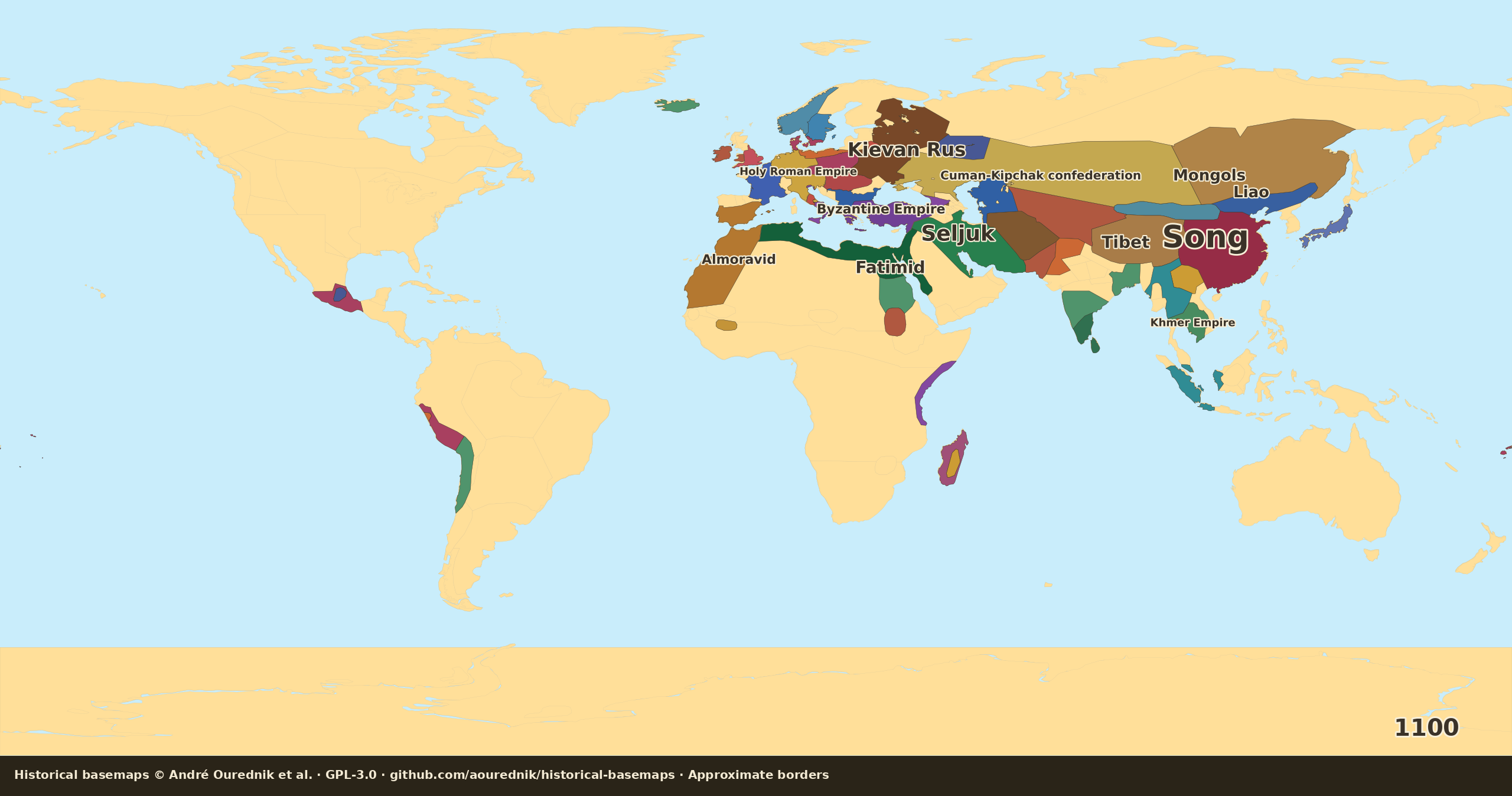
Schematic political map of the world in 1100
Historical Basemaps, André Ourednik. Map dated: 1100 CE.
Century step: 1100 André Ourednik

1100 CE

Year 1100: Baldwin is crowned in Bethlehem; in England an arrow kills William Rufus; in Rus a congress at Uvetichi; in China Huizong takes the throne.

Year 1100. Jerusalem has been in crusader hands for two years. The man they would not call king, Godfrey of Bouillon, dies in summer. At Christmas his brother Baldwin puts on the crown in Bethlehem. In England a king is killed by an arrow on the hunt. In Rus the princes, after a fierce quarrel, swear again to live in peace. In China an emperor who loves painting more than war takes the throne. To Genghis Khan: another hundred and six years.

The Holy Land

The First Crusade has already happened. In 1099 the knights took Jerusalem: cruelly, with a massacre. Godfrey of Bouillon refused to be “king where Christ wore a crown of thorns,” and took the title Defender of the Holy Sepulchre. On 18 July 1100 he dies. They argue: typhus, a wound, poison. No matter. The throne must be filled.

His brother Baldwin, until then count of Edessa, goes south. Patriarch Daimbert, Pisa’s man, wants the holy city to be ecclesiastical. The knights want a king. On 25 December in the Church of the Nativity in Bethlehem Baldwin is crowned. The Kingdom of Jerusalem appears. Nearby: Antioch, Edessa, soon Tripoli. A narrow ribbon of fortresses on a foreign shore.

Bohemond, prince of Antioch, that same year falls captive to the Danishmends. Tancred becomes regent. Haifa is taken with help from the Venetian fleet. Without Italian ships these states would have choked at once.

The Muslim world is not one. Seljuks fight each other. The Egyptian Fatimids want Palestine back. That is how the crusaders live: while the enemies have not yet fused into one Saladin, and to him almost a century.

Pope Paschal II calls new people to the East. The “crusade of 1101” will go. Later they will call it the crusade of those who funked the first time. Seljuks in Anatolia will smash them in pieces.

Europe

England. On 2 August in the New Forest on a hunt an arrow hits king William Rufus, son of the Conqueror. Officially: an accident. The shooter was supposedly the vassal Tirel; he fled at once. Younger brother Henry I does not wait for the funeral: gallops to Winchester for the treasury and in three days is crowned at Westminster. Elder brother Robert is still on crusade. So the barons will not revolt, Henry issues a “Charter of Liberties”, promises not to rob them as Rufus did. This is not the Great Charter of 1215, but the paper already exists: the king limits himself in writing.

France. King Philip I: a scandalous man; for his marriage they even excommunicated him. Real power gradually passes to his son Louis, the future Fat. The Capetians are not yet France from sea to sea, but Paris is no longer a village.

The Empire. Henry IV still quarrels with popes, an echo of the Investiture Contest. The Hohenstaufen are ahead.

Spain. The Reconquista goes on. El Cid died in 1099. The Almoravids from Africa hold the south and press Valencia. The Christian kingdoms in the north are not united, but they no longer retreat for good.

The Normans recently (1066) took England and have long sat in southern Italy and Sicily. Europe is tied by these people tighter than it seems.

Rus

Kiev is still “mother of cities,” but the throne no longer means what it did under Yaroslav. Grand Prince: Sviatopolk II Iziaslavich. Beside him stronger and wiser: Vladimir Monomakh.

In 1097 at Liubech the princes agreed: each holds his patrimony, do not trespass on your brother. They broke it at once: they blinded Vasylko of Terebovlia. War followed. In August 1100 a congress at Uvetichi. Peace. Davyd Igorevich, the main troublemaker, is judged and moved to lesser towns. On paper unity against the Cumans again. In fact the appanages harden. “Feudal” Rus is exactly these congresses: they swore, rode apart, in a year a knife in the back.

Cumans now marry daughters to princes, now burn the fringes. The Pechenegs have already been beaten. The steppe has not gone away.

Novgorod on its own. Polotsk on its own. To the Mongols: far. To Moscow as capital: farther still.

Asia

China, Song dynasty. In February Zhezong dies. His seventeen-year-old brother Huizong succeeds him, calligrapher, collector, aesthete. Kaifeng: one of the world’s largest cities, over a million with the garrison. The empire’s population about a hundred million. Gunpowder, compass, paper, printing already exist. Northern Khitans (Liao) sit at the border. The Jurchens are not yet the Jin empire. To the catastrophe of 1127, when the north will be lost, a quarter century. For now Song seems eternal and refined.

Seljuks. The great empire after Malik-Shah has sprawled into pieces: Iran, Syria, Rum in Anatolia. The Baghdad caliph under them like an honourable hostage.

Byzantium. Alexios I Komnenos: a rare emperor who knows how to wriggle free. He let the crusaders through his lands, recovered a piece of Asia Minor, did not let them sit on his neck. Constantinople is still rich and intact. The Latins will take it in a hundred and four years.

Japan. End of the Heian age. Samurai already matter more than court poets. To the first shogunate: ninety years.

Africa and beyond

Fatimids in Egypt: Shia, rivals of the Baghdad caliphs and the Seljuks. It was they who lost Jerusalem on the eve of the crusaders’ arrival.

West Africa piles up gold. America does not show its kingdoms to Europe. Vikings in America are already a forgotten episode.

What it feels like

Year 1100: the morning after a miracle that turned out to be a massacre and a state.

Europe for the first time in a long while has planted its fortress in the heart of someone else’s holy place. It thinks God is clearly for it: otherwise how could a handful of people from the edge of the world take Jerusalem? The Near East thinks otherwise: the Franks have come; we will wait; they will tear each other apart.

In England power goes to whoever galloped fastest to the treasury. In Rus power is shared by those who know how to say “peace” and not keep it. In China power is taken by brushes and silk, until from the north come people without calligraphy.

What follows:

  • 1101: smash of the “second” crusader wave in Anatolia;
  • 1111: Henry V and the pope, end of this phase of the Investiture Contest;
  • 1113: death of Sviatopolk, Kiev to Monomakh;
  • 1187: Saladin will take Jerusalem back;
  • 1204: crusaders will smash Constantinople;
  • 1206: Genghis Khan.

1100 is the year of a crown in Bethlehem and an arrow in an English forest. The holy and the accidental happen in one calendar. That is how the Middle Ages work.

World reconstruction

Source

Historical Basemaps, André Ourednik
Map dated: 1100 CE
Historical Basemaps, André Ourednik

License

GPL-3.0 licence

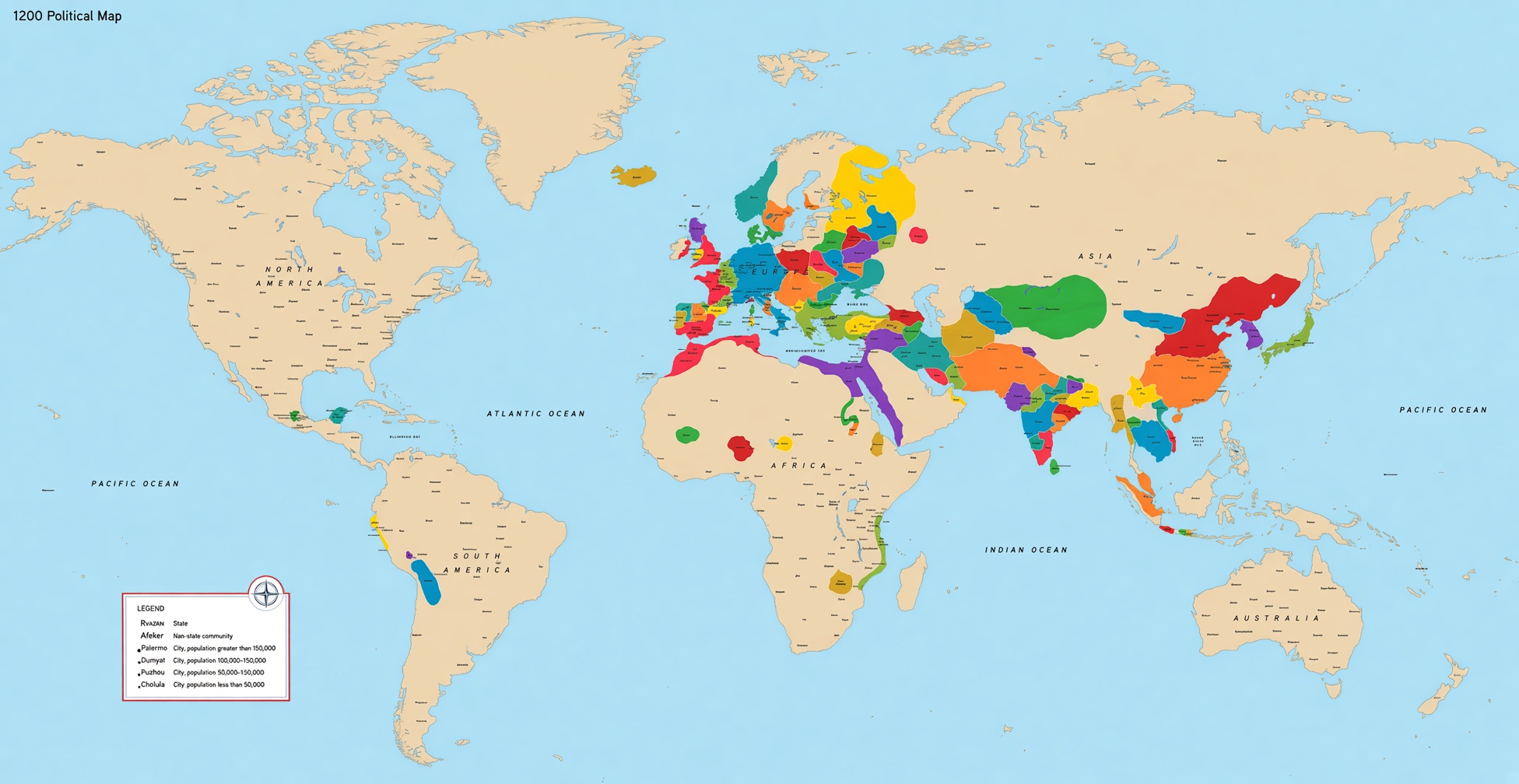
Founder-supplied political reconstruction of the world in 1200
Founder-supplied political reconstruction. Map dated: 1200 CE.
Century step: 1200 Founder reconstruction

1200 CE

Year 1200: Innocent III at his peak; the Fourth Crusade still in the preaching; Temüjin has already gathered the Mongols; in Rus, Vsevolod the Big Nest.

Year 1200. The pope in Rome is the strongest in a century: Innocent III. He is already thinking of a new crusade. In four years these crusaders, instead of Jerusalem, will take Christian Constantinople. At the other end of the steppe a man named Temüjin is not yet known to everyone as Genghis Khan. The kurultai that will make him “khan of khans” will be in 1206. In 1200 he has already gathered the Mongols into a fist and is looking at the neighbours.

Europe is dense, Gothic, confident. To the Mongols in Rus: twenty-three years. To Magna Carta: fifteen.

Europe

France. King Philip II Augustus, a rare case: a king who actually gathers a kingdom. He squeezes Normandy and other pieces from the English (that will happen in the coming years; the conflict is already on). Paris grows. The university is no longer a circle but a force. They speak Latin, argue about Aristotle, who returned to Europe through Arabic translations.

England. On the throne since 1199 John Lackland, brother of Richard the Lionheart. Richard died of a wound a year ago. John will soon quarrel with everyone: barons, pope, France. In 1215 they will put Magna Carta under his nose. In 1200 he is simply a new king with a bad temper and a leaky treasury.

Germany. An empire without a firm centre; the Hohenstaufen still hold on. On the Baltic Germans and Danes baptise and conquer pagan lands. The Sword Brothers in Livonia are already at work.

Italy. Cities grow rich on eastern trade. Venice counts ships and the crusaders’ debts, that is what will ruin Constantinople for her, or rather make her an accomplice in the sack.

Pope Innocent III meddles everywhere: coronation, marriage, heresy, crusade. He will not spare the Albigensians in southern France either, the great slaughter of heretics begins in 1209. In 1200 the church is at its peak. It seems Rome again commands kings. It seems.

In the north the Swiss Confederation is still early (1291). Norway, Denmark, Sweden live their own feuds. The Hansa is still forming.

Byzantium and the crusading wind-up

In Constantinople the Angelos dynasty. The empire is weak after Manzikert long ago and after its own coups. Bulgaria under Kaloyan again beats the Greeks. Cumans raid. Emperor Alexios III hangs on intrigue.

The pope writes of church union and of a campaign. The Fourth Crusade has been preached since 1198. Officially the goal: Egypt, then Jerusalem. In fact there will not be enough money to pay Venice for the ships. Debt, the cunning doge Dandolo, a runaway Byzantine prince: and in 1204 the Latins will take and sack the second Rome. In 1200 you can still not know that. You can preach a holy cause and not see where it will turn.

The Holy Land. Jerusalem since 1187 with Saladin and his heirs. The crusaders keep a narrow coastal strip: Acre, Tyre. Richard’s Third Crusade almost returned the city, did not. The truce is rotting.

The steppe: the future Genghis Khan

In Mongolia Temüjin has already beaten the main enemies among his own: Merkits, Tayichiuds, part of the Keraites. He is not yet master of the world. He is a leader who knows how to divide loot not only by clan but by loyalty. That is a new mechanic of the steppe.

China to his north: the Jin empire, the Jurchens who once humiliated the Mongols. To the west: the Tanguts of Xi Xia. South of Jin: the Chinese Song empire, rich and vulnerable. In 1200 the map is still the old one. In twenty years it will be unrecognisable.

Rus

Kiev has long not been the only centre. Strongest of all in the northeast is the Vladimir-Suzdal land. In Vladimir, Vsevolod the Big Nest: the most powerful prince of Rus at this hour. Novgorod trades, the veche noise, invites and expels princes. Galicia-Volhynia looks to Hungary and Poland. Chernigov, Smolensk, Polotsk: their own thrones, their own quarrels.

Cumans now father-in-law, now enemy. To the Kalka of 1223, where Russians and Cumans together will fall under the reconnaissance of Jebe and Subutai, still a generation. In 1200 the princes cut each other as usual. Batu’s invasion does not haunt their dreams.

Orthodoxy their own, after the schism of 1054 with Rome. The pope is far. The steppe is close.

Asia further

China is cut in two. North: Jin. South, Song: canals, cities, paper, gunpowder, river fleets. The most advanced economy in the world. It does not know that the Mongols are learning to take cities.

Japan. Just now, in 1192, Minamoto no Yoritomo became shogun. The Kamakura shogunate: there is an emperor, a military house rules. Samurai are no longer just servants but a stratum.

Near East. After Saladin the Ayyubids divide Syria and Egypt. The Baghdad caliph still sits, but that is more shrine than power. To Hulagu and the burning of Baghdad, 58 years.

India. In the north the Muslim Delhi Sultanate is only getting on its feet after the Ghurid campaigns. The south: its own Hindu kingdoms.

Cambodia. Angkor still lives; the Khmer empire is huge, but no longer eternal.

Africa and the Americas

Egypt: the centre of the Islamic world by money and grain. The Maghreb has its own dynasties. In the Sahel proto-states form, from which Mali will later come.

In Mexico the Toltecs are already past, the Aztecs not yet an empire. In the Andes their own cultures. Vikings in Vinland were two hundred years ago and left. For Europe the western ocean is an edge, not a road.

What it feels like

Year 1200: a high moment of the European Middle Ages: cathedrals up, the pope loud, the knight still main in the picture. And at the same time, silence before two hurricanes: crusaders will strike their own Greeks, the steppe will strike everyone.

A merchant in Venice counts interest on the fleet. A prince in Vladimir counts sons. A monk in France preaches the Holy Sepulchre. Temüjin counts horses. None of them reads one newspaper. In thirty years the map from Kiev to Beijing will be common, in blood.

What follows:

  • 1202-1204: the Fourth Crusade and the sack of Constantinople;
  • 1206: Genghis Khan;
  • 1209: the Albigensian Crusade;
  • 1215: Magna Carta and the Mongol capture of Jurchen Beijing;
  • 1223: Kalka;
  • 1237-1240: Batu in Rus;
  • 1258: Baghdad.

1200 is the last quiet year when you could pretend the world consisted of familiar neighbours. The steppe has already gathered. The pope has already sent preachers. The ships are already ordered.

World reconstruction

Source

Founder-supplied political reconstruction
Map dated: 1200 CE

License

Founder-supplied image

Schematic political map of the world in 1300
Historical Basemaps, André Ourednik. Map dated: 1300 CE.
Century step: 1300 André Ourednik

1300 CE

Year 1300: the papal jubilee in Rome; Philip the Fair already squeezes the church; Osman bites the Byzantine edge; the Mongol Empire is still huge, but already in shards.

Year 1300. The pope declares a jubilee: come to Rome, we will remit sins. So many people that on the bridge they set up one-way traffic. On the surface the church is at the summit. In fact the king of France is already preparing a slap for it. The Mongol Empire is still huge, but no longer one whole. In a corner of Asia Minor a small bey named Osman bites the Byzantine edge. From that scrap will later grow an empire that will eat Constantinople.

There is no plague yet. No printing. No America for Europe. The age of crusades has almost run out of breath: the Holy Land was lost already in 1291.

Europe

France under Philip IV the Fair. The king is handsome, the state is hard. He needs money for war with England and with Flanders, rich cloth towns that do not want to be merely a French cashbox. He taxes even the church. The pope rages.

England. King Edward I, “Hammer of the Scots.” William Wallace has already been executed (1298). Scotland has not surrendered; Robert Bruce is still ahead. In 1300 the Swedes plant the fortress Landskrona at the mouth of the Neva, opposite the future Petersburg. The Novgorodians will later smoke them out.

Italy is sliced into city-states. The Florentine florin is already counted in foreign lands, a rarity for money then. Dante has not finished the Comedy yet, but already lives in this politics of knives and exile. Sicily after the “Vespers” of 1282 is still an apple of discord between Anjou and Aragon.

Pope Boniface VIII stages the first great jubilee year. Rome earns on pilgrims. The pope himself appears now in priest’s vestments, now almost as emperor: spiritual power, he says, is above royal. In three years Philip the Fair’s men will seize him at Anagni. Boniface will not survive the humiliation. Then the popes will long be dragged to Avignon. 1300 is a parade portrait of a power that has already cracked.

Germany: Holy Roman Empire without a firm hand. The Habsburgs are not yet what they will become.

On the Pyrenees their own kingdoms: Castile, Aragon, Portugal, and in the south still the Emirate of Granada, the last scrap of Muslim Spain. Bilbao is founded around this year. To Columbus almost two centuries.

Byzantium and the Turks

Constantinople the Greeks recovered already in 1261, driving out the Latin crusaders. The empire is a stump: the capital, scraps of Greece, western Asia Minor. No money. They hire whoever turns up.

Around 1300 in Bithynia, not far from Nicaea and Nicomedia, rises the beylik of Osman. This is one of many Turkish appanages after the collapse of the Sultanate of Rum. Osman beats Byzantine detachments, settles on villages, does not yet storm the capital. In two years will be the battle of Bapheus. In a century and a half his descendants will take Constantinople. In 1300 it looks like a border gang, not like world history.

The Mongols

Genghis Khan’s empire is formally still from Korea to the steppes by Rus, but it is already four big pieces:

  • in China: the Yuan dynasty, heirs of Kublai. Capital Dadu, the future Beijing. Chinese live under them, sit exams, seethe. To the expulsion of the Mongols and the Ming, 68 years;
  • in the steppe and over Rus: the Golden Horde;
  • in Iran: the Hulaguids, already weakening;
  • in the Chagatai ulus: its own mess.

Mongols still go on campaigns: Syria, Burma. But this is no longer “the whole world at one kurultai.” These are shards with one name.

In Rus princes ride to the Horde for yarlyks. In 1300 or 1301 they gather at Dmitrov, a rare congress, against the background that in the Horde dual power has just collapsed: Nogai, the mighty temnik, has died. Grand Prince of Vladimir in these years: Andrei Alexandrovich, son of Alexander Nevsky, not the most beloved character among descendants. Moscow is not yet first. Tver is stronger. Kalita is ahead.

Novgorod trades with the Hansa. Kiev has long not been the capital.

Asia further

India. The Delhi Sultanate. Muslim sultans hold the north; the south is still its own. Mongols were beaten back from Delhi quite recently.

Japan. Kamakura shogunate. Japan beat off the Mongol fleets of 1274 and 1281: helped by the “divine wind,” the typhoon. To a new turmoil not far.

Southeast Asia: on Java Majapahit rises. The Mongol landing there in the 1290s ended in disgrace.

Africa and beyond

In West Africa the Mali Empire gathers strength. In twelve years Mansa Musa will go on hajj and shower Cairo with gold so that prices there will be knocked sideways for years.

The Mamluks in Egypt: the only ones who in the thirteenth century stopped the Mongols in open field (Ain Jalut, 1260). They also drove the crusaders out of Acre.

America lives by its own kingdoms. The Aztecs are not yet those, the Incas not yet those. Europe has no one to tell it about this.

What it feels like

Year 1300: a jubilee on a crack.

The pope sells forgiveness in Rome and quarrels with a king who has a better army and a worse conscience. Florence mints a coin that foreign merchants trust. Osman herds sheep and cuts border fortresses. The Horde still collects tribute from Russian princes, but can no longer strike to one end of Eurasia as under Batu.

People live densely: Europe after two calm centuries is cramped again; forests are cut, cities grow. That is exactly why in half a century the plague will cut so many, there is someone to cut.

What follows:

  • 1302: the “Matins of Bruges” and the Battle of the Spurs: Flemish townsmen beat French knights;
  • 1303: a slap to the pope at Anagni;
  • 1307-1314: the destruction of the Templars;
  • 1337: start of the Hundred Years’ War;
  • 1347: the Black Death in Europe;
  • 1368: Ming drives the Mongols from China;
  • 1453: Ottomans take Constantinople.

1300 is the year when the Middle Ages still stand in full vestments and you can already hear the seams crack. A pilgrim in Rome thinks he has defended his soul. A king in Paris thinks he has defended the treasury. Osman thinks about the next valley. All three are right for their short term.

World reconstruction

Source

Historical Basemaps, André Ourednik
Map dated: 1300 CE
Historical Basemaps, André Ourednik

License

GPL-3.0 licence

Schematic political map of the world in 1400
Historical Basemaps, André Ourednik. Map dated: 1400 CE.
Century step: 1400 André Ourednik

1400 CE

Year 1400: Timur drives into Syria; in Europe two popes and the Hundred Years' War; Vasily I's Moscow between the Horde and Lithuania; in China Zhu Di fights for the Ming throne.

Year 1400. Europe is still medieval to the bone: the plague has not long passed, the Hundred Years' War is not over, the church has two popes at once. And the main man of the year does not live in Paris or Rome. His name is Timur, in Europe: Tamerlane. The lame man from Samarkand who in thirty years built an empire from Delhi to Damascus and is now driving into Syria.

Columbus is not even a project yet. A hundred years until Cabral's Brazil. The world is not yet "discovered." It is already big: Europe simply knows a piece of it.

Europe

England. King Richard II was deposed a year ago and, most likely, starved to death in a castle. On the throne sits his cousin: Henry IV, the first Lancaster. The country is boiling. In Wales Owain Glyndŵr rises: a long revolt, his own almost-country, war with the English for years ahead.

France in the Hundred Years' War. The English still hold pieces. Fifteen years until Agincourt (1415). King Charles VI is at times not himself, literally: fits of madness. The dukes of Orléans and Burgundy already hate each other. Soon this will become a civil war inside the French war.

The church is split. They call it the Great Schism: one pope in Rome, another in Avignon. Both curse each other. For an ordinary person it looks like this: unclear whose mass is the right one, and an indulgence can be bought from both.

The Holy Roman Empire: a set of princes. Bohemia on the eve of the Hussite wars, but Jan Hus still preaches, does not burn.

In the north the Hanse trades herring and cloth. In the east Poland and Lithuania are already linked by personal union: one man, Jogaila, is king of Poland, and his cousin Vytautas is grand duke of Lithuania. Together in ten years they will smash the Teutonic Order at Grunwald. In 1400 that is still being prepared.

Byzantium is living out its days. Constantinople: a capital without an empire, the Ottomans already around it. In 1400 the Turks could have finished the city earlier, but Timur climbs onto their necks. That will accidentally gift Constantinople another half-century.

Timur and the Near East

Timur is not Chinggis Khan and not "just a Mongol." He is a Turk from Mawarannahr, lame, literate in his own way, cruel as a force of nature. The capital is Samarkand, which he rebuilds with pyramids of skulls and blue domes.

In 1398 he already sacked Delhi. In 1395 he crushed Tokhtamysh, khan of the Golden Horde, and burned Yelets on the edge of the Russian lands. In 1400 it is Syria's turn, then under the Mamluks of Egypt.

He takes Sivas, Aleppo. People are killed by the tens of thousands; craftsmen are driven off to Samarkand. In 1401 there will be Damascus and slaughter again. In 1402 at Ankara Timur will smash the Ottoman sultan Bayezid the Thunderbolt and take him prisoner. The Ottoman Empire will fall apart for ten years into a war of sons. Europe will later say "thank you to the barbarian": without that victory the Turks might have taken Constantinople not in 1453.

Timur himself will die in 1405 at Otrar on the road to China. The empire will almost immediately crumble. But in 1400 he seems a man to whom the map is no law.

The Russian lands

Moscow. Grand Prince Vasily I, son of Dmitry Donskoy. Kulikovo Field is already twenty years past, but the Horde has not vanished, it is simply sick.

The Golden Horde after Timur's smashings is in disarray. Khans change; often the temnik Edigu holds power. Moscow can breathe a little easier, but the yarlyk and the tribute have gone nowhere. In 1408 Edigu will still come and burn everything around Moscow.

The main neighbour to the west is not the Horde, but Vytautas's Lithuania. Vytautas has already almost swallowed Smolensk (the finish, in 1404). Vasily is married to Vytautas's daughter, and that does not stop them a few years later from standing armies against each other on the Ugra, and parting without a great battle.

Novgorod is still its own, Tver is still alive, Ryazan is still separate. There is no "Russia" in our sense. There is Moscow, already the strongest of the Russian seats, but not the only one.

Asia further on

China. The Ming dynasty replaced the Mongol Yuan only a little over thirty years ago. Now civil war: the uncle, Prince of Yan Zhu Di, fights the nephew-emperor. In 1400 at the Baihe River Zhu Di smashes the imperial army. In two years he will take Nanjing, become the Yongle Emperor, move the capital to Beijing and start building the Forbidden City. His admiral Zheng He will later lead a huge fleet into the Indian Ocean. In 1400 that is not yet a fleet, but a civil war.

The Ottomans at their peak before Timur: the Balkans under them, Constantinople in a ring. After Ankara 1402: a pause.

India. Delhi after Timur is in ruins. The Delhi Sultanate has not died, but its spine is broken.

At Malacca around this time Parameswara founds a port that will become the main spice crossroads of Southeast Asia. In a hundred years the Portuguese will come here.

Japan in its fragmentation. The Ashikaga shoguns weaken; the princes are stronger than the centre.

Africa and the Americas

In Egypt the Mamluks: a military caste that has ruled for a century and a half. They are just getting their faces smashed by Timur in Syria.

In West Africa the great Sahel kingdoms are still alive; gold goes across the Sahara to the Mediterranean. The Portuguese will take Ceuta only in 1415. There is no ocean route around Africa.

In the Americas their own empires are forming or in strength: the Aztecs already collect tribute in Mexico; the Incas in the Andes are only beginning their great push. More than a century until the Europeans. For them 1400 is simply their own year.

What it feels like

Year 1400: the year when the most terrifying man on earth rides from Samarkand to Aleppo, and in London a new king is not sure he will sit until winter.

The plague of the fourteenth century no longer mows down half a street at a time, but the world after it is thin: fewer people, lands empty, prices and manners shifted. Knights still in armour, but gunpowder is no longer a toy. There is no printing. News travels for months.

Europe is busy with itself: two popes, two dynasties, one endless war. Asia is busy with Timur and dynastic change. Africa and the Americas live by their own calendars.

What follows

  • 1402: the Ankara catastrophe of the Ottomans;
  • 1405: Timur's death, Zheng He's first voyage;
  • 1410: Grunwald;
  • 1415: Agincourt and Portuguese Ceuta;
  • 1453: the fall of Constantinople.

1400: the last great year when a man from the steppe could with one campaign put on pause the Turks, and the Egyptian sultans, and someone else's China in his plans. After him an empire of that scale could no longer be glued together from one saddle. What remained would be states with a chancery, a cannon and a fleet. Timur will not live to see that. In 1400 he is still in the saddle.

World reconstruction

Source

Historical Basemaps, André Ourednik
Map dated: 1400 CE
Historical Basemaps, André Ourednik

License

GPL-3.0 licence

Schematic political map of the world in 1500
Historical Basemaps, André Ourednik. Map dated: 1500 CE.
Century step: 1500 André Ourednik

1500 CE

Year 1500: Cabral "finds" Brazil on the way to India; Ivan III beats Lithuania at Vedrosha; in Italy the French and the dukes cut each other over cities; the Reformation is not yet here.

Year 1500. Europe still thinks it stands at the centre of the world. In fact the Portuguese have already rounded Africa; Columbus has already bumped into America and to his death was sure it was Asia. This year another fleet goes to India for pepper, and on the way "finds" Brazil. In Moscow Ivan III wrings land from Lithuania. In Italy the French and local dukes cut each other over cities. The Reformation is not yet here. Luther is still a monk, not a blast packet.

Europe

This is already not quite the Middle Ages and not yet that "new age" later called the Early Modern period.

Italy is the main stage. French king Louis XII pushes into Lombardy. In April at Novara they seize the Milanese duke Ludovico Sforza, the same one who commissioned Leonardo. Milan is French again. Popes, Venice, the emperor: all in this mess with their own knives.

The Holy Roman Empire: a patchwork quilt of princes. At Augsburg the Reichstag tries to bring at least some order to courts and circles. It works on paper.

Spain after Isabella and Ferdinand has already expelled the Jews and the Muslims from the Emirate of Granada, holds a ton of American "not-yet-understood" shore and argues with Portugal whose ocean it is.

The church is huge, rich, used to selling indulgences and living like a court. Seventeen years until the Reformation hits it. For now everyone is still one Western church, if you do not count the long-since-split Orthodox East.

They print books. Artists in Italy already paint not only saints face-on. Leonardo, Michelangelo, Raphael: these very years. But for a peasant in the field year 1500 looks like year 1400, only the taxes are different.

The sea: why Brazil at all

Portuguese king Manuel I already knows: Vasco da Gama in 1498 reached India around Africa. Spices are money you do not have to hand to Venetians and Arab middlemen.

On 9 March 1500 a second great fleet leaves Lisbon for India: 13 ships, about twelve hundred men, commander: Pedro Álvares Cabral, a nobleman, not a great sailor, but one of their own. With him experienced captains, including Bartolomeu Dias, the one who first rounded the south of Africa.

To catch the right wind they swing far west in the Atlantic. On 22 April they see a mountain. That is the shore of future Brazil. Cabral decides: the land is on the Portuguese side of the Tordesillas line (Spain and Portugal drew it in 1494: "west for you, east for us"). He plants a cross, writes the king, sends one ship back with the letter. They meet the locals, exchange gifts. Then the fleet goes on to Africa and India as planned.

The Spanish that same year are also poking about that shore: Pinzón already in January bumps into the north of Brazil. Who was "first": historians will argue later. Politically the paper won: Brazil will be Portuguese, the rest of the big chunk of America: Spanish. No one yet knows how huge the continent is. Columbus is still alive and still confuses the islands with Asia.

In India Cabral will fare badly: at Calicut the factory is massacred, he answers with fire on ships, leaves for another prince, loads pepper and returns with an incomplete fleet. The scheme for years ahead: trade plus cannon.

Russia

The sovereign is Ivan III, later called the Great. He has already gathered around Moscow Tver, Novgorod, a pile of principalities, stopped bowing to the Horde. A double-headed eagle on the seal, a brick Kremlin, a wife who once was the Byzantine princess Sophia Palaiologina, hence the habit of feeling like a "Third Rome," though those words come a little later.

In 1500 war with the Grand Duchy of Lithuania. The reason is simple: several princes from the borderlands defect to Ivan together with their towns. Lithuania calls that theft of vassals. Ivan does not wait and strikes first.

On 14 July on the Vedrosha River, not far from Dorogobuzh, the Russians smash the Lithuanian army. Hetman Ostrogski himself is taken prisoner. The war will last until 1503. Moscow will take a chunk of lands to the west: Chernihiv, Novhorod-Siverskyi and more. This is not "annexation of Ukraine" in the modern sense. It is the gathering of pieces of former Rus that for two hundred years sat under Vilnius.

In the south the ally is the Crimean khan. In the northwest Livonia will soon push in. The country is not yet Peter's empire and not "Russia" on every European map, but already not a set of appanages.

Asia

The Ottomans. Sultan Bayezid II. The Turks finish off Venetian scraps in Greece, fight at sea. Constantinople has been Turkish for half a century. A generation yet until Suleiman the Magnificent.

Iran. In a year, in 1501, young Ismail of the Safavid house will take Tabriz and start a Shia empire. In 1500 that is still being prepared: nomads, an order, luck.

In Central Asia the Uzbek khan Muhammad Shaybani takes Bukhara and Samarkand. Timur's heirs weaken.

India. The Mughal Empire is not yet here (Babur will come in 1526). In the north the Delhi Sultanate is living out its days. On the Malabar coast: princes like the Zamorin of Calicut, through whom the pepper goes. The Portuguese are only wedging in.

China. The Ming dynasty. Emperor Hongzhi. The country is rich, huge; it has already cooled toward Zheng He's distant voyages. To Europe it is almost invisible; to itself it seems the Middle Kingdom.

Japan in fragmentation; a hundred years until Tokugawa unification.

The Americas, still without the word "colony"

The Aztecs in Mexico at their peak: Tenochtitlan, a huge city on water. The Incas in the Andes hold an empire from the mountains to the shore. Neither knows that in twenty to thirty years people will come with horses, smallpox and a thirst for gold. Cortés will land in 1519. For now 1500 for them is their ordinary year of wars and tribute.

The Caribbean already burns with plague and slavery: Columbus and his heirs have broken the world on the islands. The mainland is still almost untouched.

What it feels like

Year 1500: the year when the world map cracks, and in most people's heads it is still round the old way: Jerusalem in the centre, the edge of the earth somewhere beyond Portugal.

The king in Lisbon counts pepper. The king in Castile counts islands. The prince in Moscow counts towns along the Desna. The pope counts indulgences. The artist in Florence counts the proportions of the body.

No one this year says "we live on the threshold of globalisation." They say: monsoon, heresy, patrimony, spice, a cross on a new shore.

What follows

  • 1501: the Safavids in Iran;
  • 1503: peace of Moscow and Lithuania, end of this war;
  • 1517: Luther and the 95 theses;
  • 1519-1521: Cortés and the end of the Aztecs;
  • 1522: Magellan's ship will circle the earth.

1500: the year Brazil entered the European notebook almost by accident, and Vedrosha proved that Moscow was already not Vilnius's younger brother. The ocean became a road. The land between Smolensk and Bryansk, too.

World reconstruction

Source

Historical Basemaps, André Ourednik
Map dated: 1500 CE
Historical Basemaps, André Ourednik

License

GPL-3.0 licence

World political reconstruction of 1648, used for the 1600 step
Babelia, Wikimedia Commons. Map dated: 1648 CE.
Century step: 1600 Babelia Nearest openly licensed map, not an exact year sheet.

1600 CE: nearest map: 1648

Year 1600, Japan ends the civil wars at Sekigahara; England grants the East India Company its charter; in Rome they burn Bruno; in Moscow Boris Godunov, and the country does not yet know about the famine and the Time of Troubles.

Year 1600. Japan ends a century and a half of civil wars with one battle. England issues merchants a paper for trade with India, from this an empire will grow. In Rome on a square they burn a monk for ideas about an infinite cosmos. In Moscow Boris Godunov rules: he is not of the old Rurikid dynasty, and the country does not yet know that in a year a terrible famine will begin, and then the Time of Troubles.

Europe

  • 17 February, Rome, Campo de' Fiori. Giordano Bruno is burned: a monk, a philosopher. The Inquisition tried him for heresy: he said the Universe is infinite and there are many worlds, and he refused to recant. The pyre is public. Nine years later, in 1609, Galileo will assemble a spyglass, point it at the sky and see mountains on the Moon and the moons of Jupiter. That is, the ideas for which Bruno was executed will soon begin to be tested with instruments. Galileo himself will fall under church trial much later, in 1633.
  • 31 December. Queen Elizabeth I of England signs the charter of the English East India Company. This is not a state, but a society of merchants: the queen gives them a monopoly to trade "east of the Cape of Good Hope", that is, with India and beyond. At first spices and cloth. Later this company will hold whole regions of India and collect taxes there. The Dutch will create their East India Company in 1602 and at once begin to push the Portuguese off the spice islands.
  • France: King Henry IV has already reconciled Catholics and Protestants with the Edict of Nantes (1598). In 1600 he fights Savoy over the town of Saluzzo. At the same time the French try to dig in in Canada: the king grants a captain the right to the fur trade; the Tadoussac factory appears.
  • Sweden: at Linköping in Holy Week supporters of King Sigismund (also king of Poland) are executed. Power is taken by his uncle Charles: soon he will become Charles IX.
  • Near Prague the astronomers Tycho Brahe and Johannes Kepler meet. One has the best star observations in Europe, the other a new mathematics of orbits. From this meeting the laws of planetary motion will later come.
  • Spain still seems Europe's first power: silver from America, huge colonies, a "golden age" of painting and literature. But the treasury is already leaky. Portugal since 1580 is under one crown with Spain: they call it the Iberian Union.

Russia

The tsar is Boris Godunov. The last legitimate Rurikid, Fyodor Ivanovich, died in 1598 without children. The Zemsky Sobor chose Boris: he was Fyodor's brother-in-law and for many years in fact ruled under him. For many boyars he is "not the right" tsar, not of the old dynasty.

Godunov strengthens the southern border (the fortress Tsaryov-Borisov is built), pushes Russians into Siberia, thinks of bringing scholars from the German lands to Moscow and even something like a university. It will go badly: distrust gets in the way, and the fact that the country is about to fall into trouble.

Among the noble families he fears are the Romanovs. They are kin of Ivan the Terrible's first wife. In 1600-1601 a case of "witchcraft" against the tsar is brought against them. The head of the house, Fyodor Nikitich Romanov, is forcibly tonsured as a monk and given the name Filaret. That is how they removed a dangerous man without execution: he is alive, but as a boyar and a possible claimant to influence: destroyed. His wife too is sent to a convent.

The irony of history: in a few years the Time of Troubles will begin, the Godunovs will perish, and this very Filaret will become patriarch, and his son Mikhail in 1613 will become the first tsar of the Romanov dynasty. In 1600 Godunov was simply clearing the field.

Already close is something else: from 1601 three years in a row there will be crop failure and famine. Hundreds of thousands died. After that the pretender False Dmitry will appear, and the state will for a time almost fall apart. In 1600 itself this is not yet visible, only a taut silence.

Asia

Japan. 21 October: the Battle of Sekigahara. For a century and a half the princes cut each other (the Sengoku age). The country was almost gathered by Oda Nobunaga and Toyotomi Hideyoshi, but Hideyoshi died in 1598, leaving a young son. The regents fell out.

In the narrow valley of Sekigahara two coalitions of vassals meet: the "eastern" headed by Tokugawa Ieyasu and the "western" headed by Ishida Mitsunari. Fog, mud, a few hours of fighting. Betrayal decides it: part of the western army (Kobayakawa) goes over to Tokugawa. The west is smashed; Ishida is later executed.

Ieyasu after that is master of Japan. He will take the title of shogun in 1603. The Edo age will begin: the capital in effect in Edo (future Tokyo), peace inside the country for almost 250 years, tight control of the princes. For Christians and Portuguese traders this is not good news. Later Japan will almost close itself from the outside world.

By the way, Tokugawa in this war had European cannons. In spring 1600 the Dutch ship Liefde reached Japan. Of the whole crew about two dozen remained alive, among them the Englishman William Adams. His cannons came in handy. Adams would later stay in Japan forever.

China. The Ming dynasty still rules, but already weakens: embezzlement, heavy taxes; in the north the Manchus rise. They will set up the new Qing dynasty in 1644.

India. The Mughal Empire under Padishah Akbar, one of the richest powers in the world. Akbar will die in 1605. The court relatively tolerant in religion, the treasury huge.

The Ottoman Empire still huge, but Suleiman's best years are behind. The neighbour: Shia Safavid Iran, the eternal opponent.

The Americas and the seas

  • On 19 February in Peru the volcano Huaynaputina explodes: one of the strongest eruptions in the history of South America. Ash for years, crop failures. Some link this also to the famine in Russia of 1601-1603 (through cooling), though that is disputed.
  • Brazil is already a Portuguese sugar colony: plantations, slaves from Africa. Spanish America lives on the silver of the Potosí mines. The empires of the Aztecs and Incas are long gone.
  • The Dutch sail around the world. Off Manila van Noort sinks a Spanish galleon.

What it feels like

Year 1600: already not the Middle Ages, not yet "our" seventeenth century with the scientific revolution and absolutism in full form.

A merchant company gets from the queen the right to do business like a little state. Japan in one day chooses who will rule for two and a half centuries. The church executes a man for the cosmos, and in the same Europe they are already assembling lenses. Moscow tries to look like a solid tsardom and at the same time cuts its own boyars down to the root.

What follows

  • 1601-1603: famine in Russia;
  • 1603: Ieyasu officially shogun; in England Elizabeth will die, the crown goes to James, personal union of England and Scotland;
  • 1605: Godunov's death, the start of the full Time of Troubles;
  • 1618: the Thirty Years' War in Europe.

1600: the year of a charter for the ocean, a pyre on a Roman square and six hours in a Japanese gorge. Who won the field: set the rules of the land. Who issued the paper for spices, set the rules of the sea.

World reconstruction

Source

Babelia, Wikimedia Commons
Map dated: 1648 CE
https://commons.wikimedia.org/wiki/File:World_map_1648.png

License

CC BY 4.0

Schematic political map of the world in 1700
Historical Basemaps, André Ourednik. Map dated: 1700 CE.
Century step: 1700 André Ourednik

1700 CE

Year 1700: the Great Northern War begins; at Narva the Swedes beat the Russians; the last Spanish Habsburg dies, Europe prepares to divide an empire; Peter is already aimed at the Baltic.

Year 1700. Europe switches to a new calendar. In the north three countries decide that the young Swedish king is easy prey. In the west the childless king of Spain dies, and the whole continent prepares to divide his empire. In Russia Peter has just made peace with the Turks and at once pushes into the Baltic. The year begins as a calculation. It ends with the Russians smashed at Narva.

Europe: two wars at once

The Great Northern War begins

Sweden in 1700 is the great power of the Baltic. It holds Finland, Estonia, Livonia (roughly today's Estonia and Latvia), Ingria (the land around future St Petersburg) and chunks of northern Germany. King Charles XII is only 18. The neighbours think: a boy, now we take the shore.

Against Sweden a coalition forms:

  • Denmark-Norway,
  • Saxony and the Polish-Lithuanian Commonwealth (they share one ruler: Augustus II the Strong),
  • Russia of Peter I.

In February the Saxons without a declaration of war push toward Riga. The Danes strike Sweden's ally in Holstein.

Charles does not lose his head. In summer he suddenly lands near Copenhagen. Denmark quickly asks for peace (Travendal, August) and exits the war. The English and Dutch even help with a fleet: they need a quiet Baltic, because in the west another war is about to flare.

Peter learns that peace with the Ottoman Empire has finally been concluded for 30 years, and on 30 August 1700 declares war on Sweden. The pretext simple for the people: the Swedes once insulted the tsar in Riga. The real goal: to win back access to the Baltic Sea, lost already in the Time of Troubles.

The Russian army: large, poorly trained, with foreign commanders. It besieges the Swedish fortress of Narva. Charles drops Denmark, drives the army into Estonia. On 30 November 1700 (new style) about 10 thousand Swedes beat 30-40 thousand Russians. Storm, snow, panic, the cannons surrender. Peter by then has already left the camp, he left the army to Field Marshal de Croÿ. Total shame.

Charles decides Russia is no longer dangerous and goes off to beat Augustus in Poland. That is a nine-year mistake. In 1709 there will be Poltava. In 1721 Sweden will lose great-power status; Russia will get the Baltic and become an empire. But in 1700 itself the only winner is the eighteen-year-old Swede.

The Spanish Succession: a time bomb

On 1 November Charles II of Spain dies. The last Spanish Habsburg, childless, ill. In the will the throne goes to Philip of Anjou, grandson of French king Louis XIV. Louis accepts the crown for his grandson: he becomes Philip V.

Spain then is not only Spain. It is southern Italy, the Spanish Netherlands, huge America. If France and Spain end up under one family roof, the rest of Europe will choke. England, Holland, Austria will not stand it. The War of the Spanish Succession will begin in 1701 and last until 1714.

In November the Elector of Brandenburg agrees with the emperor: for help in the coming war he will be raised to king of Prussia. The coronation: in 1701. So is born the kingdom from which Bismarck's Germany will later come.

The calendar

From 1 January Protestant Western Europe (except England) switches to the Gregorian calendar, the one we use now. The Julian was already behind by 10-11 days. Russia that same day begins to count years "from the Nativity of Christ," not "from the creation of the world," as in Byzantium. Peter will introduce the Gregorian calendar itself only in 1918: not he, but the Bolsheviks; in 1700 they simply change the year-count point and move New Year to 1 January.

Russia

Peter I has ruled for a long time already, but these very years make him a "European" tsar. The Great Embassy has just ended: he himself went to learn shipbuilding in Holland and England. After the 1698 revolt he crushed the streltsy cruelly. He cuts beards, builds a fleet.

Narva 1700 is humiliation. Peter does not break: he starts forging the army anew, casting cannons, building a fleet. In three years he will found St Petersburg, on land that still has to be won.

Asia

China. The Qing dynasty, Emperor Kangxi. The country after the Manchu conquest is already relatively calm, huge, strong. For Beijing Europe is distant exotica, not an equal partner.

India. The Mughal Empire after Akbar and Aurangzeb begins to crack: too big, too many wars. The European companies (English, Dutch, French) still sit in the ports and trade, do not rule.

The Ottoman Empire recently lost a big war with the Austrians (Treaty of Karlowitz 1699). They will not take Vienna again. Still an empire, but no longer the one of Suleiman's day.

Japan is closed. The Tokugawa shogunate. Foreigners almost forbidden, Christianity banned. Two and a half centuries of relative internal peace continue.

The Americas and the ocean

On 26 January off the Pacific shore of North America, the monstrous Cascadia earthquake (about magnitude 9). A tsunami crosses the ocean to Japan. Europeans on the spot barely record it: there are still few colonies there.

English, French, Spanish colonies in America already stand. Sugar from the Caribbean, furs of Canada, silver of Mexico and Peru. Slave labour from Africa: an ordinary part of this machine. In Pennsylvania William Penn begins to speak of freeing Black people, that is still a rarity and a circle, not imperial policy.

Brazil gives Portugal more and more gold (Minas Gerais is just ramping up in these years).

World population: on the order of 600-700 million. More than half: in Asia.

What it feels like

Year 1700: the year when the old empires still look eternal, and the new ones are already coming through the door.

Sweden seems invincible, and in twenty years it will be shoved off the Baltic. Spain seems worldwide, and its inheritance will be torn apart by war. Russia seems backward, and after Narva Peter will make a life programme out of defeat.

Louis XIV is still the "Sun King," but France will soon be worn down by the war for the Spanish crown. Newton has already written the Principia, science exists, but kings still decide everything with cannons.

What follows

  • 1701: the War of the Spanish Succession and the Kingdom of Prussia;
  • 1703: the founding of St Petersburg;
  • 1707: England and Scotland will become Great Britain;
  • 1709: Poltava;
  • 1714: end of the war for Spain, the Hanoverians on the British throne;
  • 1721: the Treaty of Nystad, Russia declares itself an empire.

1700: the last year when one could pretend the Baltic was forever Swedish and Moscow forever far from Europe. After Narva Peter hated that pretence. Charles decided he had won. Both were wrong about the timing.

World reconstruction

Source

Historical Basemaps, André Ourednik
Map dated: 1700 CE
Historical Basemaps, André Ourednik

License

GPL-3.0 licence

Schematic political map of the world in 1800
Historical Basemaps, André Ourednik. Map dated: 1800 CE.
Century step: 1800 André Ourednik

1800 CE

Year 1800: Napoleon is still consul: Marengo almost lost and won in a single day; the US capital moves to Washington; Paul I quarrels with his allies and leans toward Bonaparte.

Year 1800. Napoleon is not yet emperor: he is First Consul, the man who has already taken power in France after the Revolution. In June he nearly loses a battle in Italy and wins it the same day, and after that he is almost impossible to remove. In America they haul the capital to a half-built Washington. In Russia Paul I quarrels with yesterday’s allies and flirts with Bonaparte. A little over a year remains until Paul’s murder.

Europe and Napoleon

France after the coup of 18 Brumaire (November 1799) is no longer that revolutionary republic of endless assemblies. Napoleon Bonaparte, a general from Corsica, stands at the head of the state with two other consuls, but he decides.

The War of the Second Coalition is on: Austria and Britain against France (Russia is just leaving that company). In spring Napoleon leads an army over the Alps, through the Great St Bernard Pass, they drag the guns on sledges; it will become legend later.

14 June: the Battle of Marengo (northern Italy, near Alessandria). In the morning the Austrians nearly smash the French. By evening General Desaix’s reinforcement arrives. Desaix is killed, but the attack turns the battle. Napoleon goes from nearly beaten to “saviour of France.” Politically that matters more than the guns: after Marengo his power at home hardens. Austria begins to think of peace. They will sign it at Lunéville in February 1801.

The same day in Cairo they kill General Kléber, the man Napoleon left in command of the Egyptian army. The French still hold on in Egypt, but the expedition is already doomed: in 1801 they will have to leave.

On 2 April in Vienna they perform Beethoven’s First Symphony for the first time. Wars thunder nearby, and the music of the nineteenth century is already being written.

Napoleon founds the Bank of France. The state needs money and order in the finances after ten years of revolution.

In autumn the French hand Malta to the British. The island Napoleon took on the way to Egypt becomes British, and will stay so for a century and a half.

They elect a new pope: Pius VII. The previous one, Pius VI, the French had carted about as a prisoner; they bury him late.

Russia

The emperor is Paul I, son of Catherine the Great. A sharp man, he loves order and drill, and does not like allies who behave like masters.

Recently the Russians fought the French together with the Turks and Austrians: Ushakov took Corfu, Suvorov marched through Italy and Switzerland. Suvorov dies in 1800. Paul takes offence at Austria and especially at England (the English will not give up Malta, though Paul considered himself patron of the Knights of Malta).

He reverses policy:

  • seeks peace with Napoleon;
  • gathers with Denmark, Sweden and Prussia an “armed neutrality”: in essence a league against British control of the seas;
  • early in 1801 he will even send Cossacks on a mad march “to India” to frighten the English. They will not reach India. Paul will be killed in his own bedroom in March 1801. Officially they will say: a stroke. In fact: a guards’ conspiracy. His son Alexander I will take the throne.

In 1800 Georgia (Kartli-Kakheti) is already being prepared for annexation; the decree will come in January 1801, still under Paul. From there the wars with Persia and Turkey in the Caucasus will follow.

Britain and Ireland

Parliament passes the Act of Union: from 1 January 1801 Great Britain and Ireland will become one kingdom, the United Kingdom of Great Britain and Ireland. One monarch, one parliament in London. The Irish parliament is closed. Catholics still have almost no political rights. For Dublin it is a blow. For London: a way to hold the island after the rising of 1798.

Britain is at war with France almost without a break. The fleet is her main trump. Nelson is not yet Trafalgar (that is 1805), but the sea is already British.

The Dutch East India Company is legally dead from 1 January: the state takes the colonies for itself. The age of merchant company-empires is living out its last decades.

The United States

The country is 24 years old. The president is John Adams, a Federalist. They move the capital from Philadelphia to Washington. On 1 November Adams is the first president to sleep in the White House, the house is still damp, unfinished.

In April they found the Library of Congress.

The presidential race of 1800 is on: Adams against Thomas Jefferson. The election will prove so dirty and tangled that the House of Representatives will choose the president. Jefferson will win. A peaceful change of parties: for a young republic not something that goes without saying.

Population about 5.3 million. Almost a million are slaves. In Philadelphia free Black people petition Congress against the slave trade.

With France they end the undeclared naval war (the Quasi-War): in September the treaty at Mortefontaine.

In three years Jefferson will buy Louisiana from Napoleon and double the territory of the United States. In 1800 they do not know that yet: Spain is just secretly returning Louisiana to France.

Asia and the rest of the world

China. The Qing dynasty. The great emperor Qianlong abdicated in 1796 so as not to reign longer than his grandfather, but until 1799 he still stood behind his son. The country is huge, self-assured. In the 1790s Beijing politely showed the British Macartney embassy the door: “we have everything.” The Opium Wars are forty years away.

India. The British East India Company is no longer merely trading: it fights the Marathas and holds chunks of the subcontinent. The Mughal padishah in Delhi is more decoration than ruler.

The Ottoman Empire tries to drive the French out of Egypt. It goes badly until the English join in.

Japan is still closed. The Tokugawa shogunate.

In Haiti their own slave revolution is underway. France still hopes to reclaim the colony. In 1804 Haiti will become the first independent Black state.

What it feels like

The year 1800: a pause between revolution and empire.

The revolution in France is no longer the Jacobin meat-grinder and not yet an emperor’s court. Napoleon in a consul’s grey coat wins Italy and at the same time founds a bank. Beethoven writes his first symphony. Adams moves into the house they will later call the White House. Paul writes letters to Napoleon and fumes at London.

The world is still estate-bound, still sail-powered, still slave. But there are already the United States with a change of power through elections, France with a single civil code (they will adopt it in 1804), Britain with factories and coal.

What follows:

  • 1801: Union of Britain and Ireland; murder of Paul; Peace of Lunéville;
  • 1804: Napoleon emperor; independence of Haiti; the Napoleonic Code;
  • 1805: Trafalgar and Austerlitz;
  • 1812: the march on Russia;
  • 1815: Waterloo.

1800 is the year when the nineteenth century has already begun by the calendar and by feeling has not. You can still imagine that after Marengo a long peace will come. It will not.

World reconstruction

Source

Historical Basemaps, André Ourednik
Map dated: 1800 CE
Historical Basemaps, André Ourednik

License

GPL-3.0 licence

Schematic political map of the world in 1900
Historical Basemaps, André Ourednik. Map dated: 1900 CE.
Century step: 1900 André Ourednik

1900 CE

Year 1900: “Boxers” in China and the siege of the legations; eight powers take Beijing; in South Africa the Anglo-Boer War; in Paris the Métro and a zeppelin, for Planck, the quantum.

Year 1900. By the calendar it is the last year of the nineteenth century. By feeling, already the twentieth: electricity, the Métro, the zeppelin, quanta. And at the same time: punitive expeditions, the siege of the legations in Beijing, farmers with rifles against the British Empire. The world is almost entirely carved up. China tries to throw the foreigners out and gets eight armies at once.

China: the “Boxers”

In northern China for several years the Yihetuan movement has been growing, the “Righteous and Harmonious Fists.” Europeans call them Boxers: they practised a gymnastics like martial arts and believed amulets would stop bullets.

Why the explosion. After China’s defeat by Japan in 1895 the great powers carved themselves “spheres of influence”: ports, railways, missions, concessions. Missionaries, traders, engineers: for many Chinese this breaks the village, the temple and dignity. Droughts and famine add rage. The slogan is simple: foreigners and Christianity out.

In spring 1900 the bands burn churches, kill missionaries and Chinese Christians, tear up the rails. Empress Dowager Cixi hesitates at first, then effectively sides with them. In June they kill the German minister Ketteler. The siege of the Beijing legation quarter begins, about 55 days. Locked in the quarter are diplomats, guard soldiers, civilians: Russians, English, French, Americans, Japanese, Germans and others.

Against China an Eight-Nation Alliance gathers: Japan, Russia, Britain, France, the USA, Germany, Italy, Austria-Hungary. They take the Dagu forts, fight for Tianjin, in August take Beijing. The court flees to Xi’an. The allies loot the capital: that too is part of the story, not only the “rescue of the legations.”

Russia separately sends troops into Manchuria: there the Yihetuan strike at the Chinese Eastern Railway, which Russia built. The occupation of Manchuria will later become one of the causes of the war with Japan in 1904-1905.

Peace will be formalised in September 1901 by the “Boxer Protocol”: a huge indemnity for 39 years, executions and exile of Chinese officials, the right to keep troops at the legations, destruction of the Dagu forts. The Qing dynasty will never recover after that. The revolution of 1911 is close.

The USA in the same year pushes the “Open Door” policy: do not carve China into colonies, leave the market open to all. In practice that too is empire, only commercial.

Africa: the Anglo-Boer War

In South Africa the Second Anglo-Boer War is on (since 1899). The Boers are descendants of Dutch colonists; they have two republics: the Transvaal and the Orange Free State. Under the ground: gold and diamonds. Britain wants control.

At first the Boers beat the English. Then the empire sends a huge army. In 1900 the British take the capitals and formally annex the republics. The war does not end: the Boers go into guerrilla fighting. The English answer with camps for families, many women and children die of disease. Peace will come in 1902. In eight years they will cook the Union of South Africa out of this.

The French in the same year secure Chad. The “Scramble for Africa” is almost finished: almost no “nobody’s land” left on the map.

Europe and science

In Paris the World’s Fair and the Olympic Games (the second modern ones, very chaotic: sport mixed with a fair). They open the first kilometres of the Paris Métro.

On 2 July the first flight of the airship Zeppelin LZ 1.

The German physicist Max Planck writes the paper from which quantum physics begins: light and energy are emitted in packets, not as a continuous stream. At the time it looks like a formula for a stove. In a generation the atom and electronics will come from it.

Freud publishes The Interpretation of Dreams. Psychoanalysis enters culture.

In London trade unions and socialists form a committee from which in 1906 the Labour Party will be born.

Germany is already the world’s second industrial power after the USA, overtaking Britain in steel. Europe is sure of itself. Fourteen years to the world war.

Russia

The tsar is Nicholas II. The empire is huge, industry grows, the Trans-Siberian is nearly joined up. But inside it already seethes: workers’ circles, students, the national borderlands.

In 1900 the main foreign business is China and Manchuria. Russian soldiers in Beijing and on the CER. It seems the Far East is “ours.” In four years Japan will contest that and win.

Toll’s polar expedition goes north. This is still an empire of explorers, not only of gendarmes.

The Americas

President McKinley. The USA after the war with Spain (1898) already holds the Philippines, Puerto Rico, influences Cuba. A new empire without the word “empire.”

In September a hurricane destroys Galveston in Texas: six to eight thousand dead, one of the worst natural blows in US history.

They put the dollar on the gold standard. The navy takes its first modern submarine, the Holland.

From 1 January 1901 the Australian colonies will become one dominion, the Commonwealth of Australia. The law is passed in advance.

What it feels like

The year 1900: glitter and violence on one postcard.

Paris shows light and machines. Beijing burns and is looted. In the laboratory the quantum is born. In South Africa the empire learns that a farmer’s rifle and a camp for families are also “civilisation.” China gets a bill it cannot pay without humiliation.

The world is sure that progress is endless and the white man runs it. In 14 years that same Europe will kill millions of its own. In 17 the Russian monarchy will fall. In 11: the Chinese.

What follows:

  • 1901: death of Victoria; murder of McKinley, Roosevelt becomes president; the Boxer Protocol;
  • 1903: the Wright brothers’ aeroplane;
  • 1904-1905: the Russo-Japanese War;
  • 1905: revolution in Russia;
  • 1914: the First World War.

1900 is the year when the nineteenth century threw itself a farewell fireworks show and did not notice that the fuse was already smouldering.

World reconstruction

Source

Historical Basemaps, André Ourednik
Map dated: 1900 CE
Historical Basemaps, André Ourednik

License

GPL-3.0 licence

Present-day country fills used as the nearest atlas plate for the 2000 step
Wikimedia Commons BlankMap-World; Natural Earth is the named political base. Map dated: 2020s.
Century step: 2000 Natural Earth Nearest openly licensed map, not an exact year sheet.

2000 CE: nearest map: present-day outlines

Year 2000: Y2K almost without catastrophe; in Russia Putin; in the USA the Florida dispute; in Belgrade a bulldozer on parliament; the Second Intifada; the dot-com bubble bursts.

Year 2000. Midnight is met with fireworks in every time zone. Computers were predicted an end of the world over two digits in the date, almost nothing broke. Something else broke: the internet bubble, the American election, peace in the Middle East. In Russia a new president. In Belgrade a bulldozer drives at parliament. Sixteen months remain until 11 September.

The Year 2000 problem

Many programs stored the year as two digits: 99, then 00. People feared that banks, power stations, planes and missiles would decide that 1900 had arrived. Governments and companies spent years fixing code. On the night of 1 January the world held its breath.

There were small glitches. No catastrophe. Afterwards some said: “panic for nothing.” Others: “nothing happened because they fixed it.” Both are a little true.

That same New Year’s night Boris Yeltsin on television unexpectedly resigns. Acting president becomes Vladimir Putin. That is not a computer glitch. That is a change of era in Russia.

Russia

On 26 March Putin is elected president in the first round. The country after the nineties wants order. The Second Chechen War is on: Grozny was already taken in winter, the war is not over.

On 12 August in the Barents Sea on exercises the nuclear submarine Kursk sinks. 118 people. For several days the country watches as the authorities say one thing and no one can be saved. The first big blow to the image of “everything under control.”

Only a few percent use the internet in Russia. Not everyone has a mobile yet. Oil is rising: the economy after the 1998 crisis begins to catch its breath.

The United States

The president is still Bill Clinton, last year. On 7 November the election: Vice President Al Gore against Texas governor George W. Bush.

Gore wins more votes nationwide. The winner is whoever takes the Electoral College. Everything hinges on Florida: the margin is hundreds of ballots. Punch-card holes (“chads”), “butterflies” on the forms, recount, courts. On 12 December the US Supreme Court stops the recount. Bush becomes president.

This is not a coup. It is a lawful but very crooked victory. Trust in elections cracks. In a year the same Bush will be president on 11 September.

On 12 October in the port of Aden (Yemen) suicide bombers in a boat blow up the destroyer USS Cole. 17 sailors. Al-Qaeda is already hitting Americans. Most of the country still does not grasp the scale.

The Middle East

In summer at Camp David Clinton brings together Israeli prime minister Barak and Yasser Arafat. No deal.

In September the Second Intifada begins. The pretext is Ariel Sharon’s visit to the Temple Mount. Then: stones, shooting, bombings, air strikes, years of blood. The peace process of the nineties effectively ends there.

Europe and Yugoslavia

Slobodan Milošević loses the election and will not leave. On 5 October in Belgrade the crowd takes parliament and television. History will call it the “Bulldozer Revolution”: they actually drive construction machinery at the building. Milošević gives in. Yugoslavia after the wars of the nineties turns toward another power. Later Milošević will be handed to the tribunal in The Hague.

Asia

In June the leaders of North and South Korea meet for the first time: Kim Jong-il and Kim Dae-jung. Hope of a thaw. It will not last long.

In Taiwan they elect Chen Shui-bian president, not from the old Kuomintang party. Beijing tenses.

China is not yet in the WTO (it will join in 2001), but already the workshop of the world in the making.

Technology, money, sport

In spring the Nasdaq index, where the internet companies sit, hits a record, and begins to crumble. The dot-com bubble: firms without profit were worth billions, then the shares went to zero. The internet did not stop living. What burned were the fantasies that any site with “.com” was a gold mine.

In Japan PlayStation 2 comes out. Later it will become the best-selling console of its generation.

On 2 November the first permanent crew arrives at the International Space Station. People have lived in orbit without a break ever since.

In September the Olympics in Sydney. For Australia: a festival for the whole world.

On 25 July near Paris Concorde crashes. Supersonic passenger flights after that live only a little longer and die.

In September at the UN they adopt the Millennium Declaration. From it they will later make the Millennium Development Goals: poverty, schools, AIDS. Some will work, some will stay on paper.

What it feels like

The year 2000 they wanted as a clean sheet. What they got was a draft.

The computers did not collapse. The myth that internet stocks only rise did. America for the first time in a long while cannot quickly say who its president is. Russia changes the head of state without a tank in the street, and at once gets the Kursk. Israelis and Palestinians are at war again. Serbia removes the man because of whom half a decade Yugoslavia burned.

The world is still unipolar: the USA the only superpower. China rises quietly. Phones mostly call, they do not shoot video. News is waited for in the evening on television.

What follows:

  • 2001: Wikipedia; 11 September; war in Afghanistan;
  • 2003: Iraq;
  • 2004: EU enlargement; Beslan;
  • 2008: the world financial crisis.

2000 is the year of fireworks and a hanging chad on the ballot. They began celebrating the millennium. For many the real twenty-first century will begin on 11 September 2001.

World reconstruction

Source

Wikimedia Commons BlankMap-World; Natural Earth is the named political base
Map dated: 2020s
https://commons.wikimedia.org/wiki/File:BlankMap-World.svg

License

Public domain

Present-day public-domain country map with atlas-style region colors
Wikimedia Commons BlankMap-World; Natural Earth is the named political base. Map dated: 2020s.
Century step: 2020 Natural Earth

2020s: present outlines

Public-domain country polygons (BlankMap-World / Natural Earth), 4-colored in the same tan-land / soft-blue-sea atlas language as the early centuries. A small-scale present-day base, not a live border service. Disputed lines are drawn one way so the map can exist.

World reconstruction

Source

Wikimedia Commons BlankMap-World; Natural Earth is the named political base
Map dated: 2020s
https://commons.wikimedia.org/wiki/File:BlankMap-World.svg

License

Public domain