
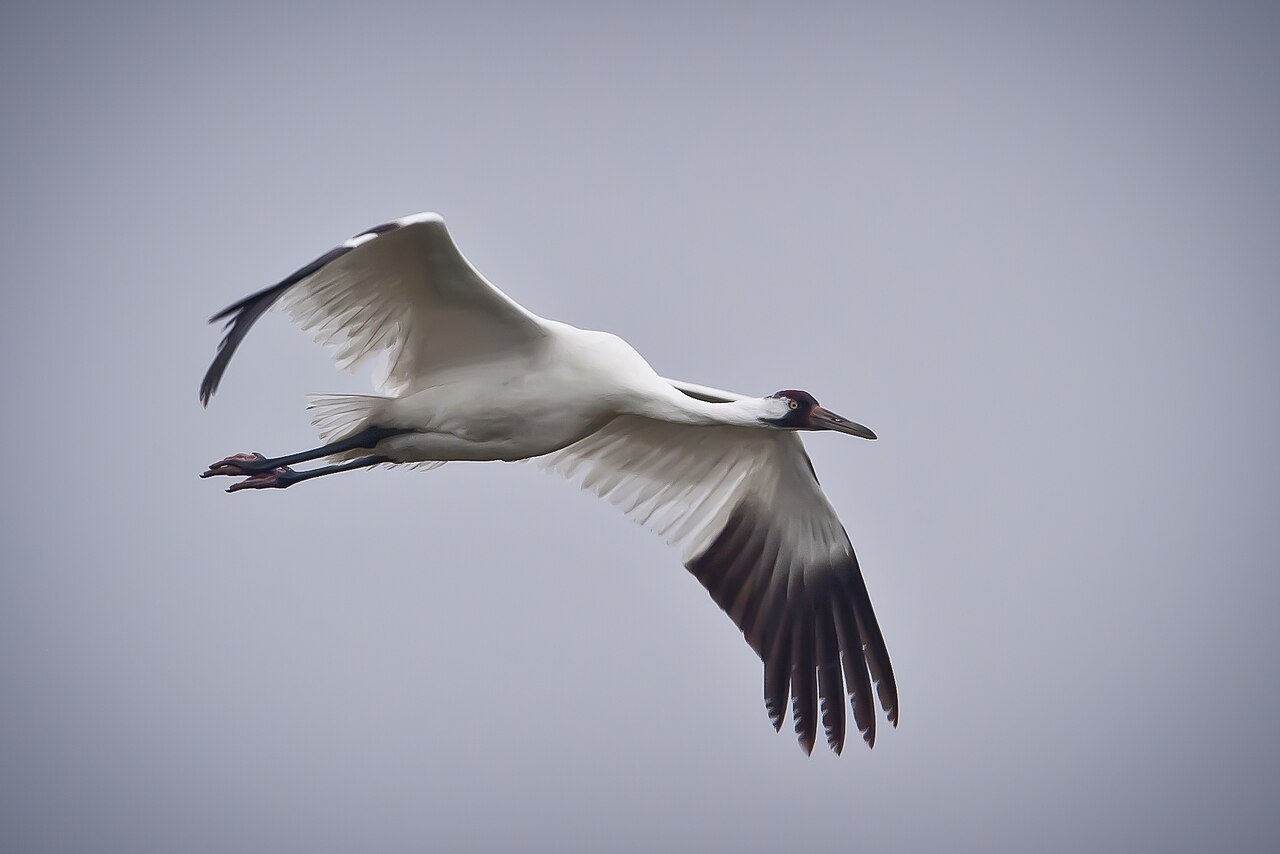
A whooping crane in flight over Texas, with white body, black wingtips and a red crown against a pale sky.
Photo: John Noll, U.S. Department of Agriculture, via Wikimedia Commons, public domain. File page: https://commons.wikimedia.org/wiki/File:Whooping_Crane_in_flight_in_Texas.jpg

What it is
The whooping crane (Grus americana) is the tallest bird in North America. Its plumage is almost entirely snowy white, with black wingtips, a red crown and sparse black feathers on the cheeks. An adult stands about 1.5 m (5 feet) tall, has a wingspan of more than 2.1 m (7 feet) and weighs 6.0 to 7.8 kg (13.2 to 17.2 pounds). The name probably comes from the loud, single-note call the birds repeat when alarmed.
Range
The only remaining wild, self-sustaining population, the Aransas-Wood Buffalo population, breeds in and around Wood Buffalo National Park in the Canadian provinces of Alberta and the Northwest Territories. Each year it migrates more than 4,000 km (2,500 miles) through the Canadian prairies and the U.S. Great Plains to the mid-coast of Texas, where it winters in and near Aransas National Wildlife Refuge. Reintroduced flocks live in Wisconsin and Louisiana, and a discontinued reintroduction programme in Florida still holds birds.
What happened
Shooting and the conversion of prairie to farmland cut a historical population of more than 10,000 birds to only 16 in 1941: 14 adults and 2 juveniles. Strict legal protection, habitat preservation, captive breeding and cooperation between Canada and the United States rebuilt the Aransas-Wood Buffalo population, which has grown by about 4 percent a year over the long term. In the winter of 2024 to 2025 a survey by the U.S. Fish and Wildlife Service estimated 557 whooping cranes, a record and the first estimate above 550.
Status today
The whooping crane is still listed as endangered in both countries. As of January 2025 the reintroduced flocks held 149 cranes, down from 162 a year earlier. Wild-raised young join those flocks at a low rate, so their numbers depend on new releases, and adult deaths are higher there than in the Aransas-Wood Buffalo population. Wetland drainage, drought linked to climate change, and wind farms and power lines along the migration route remain threats.
Human role
Agencies in both countries and their partners count the birds, monitor nests, protect habitat and raise cranes in captivity for release into the reintroduced flocks. Counts on the Texas coast and in the breeding grounds in Canada show how the wild population changes from year to year.
Sources
- U.S. Fish and Wildlife Service: Whooping Crane (Grus americana)
- U.S. Fish and Wildlife Service: 2025 Wintering Whooping Crane Count (press release)
- U.S. Fish and Wildlife Service and Environment and Climate Change Canada: Whooping Crane Status, 2024 Breeding Season to 2025 Spring Migration (PDF, February 2026)