
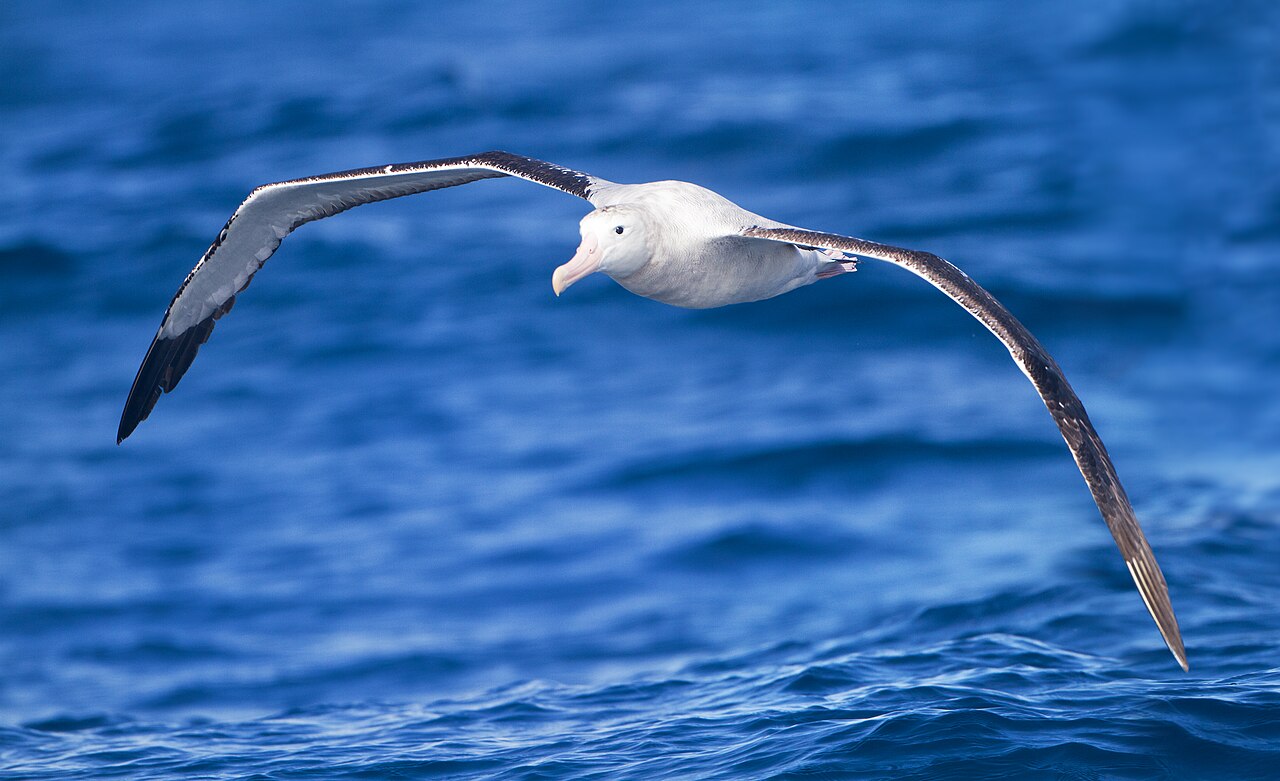
A wandering albatross in flight low over deep blue water east of the Tasman Peninsula, Tasmania, Australia.
Photo: JJ Harrison, via Wikimedia Commons, licence Creative Commons Attribution-ShareAlike 3.0. File page: https://commons.wikimedia.org/wiki/File:Diomedea_exulans_in_flight_-_SE_Tasmania.jpg

What it is
The wandering albatross (Diomedea exulans), sometimes called the snowy albatross, is a very large seabird of the Southern Ocean. It breeds every second year, and a nesting cycle just exceeds one year. Eggs are laid over about five weeks in December and January and hatch mostly in March, after 78 to 79 days of incubation. On South Georgia most chicks fledge in December, after 278 days in the nest.
Range
Wandering albatrosses breed on the French Crozet Islands and Kerguelen Islands, on South Africa’s Prince Edward Islands (including Marion Island), on Australia’s Macquarie Island and on South Georgia. Data submitted in 2007 gave about 8,050 breeding pairs a year. The three island groups of the Indian Ocean, Prince Edward, Crozet and Kerguelen, hold about 82 percent of the world population, and the Prince Edward Islands alone about 3,580 pairs, or 44 percent. Macquarie Island has only 5 to 10 pairs a year. All breeding sites are legally protected and access to them is restricted.
What happened
The figure of about 8,050 pairs is 5 percent below the 8,500 pairs of 1998, which were thought to represent about 28,000 mature individuals and a total population of 55,000. All populations have decreased at some stage over the last 25 years, and the South Georgia population has declined continuously. Adult survival on South Georgia is the lowest of all breeding sites, 92.6 percent, down from 94 percent between 1972 and 1985. The assessment links this fall to the growth of longline fisheries aimed at species other than tuna in the mid to late 1990s. The populations of Crozet, Kerguelen and the Prince Edward Islands have increased recently.
Status today
The International Union for Conservation of Nature has listed the wandering albatross as Vulnerable since 2000, and the species is on Annex 1 of the Agreement on the Conservation of Albatrosses and Petrels. That agreement’s species page still shows the status as Vulnerable. The population figures above are the most recent in the assessment, which rests on data submitted in 2007.
Human role
The assessment calls for confirming which areas of the ocean overlap with fisheries where effective measures against accidental catch and observer programmes are not yet in place. A three-year programme of satellite tracking of young and immature birds began in 2007 to show where they meet fishing fleets. Birds from the Prince Edward Islands and Crozet, for example, overlap with intense tuna longline fishing south of South Africa, where accidental catch rates are high.