
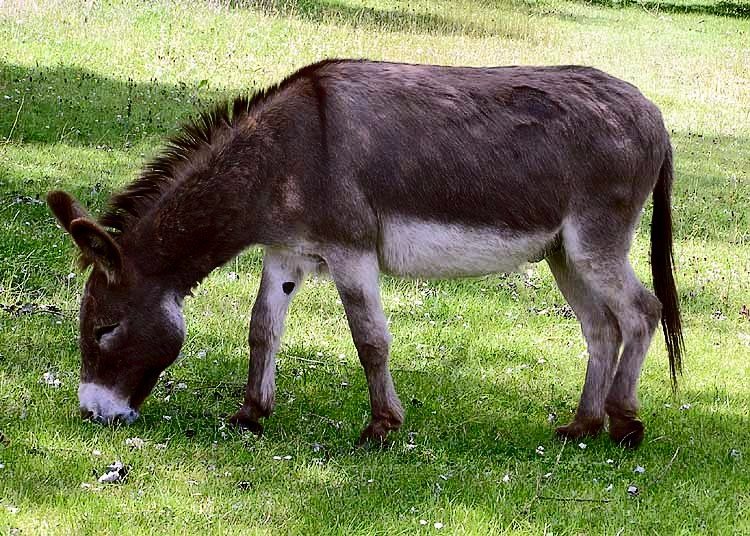
A donkey grazing at Clovelly, North Devon, England.
Photo: Adrian Pingstone, Wikimedia Commons (Public domain)

What it is
The domestic donkey (Equus asinus) is a working animal that carries loads and people over long distances, especially across semi-arid and upland country. It remains a key support for many households in low- and middle-income countries.
Range
The charity Brooke, which works to improve the lives of working horses, donkeys and mules, estimates that there are about 116 million equines (donkeys, horses and mules) in the world, about 36 million of them in the 38 lowest-income countries, and that 99% of the world's donkeys live in low- and middle-income countries. Many countries lack accurate population data: of 36 countries whose latest censuses Brooke reviewed, 22 had not counted their equines in the previous 10 years.
What happened
A study of the genomes of 207 modern and 31 ancient donkeys and 15 wild equines (Todd and colleagues, Science, 2022) supports a single domestication in Africa around 5000 BCE, followed by expansions across Africa and Eurasia. An earlier study of 126 domestic donkeys and seven wild asses (Wang and colleagues, Nature Communications, 2020) also points to Africa. It found low genetic variety on the Y chromosome, which probably reflects how people managed breeding, and showed that the undiluted black or chestnut coats of domestic donkeys were probably established during domestication.
When / status
A living domesticate and working animal. The Domestic Animal Diversity Information System (DAD-IS) of the Food and Agriculture Organization of the United Nations (FAO) records donkey breeds. Brooke asks governments to classify working donkeys, horses and mules as livestock so that national livestock censuses count them.
Human role
Donkeys have carried goods over long distances for thousands of years, and they still support the livelihoods of many communities.
Sources
- Evelyn T. Todd et al.: The genomic history and global expansion of domestic donkeys, Science, 2022 (bibliographic record, LMU Munich; DOI: 10.1126/science.abo3503)
- Changfa Wang et al.: Donkey genomes provide new insights into domestication and selection for coat color, Nature Communications, 2020 (full text in PubMed Central)
- Brooke: Data on working animals