
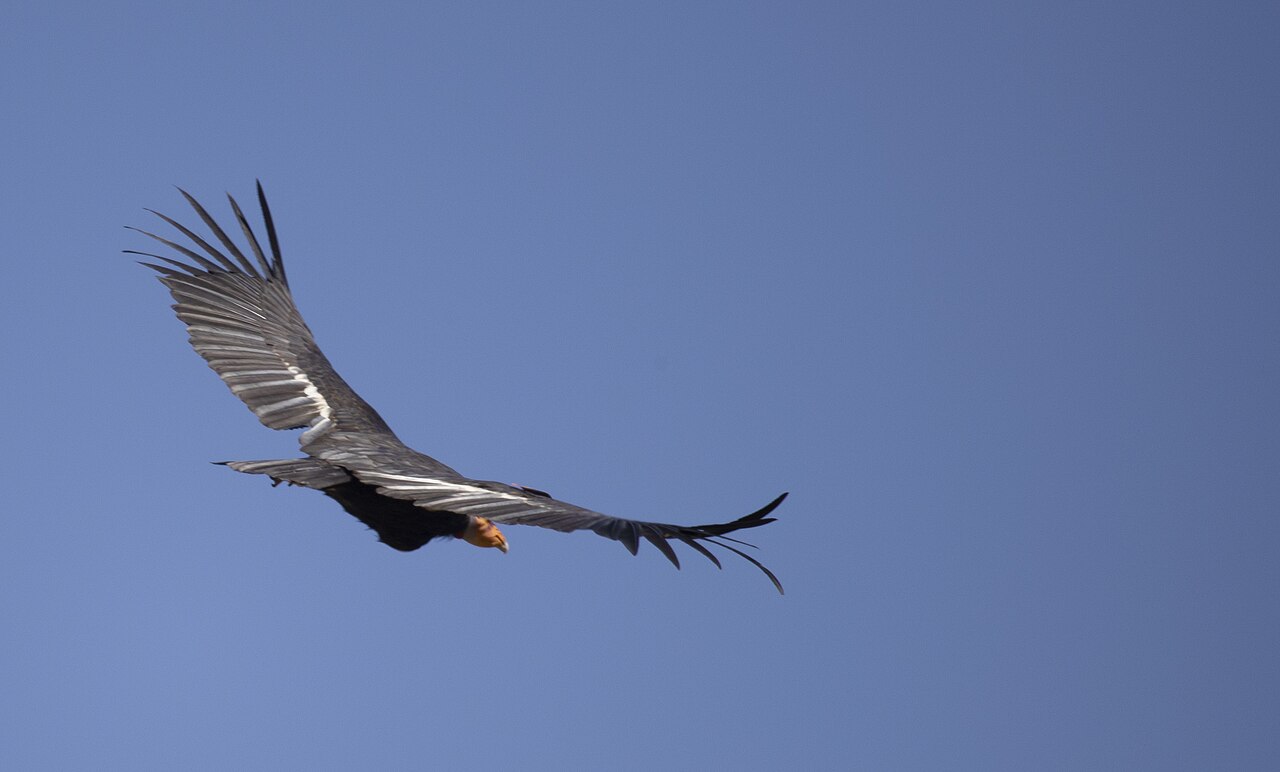
A California condor in flight at Bitter Creek National Wildlife Refuge, California, against a clear blue sky.
Photo: U.S. Fish and Wildlife Service, Pacific Southwest Region, via Wikimedia Commons, public domain. File page: https://commons.wikimedia.org/wiki/File:Condor_in_flight_%2853189570917%29.jpg

What it is
The California condor (Gymnogyps californianus) is the largest land bird in North America. Its wingspan is about 2.9 m (9.5 feet), and an adult stands 0.9 to 1.1 m (3 to 3.5 feet) tall and weighs 8 to 11 kg (17 to 25 pounds). Condors eat carrion, such as the carcasses of deer, cattle, whales and seals, and find it by sight or by following other scavengers.
Range
Free-flying condors live in four areas: Arizona and Utah, California, the Pacific Northwest and Baja California in Mexico. Of the 392 wild birds at the end of 2025, 98 lived in Arizona and Utah, 216 in California, 25 in the Pacific Northwest and 53 in Baja California. The Pacific Northwest group is classed as experimental. Condors roost on large trees, snags, rocky outcrops and cliffs, and nest in caves and on ledges of steep rocky terrain, or in cavities and broken tops of old conifers. They forage over open grasslands, oak savanna foothills and beaches beside coastal mountains, and can fly up to 400 km (250 miles) in a day.
What happened
In 1982 only 23 condors survived anywhere, and by 1987 all wild condors had been taken into a captive breeding programme. The federal government listed the species as endangered in 1967. Since 1992 the U.S. Fish and Wildlife Service has released captive-bred condors into the wild. In 2004 the first chick successfully hatched in the wild, and in 2008 more condors were flying free than living in captivity for the first time. Lead from spent ammunition remains the main cause of death in the wild: from 1992 through 2025, 161 free-flying condors died of confirmed lead poisoning.
Status today
As of 31 December 2025 the world population was 607 condors (570 a year earlier): 392 in the wild and 215 in captivity. The 1996 recovery plan sets the goal of two wild, geographically separate, self-sustaining populations, each with 150 birds and at least 15 breeding pairs, and a third population kept in captivity.
Human role
The California Condor Recovery Program is led by the same service, with partners that include state agencies, the government of Mexico, the Yurok Tribe, zoos and non-profit groups. They breed the birds, release them and monitor them in the field. Hunters and ranchers are asked to use non-lead ammunition, because lead fragments left in carcasses poison the condors that eat them.