

Managed aquifer recharge
Wells drop when cities and farms take groundwater faster than rain puts it back. Managed aquifer recharge puts treated water into basins and wells so the ground store refills.

What it is
Managed aquifer recharge (MAR) is the intentional putting of water into an aquifer for later use or for a barrier against seawater. Wells drop when cities and farms take groundwater faster than rain puts it back. Empty aquifers mean dry taps, sinking land, and no reserve in drought. MAR puts treated stormwater, river water, or recycled wastewater into basins and wells so the ground store refills.
USGS Circular 1405 surveys artificial recharge as a water-management method: spreading basins, pits, and injection wells, with the geology deciding what works. It is not a new river. It is a way to store water that already exists: storm peaks, surplus river flows, or highly treated wastewater: in the pore space underground instead of in a surface reservoir that evaporates.
How it works
Spreading basins soak water through unsaturated soil into the water table. Injection or aquifer-storage-and-recovery wells push water into a confined or semi-confined layer and pull it back later. The water must be clean enough for the receiving aquifer and for the use that will follow. Clogging of basins and well screens is the usual operational fight: silt, algae, and bubbles seal the pores.
Indirect potable reuse pairs advanced treatment with recharge. Orange County’s Groundwater Replenishment System takes highly treated wastewater that would have gone to the Pacific and purifies it by microfiltration, reverse osmosis, and ultraviolet light with hydrogen peroxide. The product is put into the basin through spreading and injection. It meets drinking-water standards before it is stored. Years of monitoring sit on top of the pipes.
Where it already runs
Orange County Water District’s GWRS is the world’s largest purification system for indirect potable reuse. The district states about 130 million gallons of water a day, serving on the order of a million people, and a share of local demand. It has run since January 2008 as a joint project with the Orange County Sanitation District. NGWA’s case study sits beside the district’s own GWRS page.
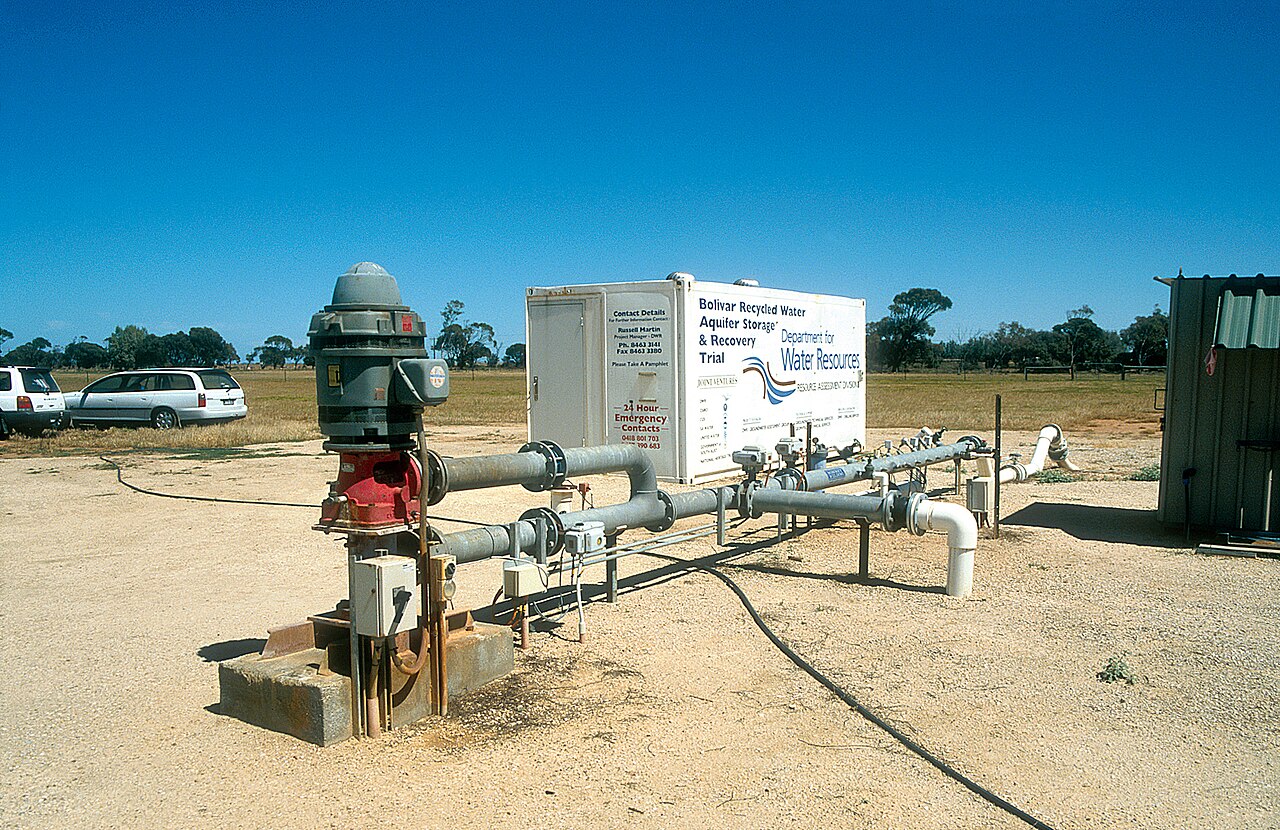
Water Corporation’s groundwater-replenishment scheme in Perth recycles treated wastewater into the Gnangara groundwater system after advanced treatment. Central Arizona Project’s recharge programme stores Colorado River water in underground sites for later recovery. The pictured Bolivar site on the Adelaide Plains was a CSIRO recycled-water aquifer storage-and-recovery trial of the same class.
Limits: what it does not fix
MAR needs clean source water, the right geology, and years of monitoring. A clay layer can block a basin. A fractured rock can send injected water somewhere you did not plan. Recovery is never one hundred percent. If the source water is dirty, you have built a contamination project.
It is not a new river. It does not create rainfall. It cannot outrun a basin that is still being pumped faster than it is recharged. Treat MAR as a store and a barrier: Orange County also uses it against seawater intrusion: not as a substitute for using less or for catching rain.
Sources
Links are for verification. The article stays on Fix Planet.