

Fog harvesting
High, dry coasts and ridges can sit in frequent fog while groundwater stays out of reach. Large mesh collectors intercept fog droplets. They are a ridge technology, not a city supply.
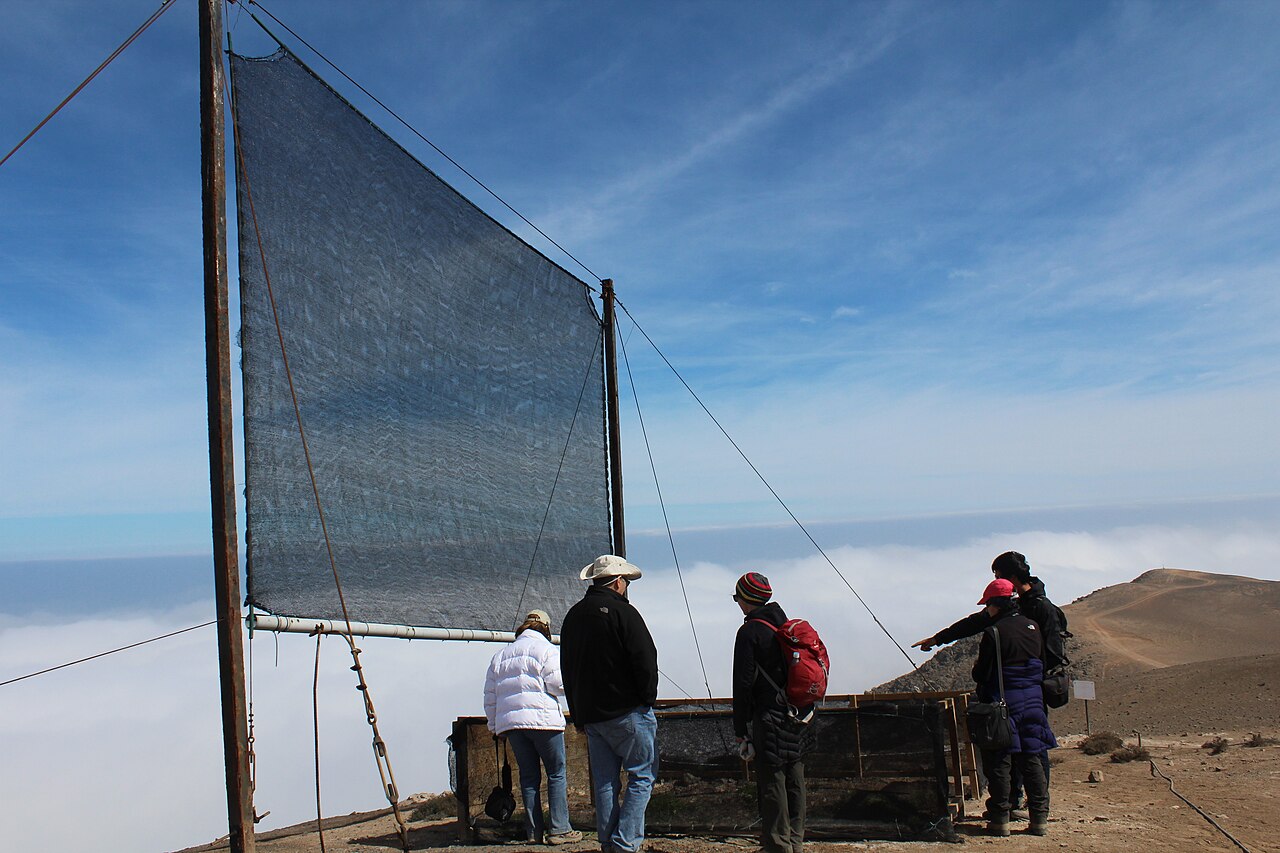

What it is
Fog harvesting intercepts fog droplets on a mesh and drains the water into a tank. High, dry coasts and ridges can sit in frequent fog while groundwater and piped water stay out of reach. The moisture is in the air, not in a river. Large mesh collectors intercept fog droplets.
FogQuest, a charity founded in 2000, helped build collectors in places such as Tojquia in Guatemala, Chile’s Atacama sites, and Falda Verde; it now mainly mentors new projects and notes that its project pages are no longer kept current. The 2012 AMBIO review (Klemm and others), hosted as a PDF on FogQuest’s site, surveys fog as a freshwater resource: yield, mesh, and climate. A 2021 Frontiers in Water paper reviews the same family of collectors.
How it works
A typical large collector is a rectangular mesh panel stretched between posts, standing across the prevailing wind on a ridge that sits in cloud. Droplets collide with the fibres, join, and run to a gutter. Yield is measured in litres per square metre of mesh per day and depends on fog-water content, wind speed, mesh type, and how many fog hours the ridge actually has.
The method needs a site with frequent advection fog: a coastal or mountain cloud that moves through the panel: not a still valley mist. Collectors need local upkeep: torn mesh, stolen wire, and clogged gutters end the yield. Storage and a clean tap are part of the project. A panel without a tank is a science photograph.
Where it already runs
Named FogQuest and related sites include Tojquia in Guatemala, Chile’s Atacama collectors (the photograph on this card is Alto Patache), and Falda Verde. The same idea has been tried on other dry fog coasts and high villages. AMBIO 2012 and the 2021 Frontiers review collect those experiments; they are village and research installations, not municipal plants.
FogQuest’s current-projects page is the charity’s own index. The organisation says those pages are no longer kept current and that its role is now mainly mentoring. This encyclopedia follows that honesty: the places are real; the yield is local and seasonal; the website is not a live operations dashboard.
Limits: what it does not fix
Yield depends on wind, mesh, and fog days. Collectors need local upkeep. They are a ridge technology, not a city supply. A capital city cannot drink from a row of meshes. When the fog season ends, the tank is what you stored.
Fog harvesting does not replace a well, a pipeline, or a desalination plant. It does not work on a calm, fog-free plain. Stolen or torn mesh is a failed project. Treat it as drinking water for a high village that already lives in the cloud: not as a climate adaptation for everyone.
Sources
Links are for verification. The article stays on Fix Planet.