

Constructed floating wetlands
Stormwater basins and wastewater lagoons collect nutrients and algae. Floating pontoon modules hang plant roots in the water. CSIRO is piloting them at Cowes and Salisbury.

What it is
Constructed floating wetlands are pontoon modules whose plant roots hang in the water, hosting biofilms that take up nutrients and trap particles. Stormwater basins and wastewater lagoons collect nutrients and algae. A land-based wetland needs space and changes flood storage. Many existing ponds have neither.
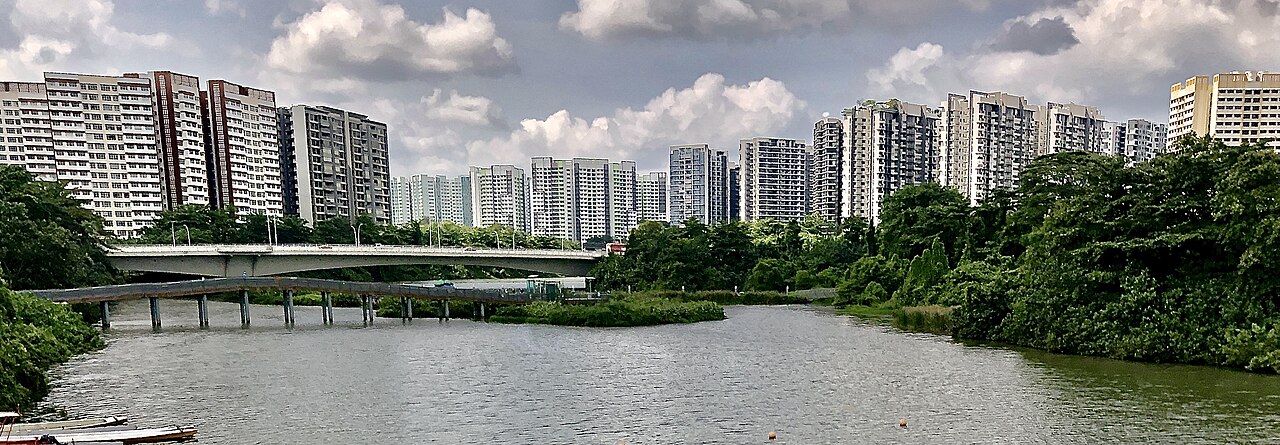
CSIRO describes them as a recent retrofit for stormwater and wastewater. Queensland’s WetlandInfo design summary treats floating wetlands as a treatment-system option: a planted raft, a mooring, and a harvest plan. The photograph on this card is Singapore’s Sengkang Floating Wetland: a planted mid-channel strip: which shows the same class of floating planted structure, not the Australian pilots themselves.
How it works
A buoyant frame holds a growing media and wetland plants. Roots and hanging biomass extend into the water column. Microbes on those surfaces take up nitrogen and some phosphorus and trap fine particles. The raft is moored so it does not block outlets or become a navigation hazard. Water still flows under and around the module; the pond remains a pond.
WetlandInfo’s design summary stresses sizing, plant choice, mooring, and maintenance. Plants must be harvested or they return what they stored when they die and rot. Modules clog with litter. Birds and people walk on poorly built rafts. The treatment is only as good as the contact time and the harvest.
Where it already runs
CSIRO is piloting systems on a lagoon at Cowes, Phillip Island, and on an urban channel in Salisbury, South Australia. Those are named research and demonstration sites, not a national retrofit programme. WetlandInfo publishes design guidance for agricultural and stormwater treatment in Queensland.
Floating planted islands also appear in urban reservoirs and parks: Sengkang in Singapore is the image on the card: as landscape and some treatment. This page does not treat a park island as proof that a city’s sewage is solved. The CSIRO pilots are the sourced Australian deployments this encyclopedia follows.
Limits: what it does not fix
They are pilots, not a replacement for a treatment plant, and plants must be harvested or they return what they stored. A floating wetland does not add the land area of a full constructed wetland, and that is the point, but it also cannot match a properly sized land bed or a mechanical plant on a high load.
It does not fix a catchment that keeps sending nutrients. It does not turn a sewage lagoon into drinking water. Mooring fails in floods. Treat floating wetlands as a retrofit for a pond you already have: Cowes and Salisbury are the named trials: not as a city water supply.
Sources
Links are for verification. The article stays on Fix Planet.