

Extended producer responsibility for packaging
Extended producer responsibility makes the companies that put packaging on the market responsible for it after use, by paying for collection and recycling or by organising them. In the European Union, packaging waste reached 186.5 kg per person in 2022.
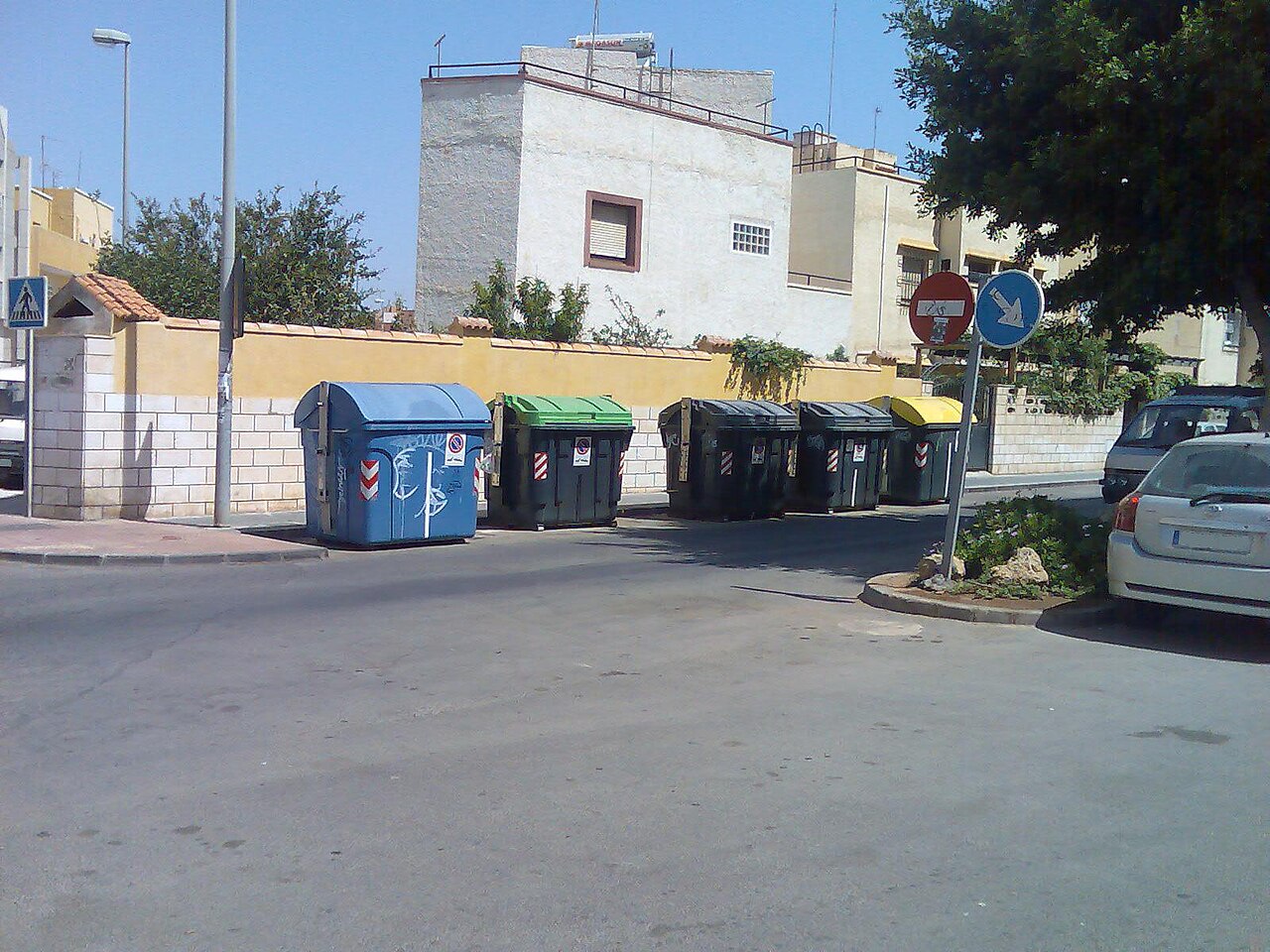
Recycling containers in Almería, Spain, for paper and cardboard, glass, organic waste and packaging, and plastic and metal.
Photo: Schumi4ever, via Wikimedia Commons, licence Creative Commons Attribution-ShareAlike 4.0 (https://creativecommons.org/licenses/by-sa/4.0/). File page: https://commons.wikimedia.org/wiki/File:Contenedores_de_reciclaje_Almer%C3%ADa.jpg

What it is
Extended producer responsibility is a policy approach that makes producers responsible for their products along the entire lifecycle, including after consumers discard them. The Organisation for Economic Co-operation and Development describes it as shifting responsibility for products from municipalities and consumers to producers. A producer can meet the duty by providing the money, by taking over the organisation of collection and sorting from municipalities, as often happens with packaging, or by doing both. Most often producers act together through producer responsibility organisations.
Why it matters
According to the European Commission, packaging waste in the European Union reached a record 186.5 kg per person in 2022, and packaging accounts for nearly half of all marine litter. The Packaging and Packaging Waste Regulation, in force since 11 February 2025 and applying from 12 August 2026, replaces the 1994 packaging directive with common rules on design, recycled content, waste prevention, reuse, collection and recycling. A survey that the Organisation for Economic Co-operation and Development summarised in 2016 counted about 400 extended producer responsibility systems in operation, with electronics the largest group at 35 percent and packaging and tyres at 17 percent each. In some countries, such as France, the evidence shows that these systems shifted part of the financial burden of waste management from municipalities and taxpayers to producers.
How to read it
Extended producer responsibility can be voluntary or required by law, and it can use take-back requirements, deposit-refund systems or advance disposal fees. Take-back requirements are the most commonly used instrument, accounting for nearly three quarters of the systems surveyed. The Organisation's 2001 guiding principles say that these systems should give producers incentives to change product designs.
Limits
Assessing the impact of these systems is difficult: data are lacking, their effect is hard to separate from other factors, and the systems vary too much to compare. The Organisation notes that they have contributed to waste prevention, such as eco-design, in some countries and sectors, but that they are seldom sufficient to trigger it on their own. The count of about 400 systems comes from a survey summarised in 2016.
Sources
Links are for verification. The article stays on Fix Planet.
- European Commission: Packaging waste : https://environment.ec.europa.eu/topics/waste-and-recycling/packaging-waste_en
- Organisation for Economic Co-operation and Development (OECD): Extended producer responsibility and economic instruments : https://www.oecd.org/en/topics/extended-producer-responsibility-and-economic-instruments.html
- Organisation for Economic Co-operation and Development (OECD): Extended Producer Responsibility: Basic facts and key principles, OECD Environment Policy Papers No. 41 (2024) : https://www.oecd.org/en/publications/extended-producer-responsibility_67587b0b-en.html
- Organisation for Economic Co-operation and Development (OECD): Extended Producer Responsibility: Policy Highlights (2016, PDF) : https://www.oecd.org/content/dam/oecd/en/topics/policy-sub-issues/extended-producer-responsibility-and-economic-instruments/Extended-producer-responsibility-Policy-Highlights-2016-web.pdf