

E-waste collection and recycling
Documented collection and recycling of discarded electronics recovers copper, gold and other metals. In 2022 the world generated 62 billion kg of e-waste, and 22.3 percent of it was documented as formally collected and recycled.
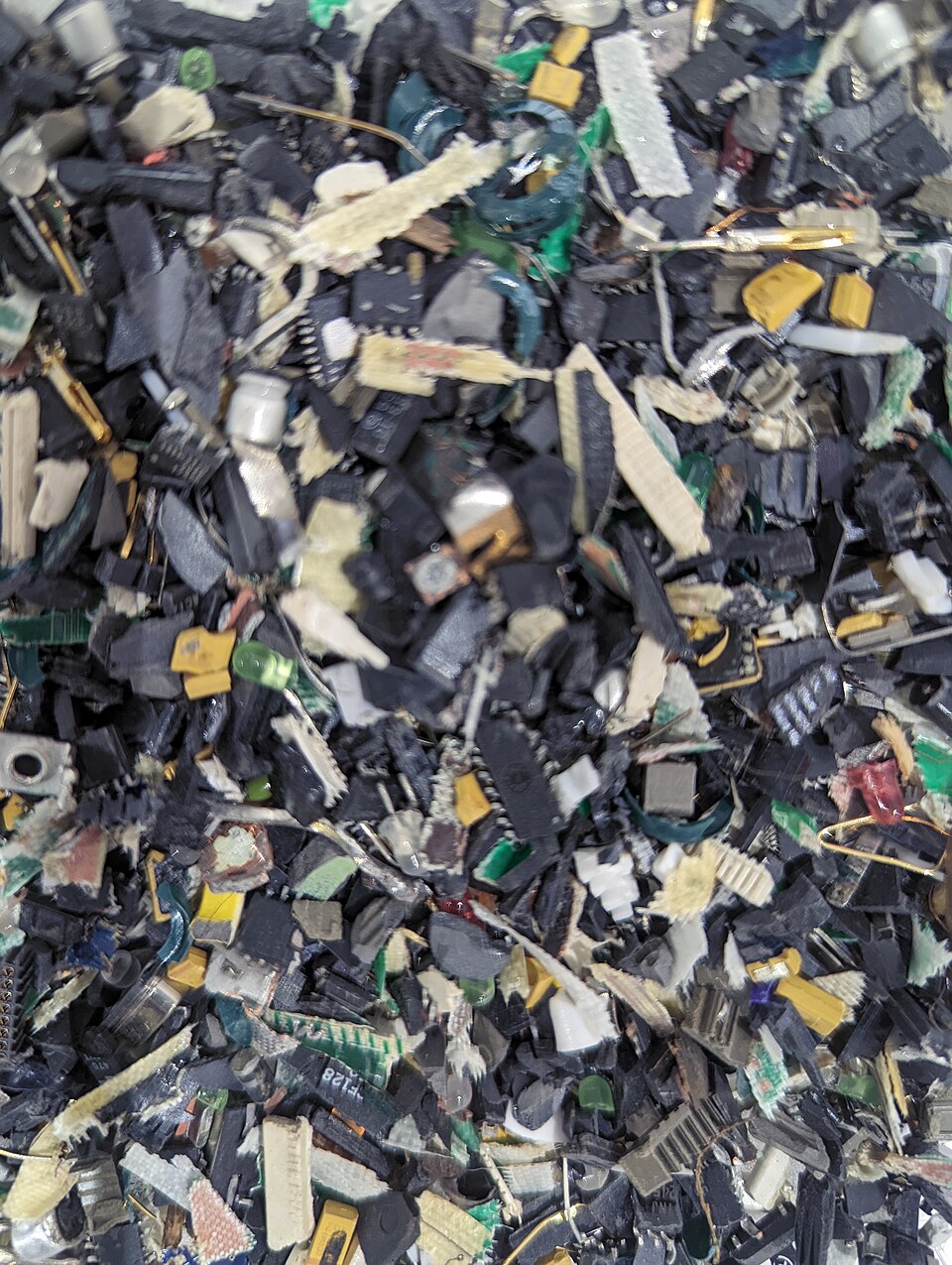
Shredded circuit boards and electronic components sorted for material recovery, shown as an exhibit in Tsukuba, Japan.
Photo: Syced, via Wikimedia Commons, Creative Commons Zero public domain dedication (https://creativecommons.org/publicdomain/zero/1.0/). File page: https://commons.wikimedia.org/wiki/File:Electronic_junk_separation_in_view_of_recycling_3.jpg

What it is
E-waste is discarded electrical and electronic equipment, from phones and laptops to large appliances. The Monitor counts e-waste as recycled only when it is documented as formally collected and recycled in an environmentally sound manner. The Global E-waste Monitor is prepared by the International Telecommunication Union and the United Nations Institute for Training and Research, and its 2024 edition covers the year 2022.
Why it matters
In 2022 the world generated a record 62 billion kg of e-waste, an average of 7.8 kg per person. Only 22.3 percent of it (13.8 billion kg) was documented as formally collected and recycled. Since 2010, when 34 billion kg were generated, the amount has grown by an average of 2.3 billion kg a year, while the documented formal collection and recycling rose from 8 billion kg at an average of 0.5 billion kg a year. The rise in generation therefore outpaces the rise in formal recycling by a factor of almost 5. The metals in the e-waste of 2022 were worth an estimated 91 billion United States dollars, including copper (19 billion), gold (15 billion) and iron (16 billion).
How to read it
The 22.3 percent counts only e-waste documented as formally collected and recycled; the Monitor estimates that the rest was disposed of with residual waste, collected and recycled outside formal systems, or handled mostly by the informal sector. Collection and recycling rates are typically highest for heavier and bulkier equipment, such as large equipment, temperature exchange equipment and screens, while recycling of small equipment such as toys, microwave ovens, vacuum cleaners and e-cigarettes remains very low, at only 12 percent globally. Among regions, Europe has the highest documented collection and recycling at 7.53 kg per person.
Limits
The Monitor's chapter on Asia notes that informal workers often work with limited resources and inadequate protective equipment, which exposes them to hazardous chemicals, and non-compliant e-waste management releases 58 thousand kg of mercury and 45 million kg of plastics containing brominated flame retardants into the environment every year. International trade codes treat new and used equipment alike, which opens the door to misclassification of illegal shipments. Because the 22.3 percent counts only documented formal collection and recycling, the flows outside the formal system are estimates.
Sources
Links are for verification. The article stays on Fix Planet.
- International Telecommunication Union (ITU): The Global E-waste Monitor 2024 : https://www.itu.int/en/ITU-D/Environment/Pages/Publications/The-Global-E-waste-Monitor-2024.aspx
- International Telecommunication Union (ITU) and United Nations Institute for Training and Research (UNITAR): Global E-waste Monitor 2024 (PDF) : https://ewastemonitor.info/wp-content/uploads/2024/12/GEM_2024_EN_11_NOV-web.pdf
- International Telecommunication Union (ITU): Global E-waste Monitor 2024 (publication page) : https://www.itu.int/pub/D-GEN-E_WASTE.01-2024