

Cellulose insulation
Loose-fill and spray-on insulation made from recovered paper fibre. The United States Environmental Protection Agency recommends 75 percent postconsumer paper for cellulose loose-fill and spray-on insulation, measured by the weight of the insulating core.
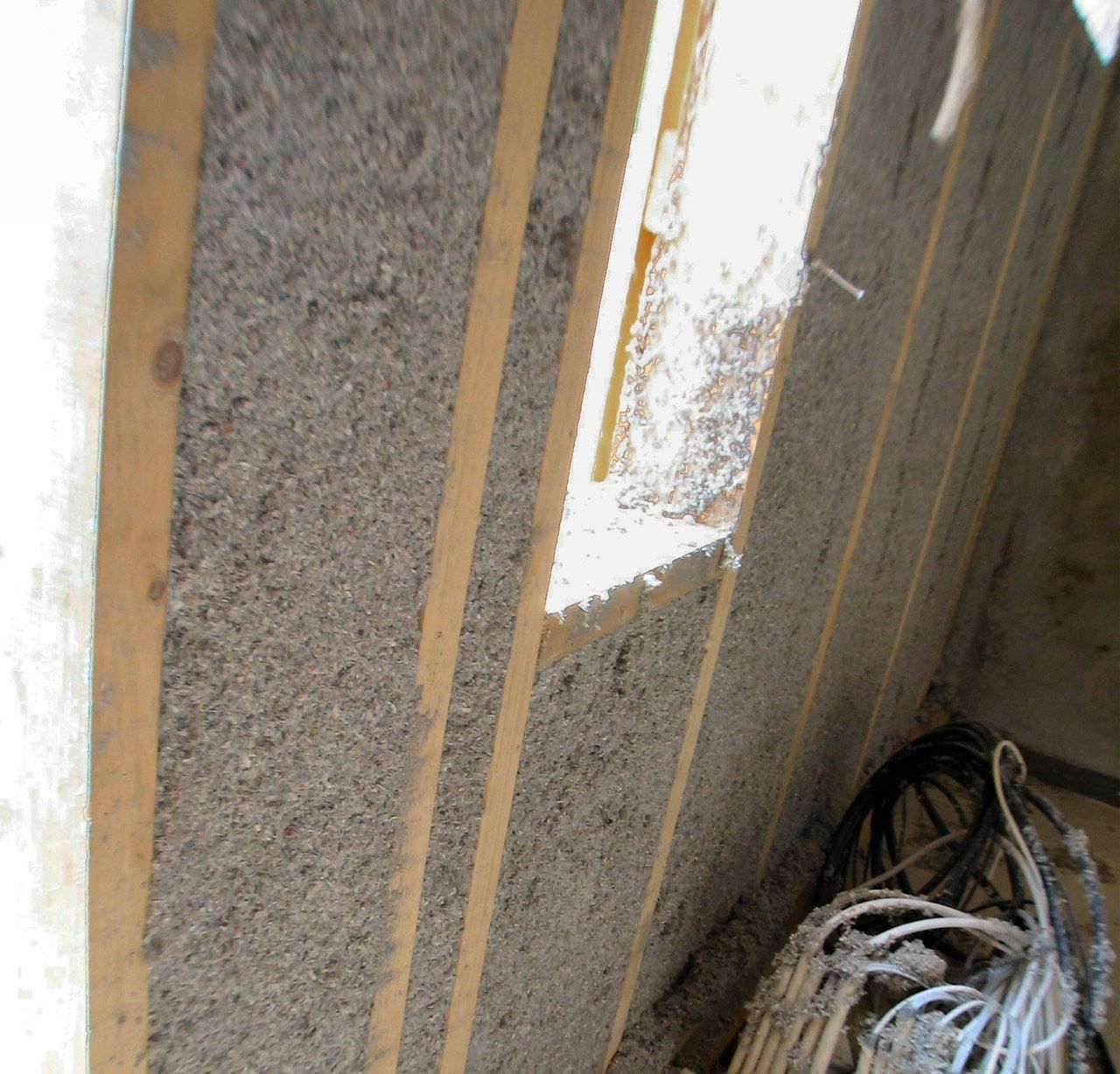
Sprayed paper-based cellulose insulation filling the cavities of a timber wall frame.
Photo: Riisipuuro, via Wikimedia Commons, cropped, licence Creative Commons Attribution-ShareAlike 3.0 (https://creativecommons.org/licenses/by-sa/3.0/). File page: https://commons.wikimedia.org/wiki/File:Paper_insulation.jpg

What it is
Cellulose insulation is a fibrous insulation applied as loose fill or as a spray-on product, and it can be made from old newspaper. The United States Environmental Protection Agency lists cellulose loose-fill and spray-on insulation among the building insulation products that can be made from recovered materials.
Why it matters
The Comprehensive Procurement Guidelines program of the United States Environmental Protection Agency designates products that are or can be made with recovered materials, to promote the use of materials recovered from municipal solid waste. Once a product is designated, procuring agencies are required to buy it with the highest recovered material content level practicable. For cellulose loose-fill and spray-on insulation the agency recommends 75 percent postconsumer paper, which is also 75 percent total recovered materials content.
How to read it
The recommended levels for building insulation are based on weight. Volume is left out of the calculation, and the insulating core is the only part counted. A figure of 75 percent therefore describes the share of the core's weight that is postconsumer paper.
Limits
The 75 percent level is a recommendation for purchases by procuring agencies of the United States government. It describes the recovered content of the product. Thermal performance, settling, moisture behaviour and fire behaviour of cellulose insulation lie outside the cited sources, and so do its market share and price.
Sources
Links are for verification. The article stays on Fix Planet.
- United States Environmental Protection Agency: Comprehensive Procurement Guidelines for Construction Products : https://www.epa.gov/smm/comprehensive-procurement-guidelines-construction-products
- United States Environmental Protection Agency: Comprehensive Procurement Guideline (CPG) Program : https://www.epa.gov/smm/comprehensive-procurement-guideline-cpg-program