

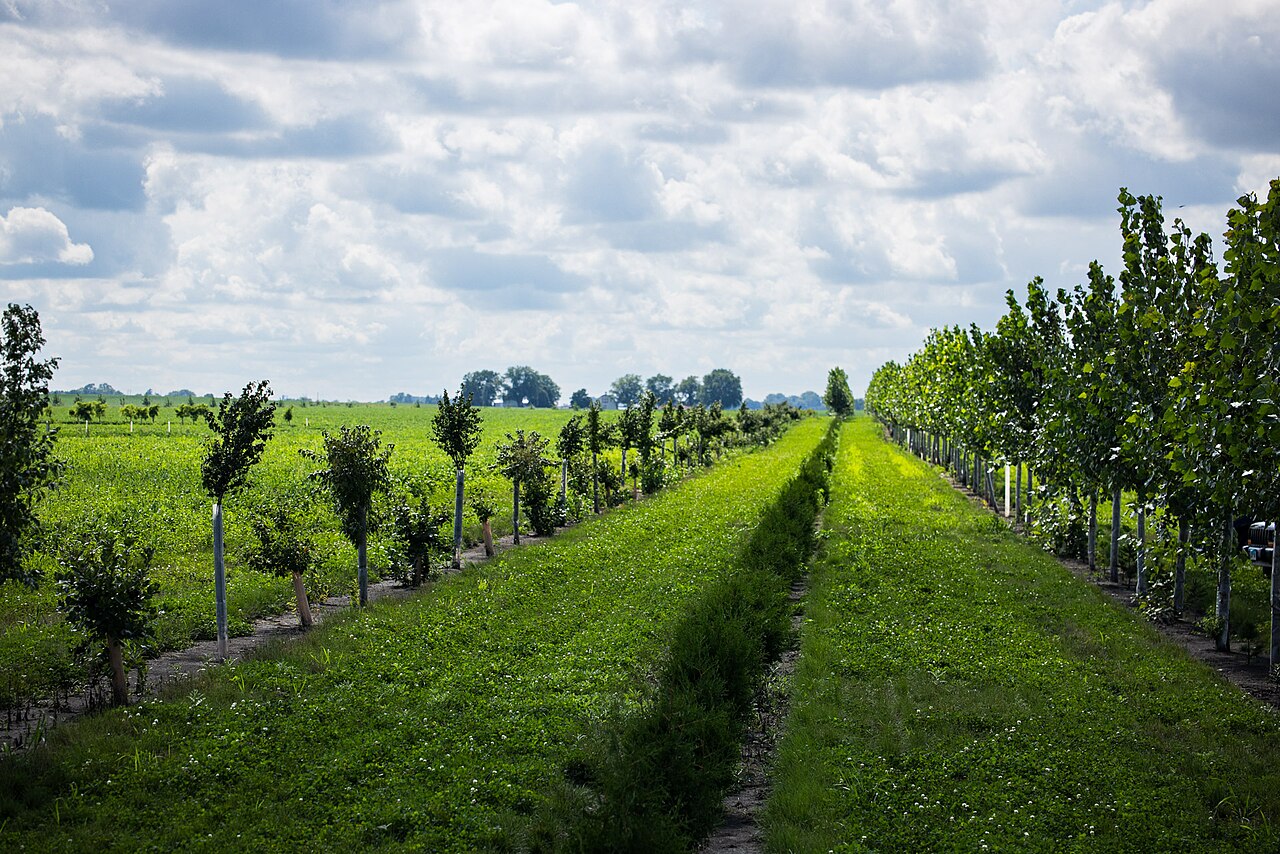
Image: Savanna Institute, young three-row windbreak in an Illinois field ( CC BY-SA 4.0 )

What it is
Windbreaks, also called shelterbelts, are linear plantings of trees and shrubs laid out to slow the wind and to do related farm jobs: field protection, livestock shelter, living snow fences, and farmstead screening. The windbreaks page of the National Agroforestry Center at the U.S. Department of Agriculture is the definition used here. Open fields and yards take the full force of wind. Soil blows, snow drifts onto roads, and animals burn more feed in cold weather. A designed belt of trees is the ordinary answer on the Midwest and the Great Plains.
The Center is plain that windbreaks come in more than one design. Location, orientation to the wind, height, width, density, and species decide what the belt does. Some belts are meant mainly to cut wind speed across a crop. Others are meant to hold snow on the field, keep it off a road, shade livestock, or screen a farmstead. Agroforestry Notes 25 and 36 are the Center’s technical notes on those design choices. The belts are farm infrastructure.
How it works
Height sets the protected zone: the quiet air on the leeward side scales with how tall the trees are. Density, meaning how porous the belt is, sets whether the wind drops sharply and then recovers, or is eased over a longer distance. Gaps become jets. A missing tree is a hole that can scour soil. Orientation is usually across the prevailing damaging wind. Notes 25 and 36 walk through those relationships and through multi-row belts and single-row belts. A three-row young belt, the Illinois photograph, is a different tool from a mature multi-storey shelterbelt.
Establishment is planting, weed control, and replacement of dead trees until the belt closes. Renovation is the later job: old Plains belts have gaps, volunteer trees, and lost density. The Center and its partners work on inventory, establishment, and renovation, including Great Plains windbreak mapping. Specialty shrubs can be added for a second product if harvest leaves the wind function intact. A belt that is left after dieback becomes a row of snags.
Where it already runs
The named practice is farm windbreaks in the United States as the Center describes them: field belts, livestock belts, living snow fences, and farmstead belts, with a long Great Plains and Midwest history. The photograph is a young three-row belt in an Illinois field, that class of planting. The Center notes that producers use windbreaks mainly for soil, livestock, wind, and snow control, and that satisfaction in the studies it brings together has been high.
Linear shelterbelts also exist in other windy farming regions. The Center’s windbreaks page and Notes 25 and 36 are the sources for this design. The practice described is that United States design.
Limits
Windbreaks fail when they are left untended. Gaps, neglected rows, and a belt planted parallel to the damaging wind leave the field exposed. A thin line of trees is farm infrastructure with a height, a density, and an orientation. It leaves a drought in place. Shading a stream is the job of woody cover on the bank.
A windbreak is one linear planting on a farm. Its design is height, density, and orientation, as Notes 25 and 36 set them out. The notes describe that design and leave a yield percentage for a later measurement.