

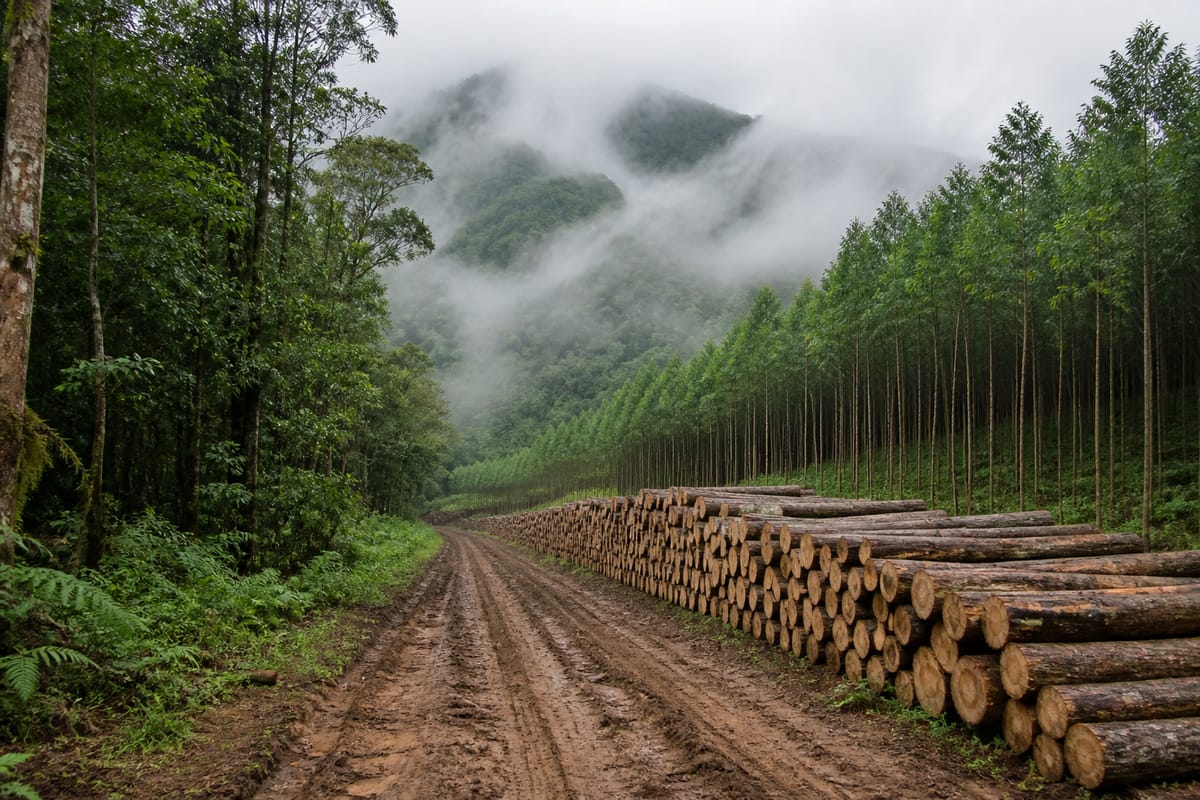
Image: Fix Planet generated documentary still of a plantation track and a log stack (Site asset)
What it is
Sustainable forest management is the long practice of growing, measuring, and harvesting wood so a forest keeps producing timber and other services. The Food and Agriculture Organization of the United Nations treats it as management that maintains the forest’s capacity. Slow-growing timber still pulls logging into old forests when markets want boards and pulp. Fast-growing planted species and planned harvest of existing managed forests are the ordinary industrial answer.
The Global Forest Resources Assessment 2020 puts planted forest at about 294 million hectares, roughly 7 percent of the world’s forest. About 131 million hectares of that are plantations: intensively managed, even-aged, often one or two species, grown mainly for wood. The rest of the planted area was established or restocked and is kept on a longer cycle than a short-rotation crop. Planted-forest pages note that planted forests supplied about 45 percent of industrial roundwood in 2014. Those figures come from the assessment.
A plantation is a wood factory with rows, roads, and a rotation. Primary woodland and mixed old growth keep a different structure. Sustainable forestry, as the organization describes it, covers planted stands and the inventory-and-cut systems used in naturally regenerated production forest.
How it works
The work is measurement first. National forest inventories count trees, growth, and removals so a harvest plan has a volume. Sweden and Finland run among the oldest continuous inventories in Europe: sample plots, increment, and an annual allowable cut that is supposed to stay inside growth. In the United States the Forest Inventory and Analysis program of the Forest Service does the same job on a permanent plot grid, including the South’s planted pine. The inventory makes an overcut visible. The harvest still has to stay inside growth.
On the ground the method is species choice, stocking, thinning, and a road system that can take the wood out while leaving the next crop standing. Planted radiata pine, eucalyptus, and southern pine are grown on rotations measured in decades. Fertilizer, weed control, and genetic stock are part of the kit where the owner is running a plantation. In mixed production forest the same idea is a yield table and marked trees. The planted-forest module covers establishment, tending, and harvest.
Where it already runs
Northern Europe’s production forests are the textbook inventories: Sweden and Finland grow, measure, and cut on national systems that have run for generations. The stands are managed production forest. In the United States the South’s pine belt and the Forest Inventory and Analysis plots are the named industrial counterpart: planted pine, pulp and sawtimber, and a public inventory.
New Zealand’s radiata pine estate, Chile’s radiata and eucalyptus plantations, and Brazil’s eucalyptus pulp stands are the large Southern Hemisphere planted forests that already feed mills. Smaller planted areas in India, Viet Nam, and Indonesia sit in the same planted-forest class: people put trees on land to grow wood or restore cover. The 2020 planted-forest and plantation totals are global sums of those national reports.
Limits
A plantation holds rows, a road network, and a rotation. Old primary woodland keeps a different structure, species mix, and carbon store. Converting a natural forest into rows to meet demand is a land-use change. Planted wood can take pressure off some old stands when the mill buys the planted log and the old forest is left uncut.
Inventories fail when plots are political, illegal wood is laundered as certified, or the allowable cut is raised to match an oversized mill. Fast-growing species still need water, soil, and a market. The figures to keep in view are the 294 million hectares of planted forest, the 131 million hectares of plantation, and the 2014 roundwood share.