

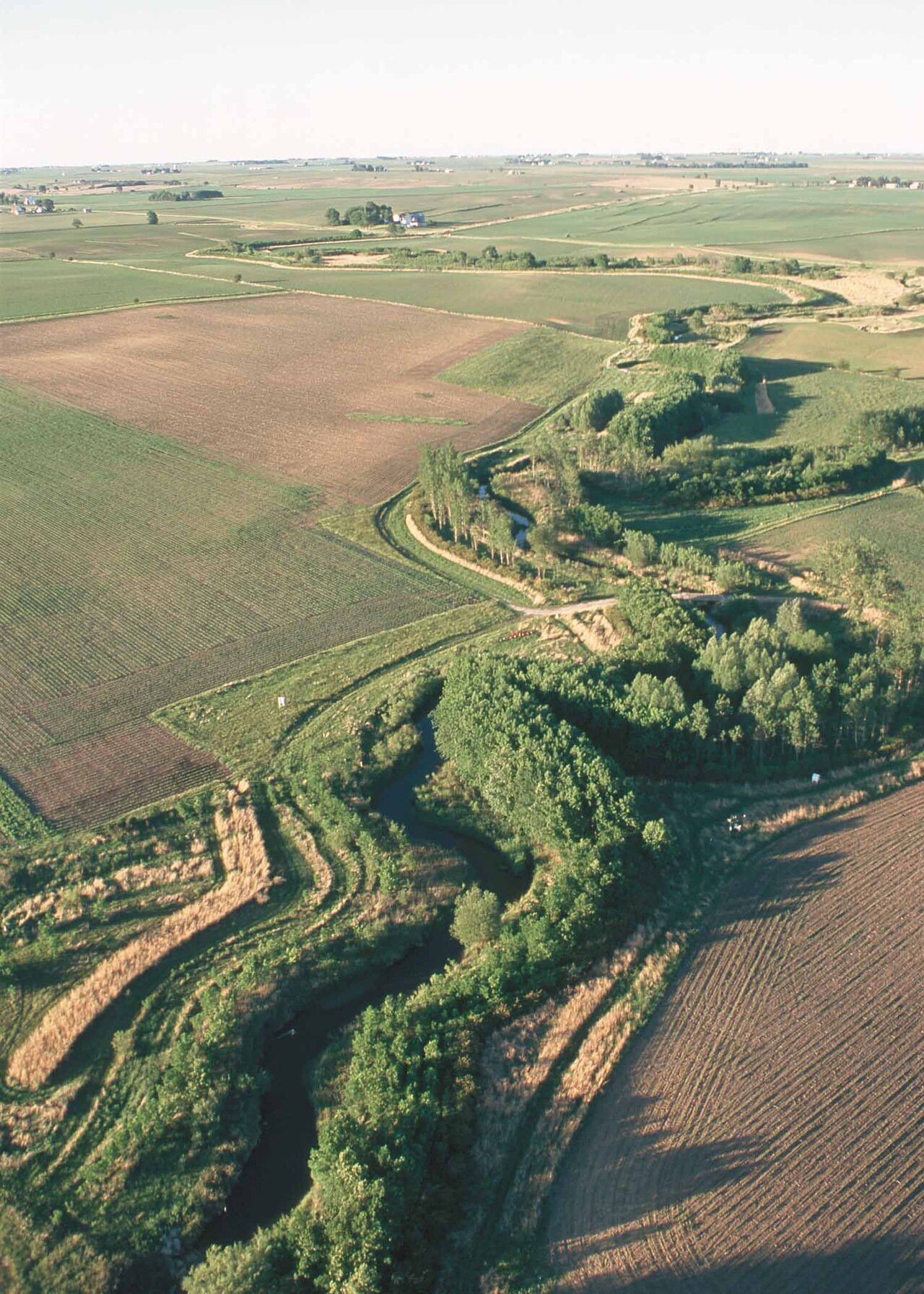
Image: U.S. Department of Agriculture, riparian buffer on Bear Creek, Story County, Iowa ( Public domain )

What it is
Riparian forest restoration puts woody and other vegetative cover back on the land beside a stream, river, or wet drainage so the bank holds, the water is shaded, and the channel has roots and wood. The Climate Hubs of the U.S. Department of Agriculture describe forests in riparian areas as reducing erosion, buffering high flows, moderating temperature, cutting evaporation, and providing corridors. When those trees are cleared for fields or lots, banks erode, nutrients wash in, and summer water warms. Fish and the channel lose the shade and roots that held the edge.
The companion Climate Hubs page on maintaining or restoring riparian areas, and the Forest Service riparian restoration handbook, are the practice manuals followed here. The aim is shade, woody debris, and soil held by roots: mixed plantings, buffers with harvest limited or left out, and bank stabilization where the toe is failing. The work is the strip of woods along the water.
How it works
The Climate Hubs tactics are concrete. Restore a mix of tree and plant species to increase shade, supply wood to the channel, stabilize soil, and reconnect habitat. Reforest riparian ground next to agriculture or development to cut erosion and nutrient loading. Size buffers to landform and hydrology, and set harvest in them to a reduced level or to none. Keep canopy and ground cover so rain falls on plants. Where banks are already failing, anchor them with fabric, wire, or natural materials. Where dams or gates exist, manage water so the riparian soil stays wet at the season the plants need.
The Forest Service handbook walks through site assessment, species, planting, and the difference between a living buffer and a rock dump. A single row of one species on a raw bank falls short of that handbook. Livestock that stand in the channel undo a season of work. The buffer has to be wide enough for the landform. A decorative line of trees on a straightened ditch leaves the riparian forest still to be built.
Where it already runs
The named guidance is federal guidance in the United States: Climate Hubs adaptation approaches for forested watersheds, and the Forest Service riparian restoration handbook. The photograph is a wooded buffer on Bear Creek in Story County, Iowa, farm country with a tree strip on the creek. Similar buffers are used on agricultural streams in other temperate countries. Lengths for those other countries are left to their own inventories.
Projects run on public forests, on farm conservation contracts, and on urban creeks. They already run. The sources above name the guidance. Coverage varies from stream to stream.
Limits
A planted strip leaves the rest of a watershed to the uplands. If those uplands stay bare, nutrients and sediment still arrive from the field. A buffer is a band of cover on the bank. In a large flood the channel will move. In a dry year the plantings die if they were the wrong species for the water table.
The work is local, on the bank: Climate Hubs tactics plus the Forest Service handbook. The rest of the catchment still sends water, soil, and livestock toward the channel. Keeping livestock and ploughs out of the water is part of holding the bank.