

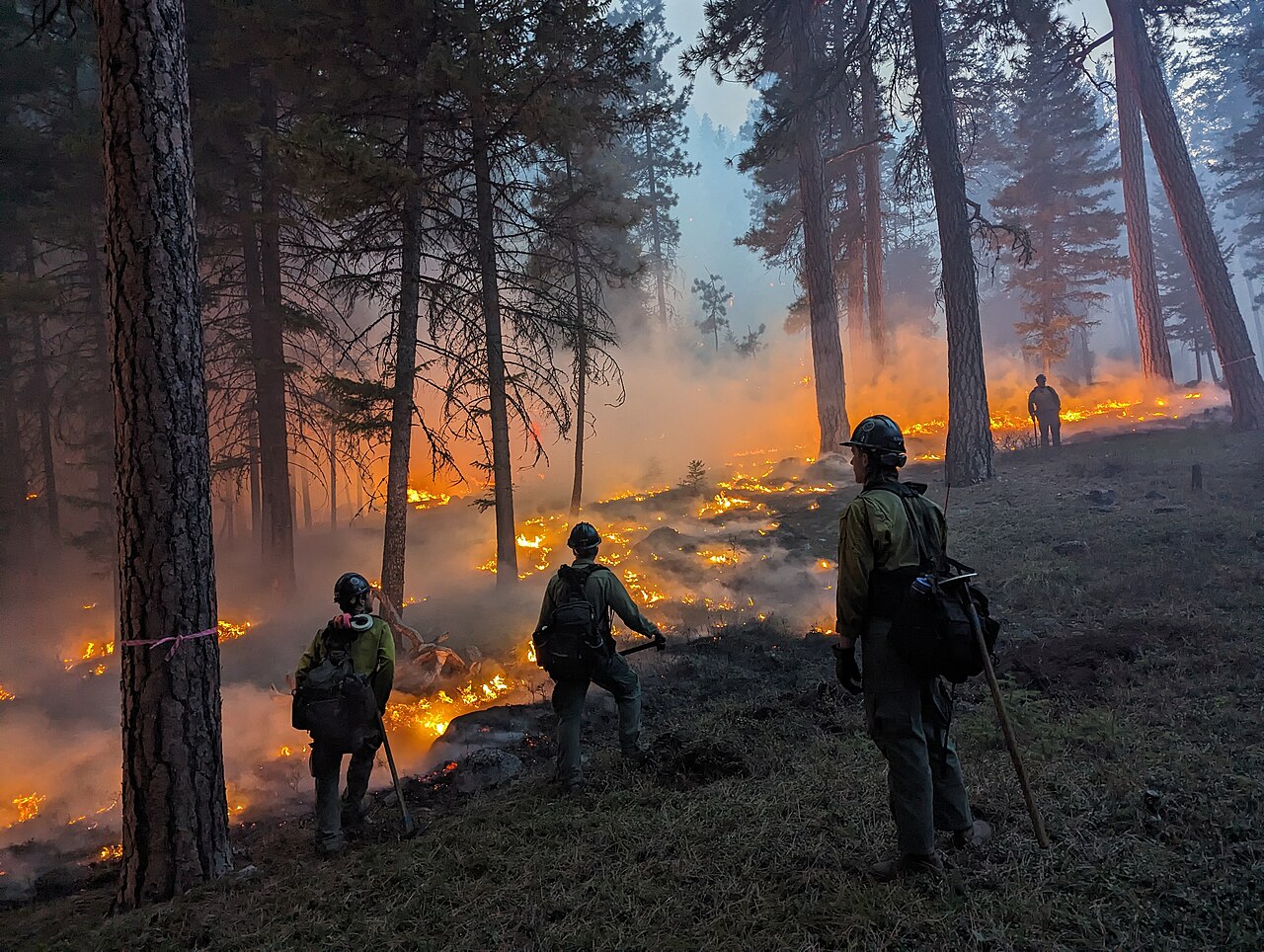
Image: Forest Service Northern Region, prescribed fire at Lake Como, Bitterroot National Forest ( Public domain )

What it is
Prescribed fire is the planned ignition of a forest, woodland, or grassland under chosen weather, fuel, and staffing so the fire does a job: consume litter and small fuels, keep shrubs from becoming a ladder into the crowns, and reopen a stand that used to burn often. The National Wildfire Coordinating Group’s Interagency Prescribed Fire Planning and Implementation Procedures Guide of May 2022 is the United States interagency rulebook for that work at the Forest Service, the Department of the Interior, and partner agencies. It is a planning and implementation standard.
A century of putting out every fire left dense fuel in many temperate forests. When weather is extreme, those stands burn hotter and kill trees that used to survive lighter fire. The maintenance is prescribed fire, often paired with thinning of small trees and ladder fuels, in dry mixed-conifer and similar fire-adapted types. General Technical Report 292 from the Forest Service reviews how composition and structure in those dry mixed-conifer forests departed from frequent-fire conditions, and which treatments are meant to bring that structure back.
How it works
The 2022 guide requires a written prescribed-fire plan: objectives, windows for weather and fuel moisture, holding crews, steps if the fire leaves the unit, smoke, and who is qualified to be burn boss. Ignition starts only when those conditions are met. Crews light in strips or spots so flame length stays in the plan. If the wind shifts or a spot fire leaves the unit, the operation is fought as a wildfire. The guide exists because escaped burns are a known failure.
Thinning is the other half where stands are too dense for a safe first fire. The technical report discusses reducing density and ladder fuels so a low fire can move on the ground. The trees taken are the small suppressed stems that carry flame into the crowns. After the first entries, fire itself does more of the maintenance when managers keep using it. A single burn that is never repeated lets the fuels return.
Where it already runs
The named practice is federal and interagency prescribed fire in the United States under the 2022 guide, used by the Forest Service and Interior bureaus on national forests, rangelands, and wildlife refuges. The photograph is a Forest Service prescribed burn at Lake Como on the Bitterroot National Forest, a working fire. Dry mixed-conifer restoration in the inland West is the forest type the technical report addresses. Indigenous practitioners in the same landscapes have used fire as land care for far longer than the 2022 guide.
Similar planned burning is used in parts of Australia and in some European heath and pine systems. Those programmes have their own statutes and weather rules. The account here follows the United States interagency guide and the dry mixed-conifer technical report.
Limits
In a heatwave, when fuels, drought, and wind align, even a treated stand can burn. Poorly planned burns escape. Smoke is a real public-health cost. A burn run to open a road for a timber sale sits outside the objective in the 2022 guide.
Taking large, fire-resistant trees and calling the skid trail fuel reduction is a different job from thinning plus prescribed fire as the technical report describes it. Prescribed fire is landscape maintenance under a written prescription: the May 2022 guide, the Forest Service, and the Department of the Interior. An extreme season can still burn a treated stand.