

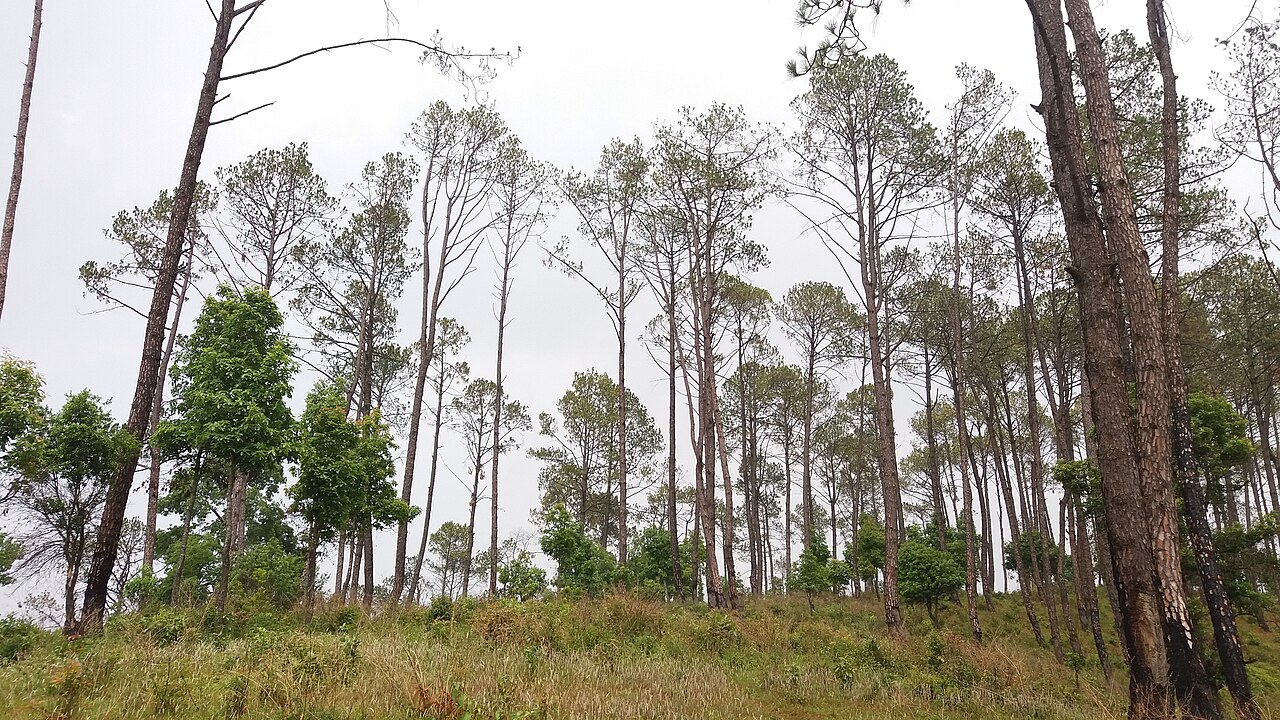
Image: Shadow Ayush, Badikhel community forest, Lalitpur ( CC BY-SA 4.0 )

What it is
Community forestry is forest management in which local people hold recognised rights to use and care for a defined woodland, under rules they help set, with the state sharing the legal role. An older note from the Food and Agriculture Organization of the United Nations treats that shift of rights and responsibilities as the core idea. When use rights sit only with a distant office, nearby households have little reason to guard a forest they cannot legally use. Illegal cutting and weak upkeep follow. With a user-group title, the people next to the trees can harvest what the rules allow and are expected to protect the rest.
The account here is Nepal’s system. The Forest Act, 2049 (1993), in the legal text cited below, gave community forest user groups a legal path to manage national forest handed over as community forest. The organization and the Federation of Community Forestry Users, Nepal, in a note of 28 July 2025, describe the present scale: more than 23,000 user groups managing about 2.4 million hectares, involving about 16 million people. Those figures are for Nepal under that Act.
How it works
A user group is a local assembly with a constitution, an operational plan, and a boundary. The group decides who may take firewood, timber, and forage, what is paid into the group fund, and how patrols run. The 1993 Act is the legal basis that makes that plan more than a village custom. District forest officers remain in the process. Handover follows the statute. The federation bargains with the state and with programmes of the Food and Agriculture Organization on training, enterprises, and projects that concern a changing climate.
The method fails when the group is captured, when women and Indigenous users are left off the committee, or when a market for timber strips the stand faster than the operational plan assumed. The 2025 meeting text stresses enterprises, women’s leadership, and open data, because a title on paper still needs a group that keeps the plan. The photograph is Badikhel community forest in Lalitpur, a named community forest in Nepal.
Where it already runs
Nepal is the geography the sources describe. The 1993 Act applies there. The 2025 figures, more than 23,000 groups, about 2.4 million hectares, and about 16 million people, are Nepal’s community-forestry numbers. Mid-hills districts are the classic landscape. The Churia and eastern programmes mentioned in that note are later work inside Nepal.
Other states run community or village forest schemes under other laws, with their own counts. The figures above belong to Nepal’s Act and to the 2025 note.
Limits
A user-group title still needs the group to keep the woodland. Groups can overcut, exclude women, or become a local elite’s woodlot. Markets that pay for clear stems will pressure the operational plan. The state can still reclaim a forest or stall the handover. The 2025 note is a partnership account. Condition of each hectare is a separate measurement.
The scope here is Nepal’s 1993 Act and the 2025 scale from the Food and Agriculture Organization and the Federation of Community Forestry Users, Nepal: more than 23,000 user groups, about 2.4 million hectares, and about 16 million people. It is a way of sharing management that still needs groups who answer for the plan.