

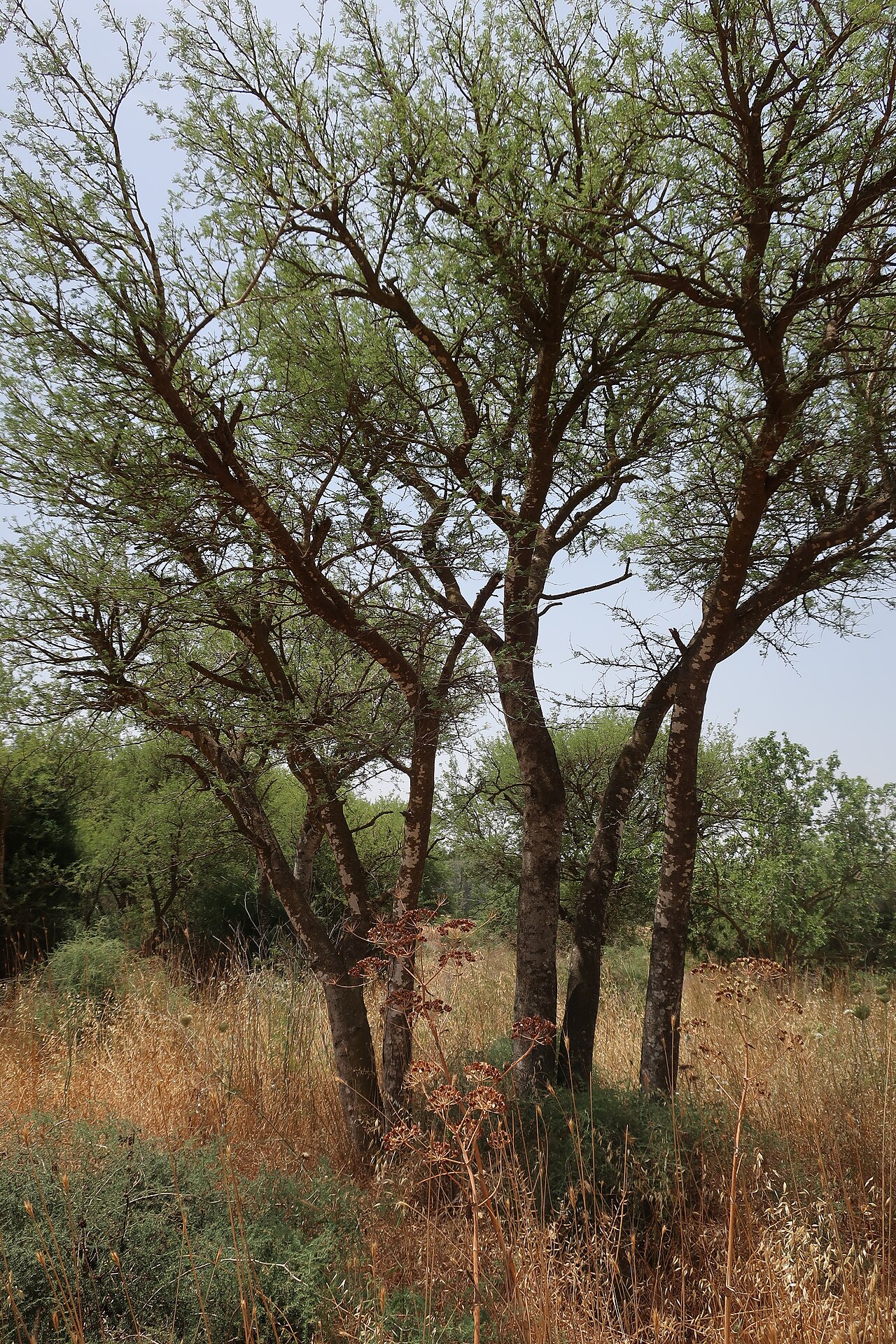
Image: Davidbena, winterthorn (Faidherbia albida) in the Elah valley ( CC0 )

What it is
Assisted natural regeneration is the deliberate protection and tending of trees that are already trying to return from roots, stumps, and seed, instead of planting a new stand from a nursery. The manual from the Food and Agriculture Organization of the United Nations treats it as a restoration method: keep fire and livestock off the recruits, release them from weeds and competing sprouts, and let the existing stock become a woodland. After cutting and cropping, dry landscapes often stay bare because those sprouts are grazed or burned before they can become trees. Seedlings trucked in later fail in the same heat.
Farmer-managed natural regeneration is the farm version of the same idea. Chomba and colleagues, in a 2020 review, define it as farmers protecting and managing naturally regenerating woody plants on agricultural land: selecting, pruning, and shielding shoots from rootstock or seed. They set it apart from regeneration work on forest or abandoned land, and from enrichment planting. The practice is to protect living stock that is already in the ground.
The photograph shows winterthorn (Faidherbia albida), the tree used in Sahelian parklands and the species most often named in the Niger account. Trees stand on fields, and the method is regeneration from what is already there.
How it works
A farmer or a restoration crew walks a field or a degraded woodland and finds the living stumps and seedlings. They choose which stems to keep, prune competing shoots so one or a few leaders can grow, and protect those stems from goats, cattle, and fire for long enough that they become trees. The manual describes weeding, firebreaks, and grazing rules as the ordinary tools. A nursery and a planting day are optional. Enrichment planting can be added later if the seed and root bank is too thin. Chomba and colleagues say that combination should be judged by the place.
Rights matter as much as pruning shears. If the person who protects a sprout has a right to the tree, a neighbour or a passing herd has a reason to leave it. Regreening Africa presents farmer-managed natural regeneration as one of its restoration approaches: farmer skill, local rules, and time. In arid country it costs less than industrial planting because the plant is already alive. Someone still has to keep the animals off and wait.
Where it already runs
The named landscape is south-central Niger, Maradi and Zinder, where winterthorn parklands returned across millions of hectares after farmers stopped treating every woody shoot as a weed. Chomba and colleagues review that literature and say that quantitative evidence is still sparse and comes mainly from those regions. Millions of hectares in Maradi and Zinder are the scale the sources give.
Regreening Africa and related programmes have carried the training into other Sahelian and East African landscapes. The manual also covers forest and woodland restoration where the remaining root stock is on public or community land rather than a household field. A printed leaflet alone leaves a dry hillside as it was.
Limits
If the stumps are dead, the seed bank is gone, and the soil is sealed, there is nothing to assist. Chomba and colleagues warn that bold claims outrun the measured evidence outside a few well-studied districts. Where the root bank is too thin, enrichment planting is added. A planted seedling is a planting.
Grazing, fire, and insecure tenure undo a season of pruning. A project that pays for training and then leaves without local rights often leaves a bare field. The work is the protection of living roots. Niger’s winterthorn parklands are the named large case.