
← Terraforming · Climate intervention
Marine cloud brightening
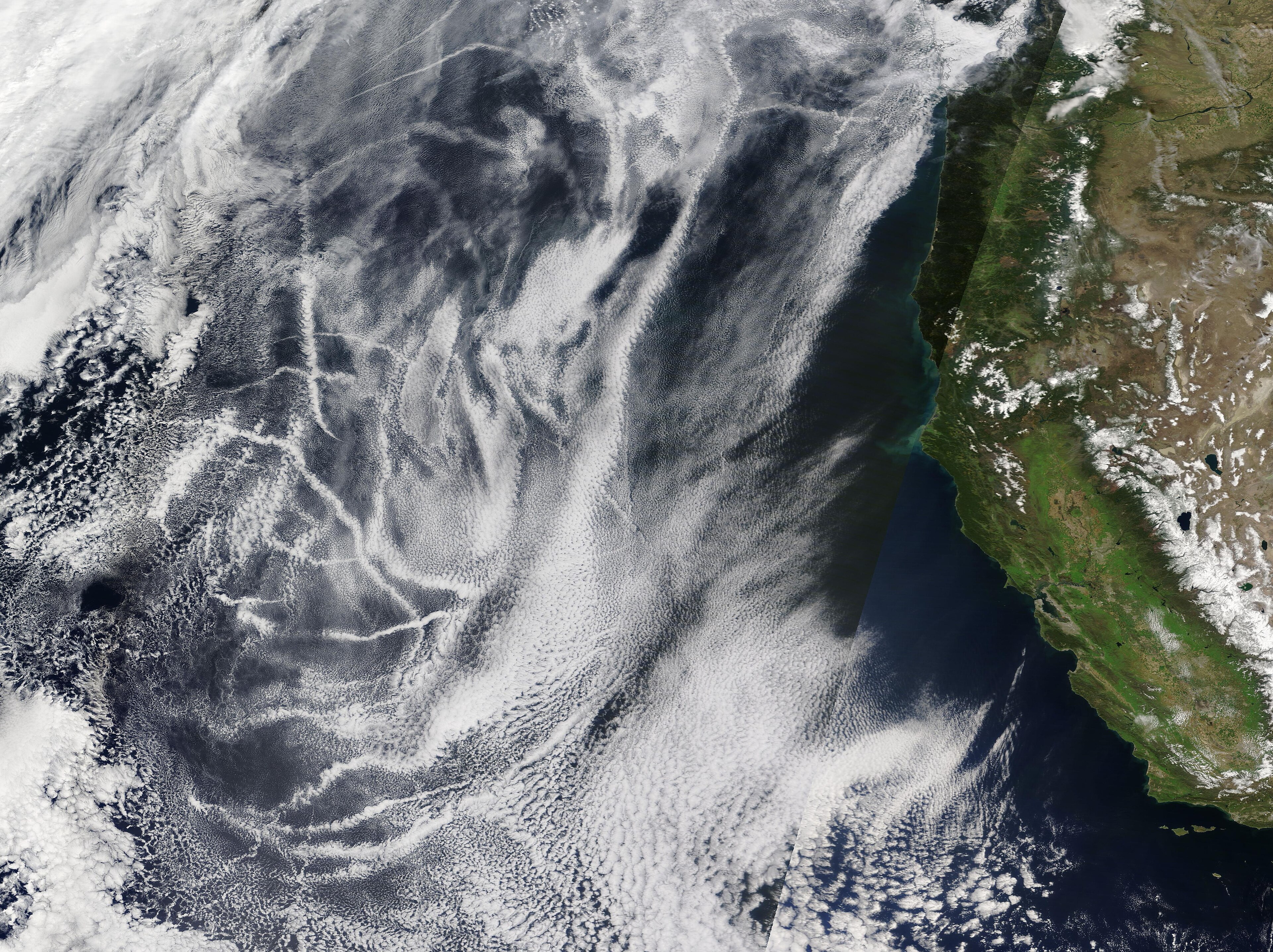
Spray sea salt into low ocean clouds so they reflect more sun. Ship tracks prove clouds notice pollution. That is not a planetary dimmer switch.

Jurisdiction: Research groups (Australia reef trials; U.S. university programme)
Years / status: Proposed by Latham (1990) and later reviews. Great Barrier Reef RRAP spray campaigns from 2020. University of Washington MCB Program ongoing; Alameda outdoor spray halted by the city in 2024. Status: research.
The plan
Fine seawater droplets would raise cloud droplet numbers in marine stratocumulus, increasing albedo and, in theory, cooling locally or globally. Ship tracks are the accidental experiment: exhaust particles already brighten some decks of cloud. MCB would try to do that with salt, on purpose, at a chosen size.
Construction / status
No operational cooling fleet. Southern Cross University teams, under the Reef Restoration and Adaptation Program, have sprayed from ships on the Great Barrier Reef since 2020 to test nozzles and, later, airborne cloud physics: a shading research line, not a saved reef. The UW-led programme builds generators and models. In 2024 Alameda, California, stopped a mist trial on a decommissioned ship after the fact.
What went wrong, or only partly worked
Physics papers can show more, smaller droplets in a treated cloud. That is a microphysical result. It is not proof that MCB can be steered, verified, or kept from shifting rainfall. It does not cancel ocean acidification. IPCC-class assessments still treat SRM methods as research with governance gaps, not as mitigation.
Lessons
A ship track is a clue, not a climate policy. Local reef shading experiments must stay labelled experiments. Do not sell MCB as a way to keep emitting. If a city can shut a trial, you do not have a planetary technology: you have a contentious instrument.
Sources
Latham et al. 2012 Philosophical Transactions review; University of Washington MCB Program; RRAP Cooling and Shading programme pages.