
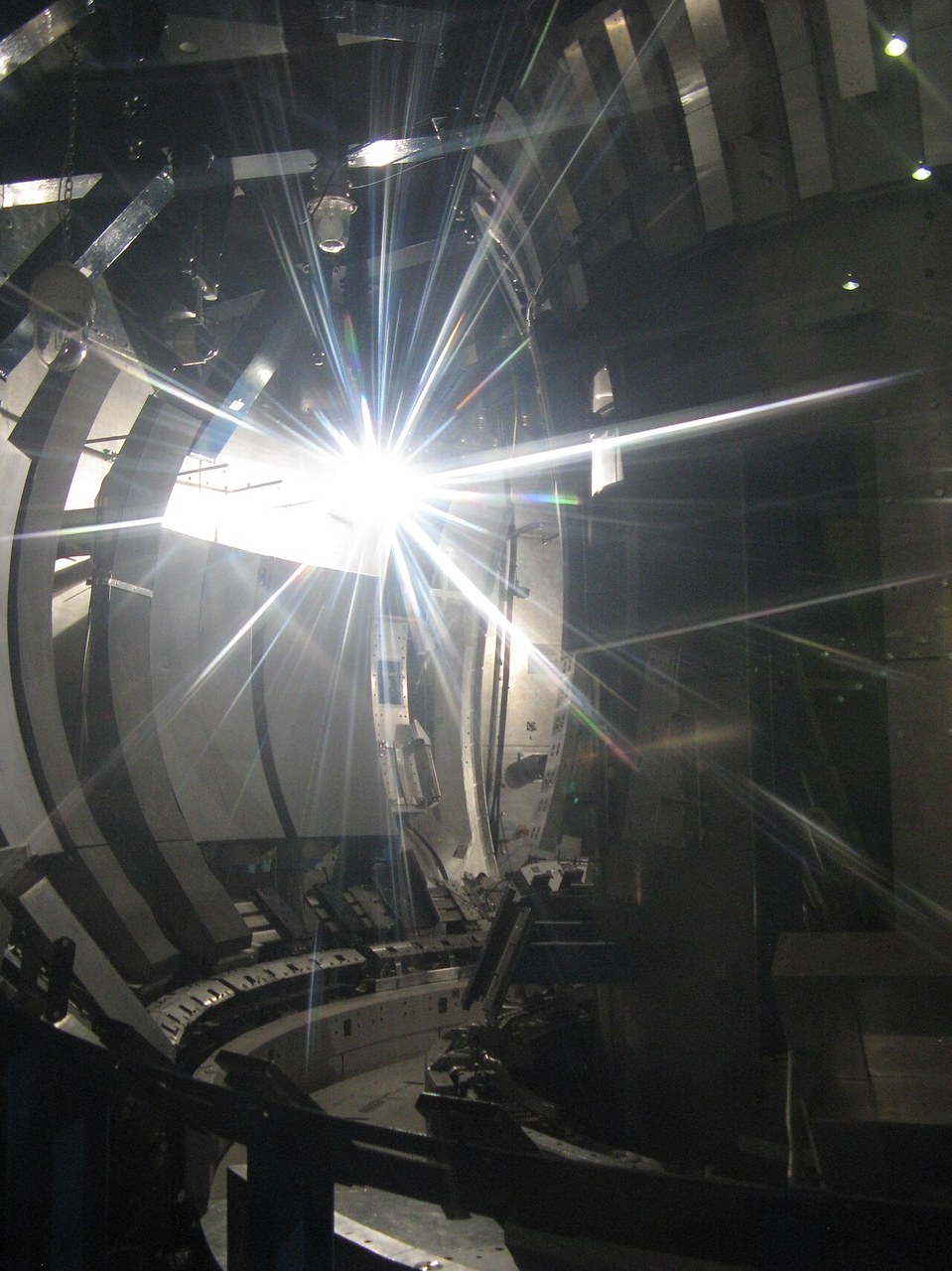
Illustrative stock photograph of the inside of the Joint European Torus, a tokamak in England and a different machine from SPARC.
Photo: Kevan, via Wikimedia Commons, licence Creative Commons Attribution 2.0 (https://creativecommons.org/licenses/by/2.0/). File page: https://commons.wikimedia.org/wiki/File:Joint_European_Torus_(6055833306).jpg
What it is
Fusion energy aims to join light atoms in a gas heated to over 100 million degrees Celsius, called a plasma, which is held in place by magnetic fields inside a doughnut-shaped machine called a tokamak. Before running such a machine, engineers use computer simulations to predict how heat, electric current and particles move through the plasma. TORAX is a simulator for the core of the plasma, released as open source by Google DeepMind in May 2024. It is written in a way that lets the computer work out how a small change in any setting would change the result, which makes it suitable for automatic searches for good settings and for training artificial intelligence. On 16 October 2025 DeepMind and Commonwealth Fusion Systems, a company building a tokamak called SPARC in Massachusetts, announced a research partnership. According to Google DeepMind, TORAX has already become central to the daily simulation work of Commonwealth Fusion Systems on SPARC.
Why it matters
A tokamak has many settings, such as magnet currents, fuel injection and heating power, and finding the best combination by hand is slow. DeepMind and Commonwealth Fusion Systems describe running millions of virtual experiments in TORAX before SPARC is switched on, so that the team can start with promising plans. SPARC aims to be the first magnetic fusion machine to produce more power from fusion than it takes to sustain it. The partnership also explores using reinforcement learning, a way for a computer program to learn by trial and reward, to manage the heat that SPARC will release onto its walls. Because TORAX is open, other fusion teams can use and check the same tool.
How to read it
All of this work concerns planning and simulation. A simulation is a prediction, and its value depends on how closely it matches a real machine. Google DeepMind says it will validate and calibrate TORAX against past tokamak data and more detailed simulations as it goes. The partnership is a research effort, and SPARC itself has not yet produced a plasma: in late August 2026 Commonwealth Fusion Systems wrote that it expects to start operating SPARC in the coming months. Two dates are easy to confuse: May 2024 is the release of the simulator, and 16 October 2025 is the announcement of the partnership.
Limits
TORAX models the core of the plasma. It covers heat and particle flow and the electric current, and it relies on simpler stand-in models for some physics; the project’s own description says that one of its stand-ins covers only limited conditions. It still has to be checked against experiments. SPARC has not demonstrated net fusion energy, which is its goal. The control work is at an early stage: the partnership says it begins with learning to spread the heat on the machine’s walls, and Google DeepMind describes wider real-time control as a possibility for the future. An earlier DeepMind result from 2022 showed that reinforcement learning could control the magnets of a research tokamak in Switzerland, but that was a different machine and a different task.
Sources
- Google DeepMind: Bringing AI to the next generation of fusion energy (16 October 2025)
- Google DeepMind: Accelerating fusion science through learned plasma control (with the note on the May 2024 TORAX release)
- Commonwealth Fusion Systems: With AI alliance, Google DeepMind and CFS take fusion to the next level (16 October 2025)
- Commonwealth Fusion Systems: Why CFS is confident we’ll demonstrate net fusion energy (28 August 2026)
- GitHub: google-deepmind/torax (code and description)
- Wikimedia Commons: Joint European Torus (photo)
