

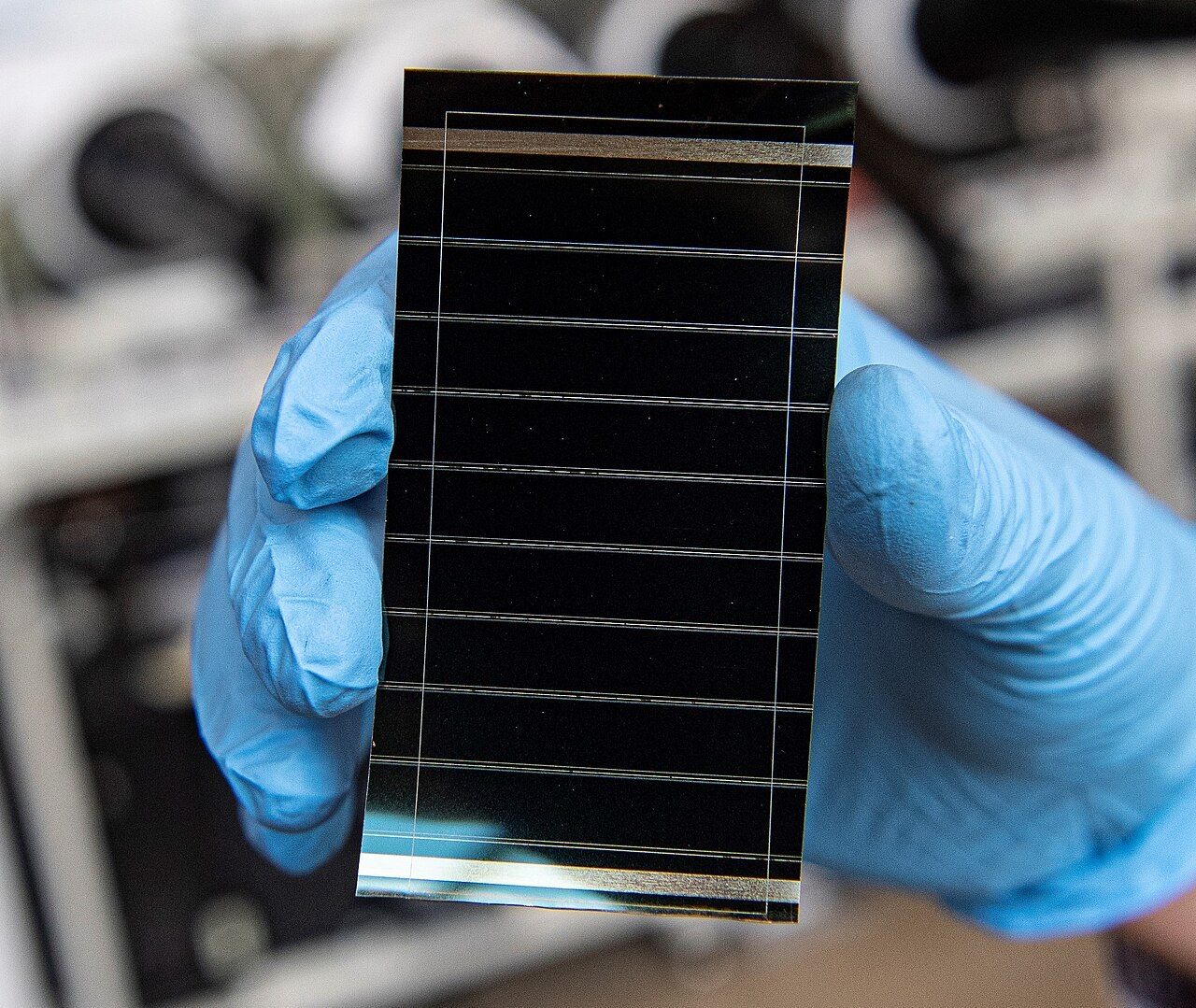
A gloved hand holding a small perovskite solar cell.
Photo: Dennis Schroeder, National Renewable Energy Laboratory (renamed the National Laboratory of the Rockies in December 2025), via Wikimedia Commons, public domain (work of the U.S. federal government).

What it is
A perovskite-silicon tandem solar cell puts a thin layer of a perovskite material on top of a silicon cell. Perovskites are a family of materials that absorb certain colors of light very effectively, and the U.S. Department of Energy explains that the silicon layer beneath uses the colors of light that the perovskite lets through, which lets a tandem cell be more efficient in theory than either material alone. Oxford PV is a solar technology company with offices in England and Germany, and it has worked on this technology since 2014. Its first commercial panels use 72 of its own perovskite-on-silicon cells.
Why it matters
On 5 September 2024 Oxford PV announced that it had started commercializing its tandem technology with a first shipment to a U.S.-based customer, for a utility-scale installation. The company calls this the first commercial deployment of a perovskite tandem solar panel worldwide. Oxford PV says the panels can produce up to 20 percent more energy than a standard silicon panel, and that this can lower the levelised cost of electricity, the average cost of each unit of electricity over a plant’s life, and make more efficient use of land. The company gives the first panels on the market a module efficiency of 24.5 percent, and it also cites a recent module efficiency record of 26.9 percent. The cells are made on Oxford PV’s megawatt-scale pilot line in Brandenburg an der Havel, Germany.
How to read it
The figures for panel efficiency, extra energy and the record come from Oxford PV’s own announcement. Module efficiency is the share of the sunlight falling on a whole panel that becomes electricity. The U.S. Department of Energy reports that perovskite-silicon tandem cells have reached efficiencies of almost 34 percent in research. The sale of 5 September 2024 is one shipment from a pilot line, and the company describes plans for further utility customers, specialty products and pilot residential applications.
Limits
The U.S. Department of Energy says perovskite solar technology is still short of large-scale manufacturing. It lists four challenges for commercial success: cell stability and durability, power conversion efficiency at scale, manufacturability, and technology validation and bankability, meaning whether lenders will finance projects that use it. Oxford PV’s 2024 announcement describes scaling production to gigawatt scale as a plan for a future high-volume manufacturing site. Independent test results and field data on how the panels age will settle how they compare with silicon panels.
Sources
- Oxford PV: 20% more powerful tandem solar panels enter commercial use for the first time in the US (5 September 2024)
- U.S. Department of Energy: Perovskite Solar Cells
- U.S. Department of Energy: Energy Department Renames NREL “National Lab of the Rockies” (1 December 2025)
- Wikimedia Commons: Perovskite solar cell (photo)