

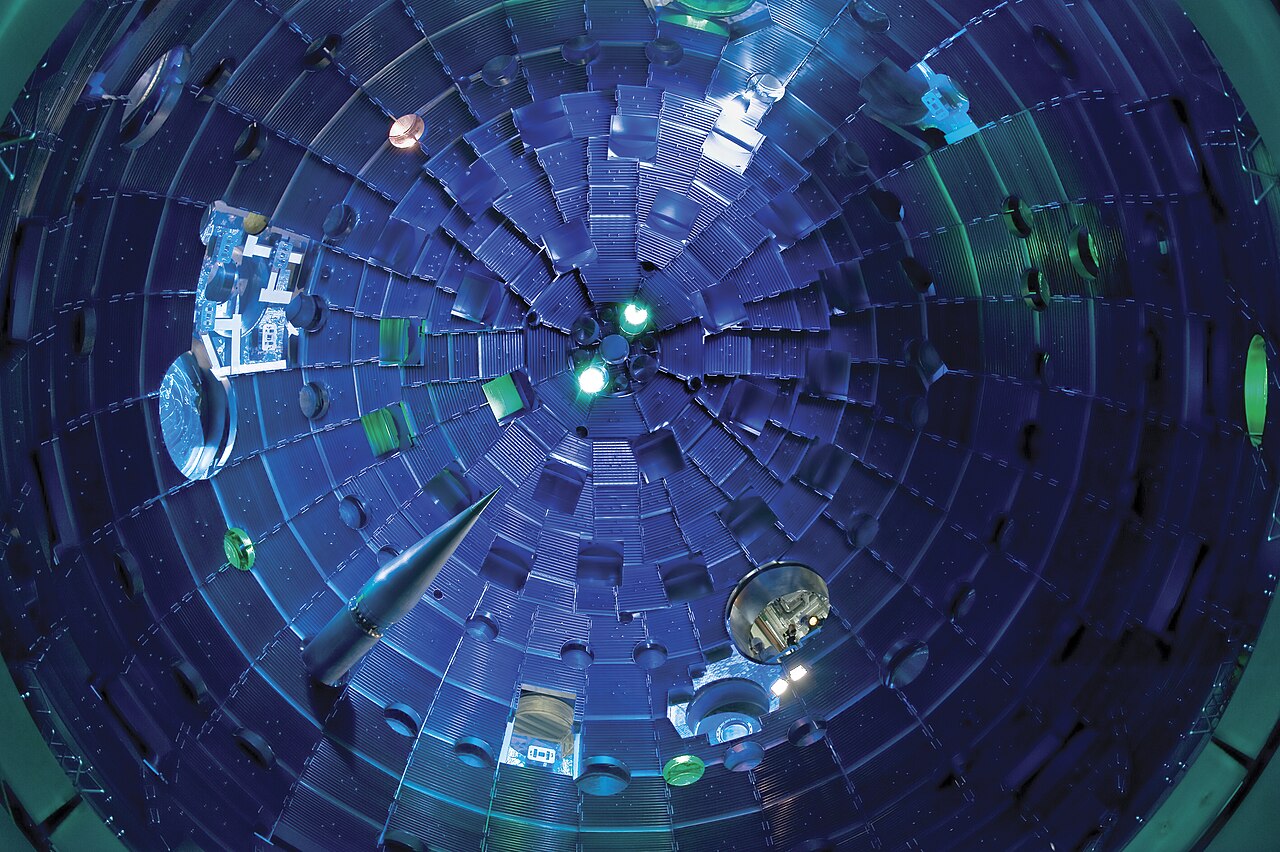
Image: Lawrence Livermore National Security ( CC BY-SA 3.0 )

What it is
The National Ignition Facility at Lawrence Livermore National Laboratory fires 192 laser beams at a tiny capsule. On 5 December 2022 the capsule yielded about 3.15 MJ of fusion energy after about 2.05 MJ reached the target: the first controlled ignition, also called scientific breakeven on the target. Later shots repeated and sometimes exceeded that result. NIF’s job is stockpile stewardship and science, not a turbine.
Problem it targets
Inertial fusion energy (IFE) is a second path beside tokamaks: many tiny implosions per second instead of a steady magnetic bottle. Ignition showed the physics can work. A power plant would need cheap targets, high repetition rate, and wall-plug efficiency that NIF does not have.
How it works
Lasers convert to X-rays inside a hohlraum; the capsule implodes; deuterium-tritium fuses for a fraction of a second. The lasers themselves take far more energy from the wall than the 2 MJ that reach the target. That gap is why this is not a power station.
Status and players
LLNL / NNSA (NIF). Private IFE firms (for example Focused Energy, Xcimer, Marvel Fusion, and others) are trying higher-efficiency lasers or different drivers. DOE restarted a coordinated IFE program after ignition.
Risks and limits
Confusing target gain with plant gain. Weapon-lab priorities. Target manufacturing at power-plant rates is unsolved. Honest talk says “ignition happened” and “commercial IFE has not.”
Sources
LLNL ignition page; DOE announcement of 13 Dec 2022 (shot of 5 Dec 2022: about 2.05 MJ on target, 3.15 MJ fusion yield). Target gain is not plant gain.