
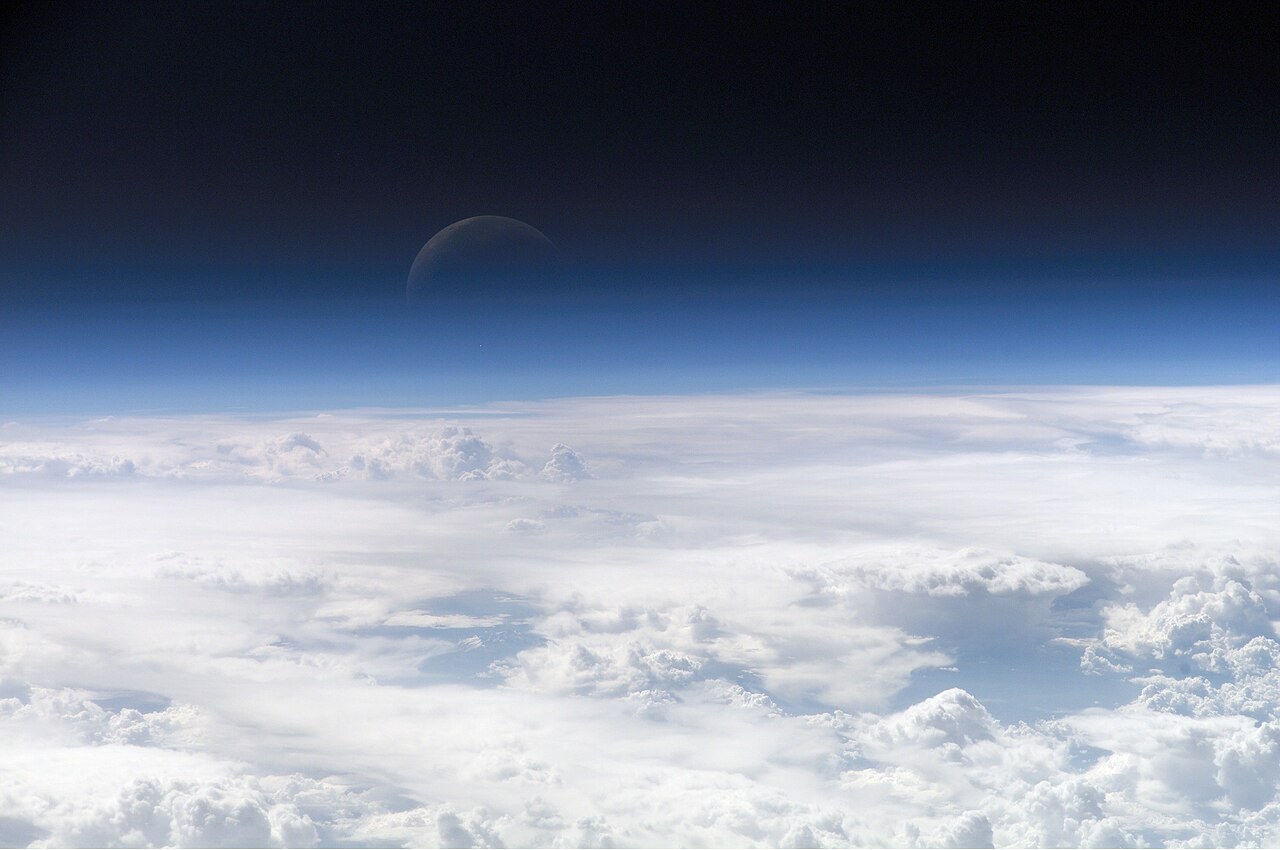
Illustrative stock photograph of Earth’s atmosphere and a crescent Moon taken from the International Space Station in 2006.
Photo: National Aeronautics and Space Administration Earth Observatory (International Space Station Expedition 13 crew), via Wikimedia Commons, public domain . File page: https://commons.wikimedia.org/wiki/File:Top_of_Atmosphere.jpg

What it is
A climate model divides the atmosphere into a grid of boxes and calculates how air, heat and moisture move between them. Large-scale motion follows well-known physics, but clouds and rain form on scales much smaller than a box, so conventional models fill that gap with simplified rules of thumb. NeuralGCM, from Google Research with the European Centre for Medium-Range Weather Forecasts, is a hybrid. It keeps a physics solver for the large-scale motion and replaces the rules of thumb with a neural network, a computer program that learns patterns from data, trained on decades of past weather records. Because the solver and the network were trained together as one system, this helps the model stay stable when it runs for years. Its code and trained models are published openly.
Why it matters
Climate research needs many long simulations to see how the atmosphere might respond to changes, and each simulation of a detailed physics model needs a supercomputer. According to Google Research, a year of simulated atmosphere took about 8 minutes with NeuralGCM, against about 20 days with a very detailed physics model from the United States National Oceanic and Atmospheric Administration, which makes NeuralGCM more than 3,500 times faster. Because it can run on a single machine, more research groups could run their own experiments. The Nature paper also reports that NeuralGCM’s ensemble weather forecasts (sets of forecasts from slightly different starting conditions) are competitive with the European Centre’s own for 1 to 15 days ahead.
How to read it
The 0.25 against 0.75 degrees Celsius comparison is a test on the past. The model was run over the 40 years from 1980 to 2020, given the real sea-surface temperatures of those years, and its air temperatures were compared with a standard record of past weather. According to Google Research, the average error was 0.25 degrees Celsius for NeuralGCM and 0.75 for the atmosphere-only models from an international model comparison project, which makes the new model about three times closer. Atmosphere-only means that the ocean is not simulated: its temperatures are fed in from observations, which is how the comparison models are also used. The speed figure compares the same task, simulating the atmosphere for a year, at the settings the researchers chose for each model.
Limits
NeuralGCM simulates only the atmosphere. Oceans, sea ice and the carbon cycle are outside the model, and Google Research hopes to add them later. In the 40-year test, 22 of 37 runs stayed stable for the full 40 years, and the results come from those 22. The authors state that the model does not extrapolate to substantially different future climates: when sea-surface temperatures were raised by 1 and 2 degrees it showed some realistic features of warming, but at 4 degrees its response departed from what scientists expect and it drifted. In an indirect comparison with the detailed physics model, its error for rainfall (measured as rain minus evaporation) is slightly larger, and in short forecasts it underestimates the most extreme tropical events. The authors also note that their comparison with the detailed physics model slightly favours NeuralGCM, because it was tuned to match the same weather record it was judged against.