

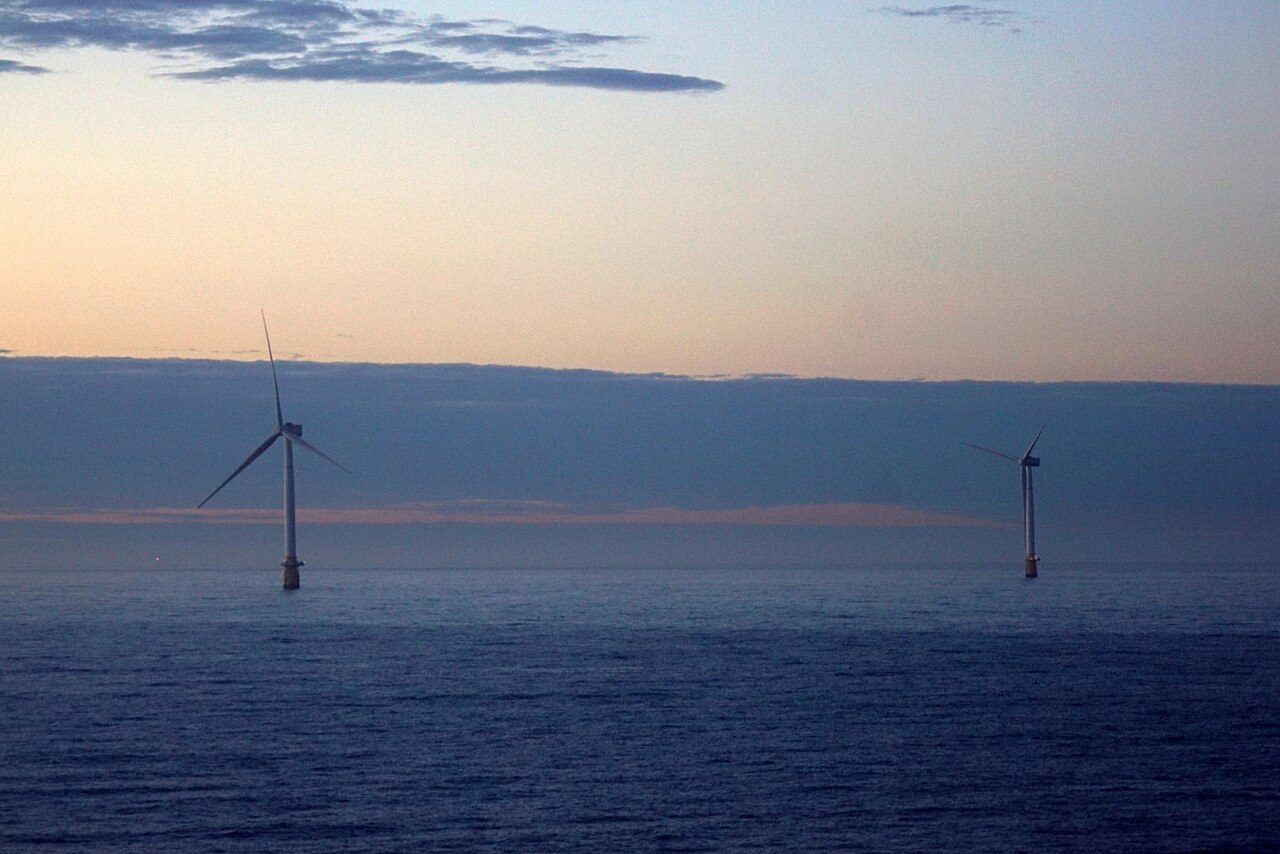
Two floating wind turbines of the Hywind Scotland wind farm in the North Sea off Peterhead, Scotland.
Photo: Mike Pennington, geograph.org.uk, via Wikimedia Commons, Creative Commons Attribution-ShareAlike 2.0 Generic licence .
What it is
A floating offshore wind turbine stands on a buoyant platform held in place by mooring lines and anchors, so it can be placed in water too deep for a foundation fixed to the seabed. The Goto Offshore Wind Farm is run by Goto Floating Wind Farm LLC, a project company owned by six firms: TODA CORPORATION, a Japanese construction company that leads the project company, ENEOS Renewable Energy Corporation, Osaka Gas, INPEX CORPORATION, and the electric utilities Kansai Electric Power and Chubu Electric Power. It has eight turbines of 2.1 megawatts each, 16.8 megawatts in total, with a rotor diameter of 80 meters. Each turbine stands on a hybrid spar-type floater, an upright floating cylinder with a steel upper section and a concrete lower section, designed and built by TODA CORPORATION.
Why it matters
The U.S. Department of Energy reports that about two-thirds of U.S. offshore wind potential lies in water too deep for standard fixed-bottom turbines, using a limit of 60 meters, so floating technology is needed there. The project company and its shareholders announced on 5 January 2026 that commercial operation of the Goto farm had begun. They describe it as Japan’s first commercial floating offshore wind farm, and as the first facility of its kind in Japan certified under the Act on Promoting the Utilization of Sea Areas for the Development of Marine Renewable Energy Power Generation Facilities (the Marine Renewable Energy Sea-Area Utilization Act). They also call the hybrid spar floater the world’s first commercial application of that floater type. The electricity is to be supplied preferentially to local retail electricity providers.
How to read it
The 16.8-megawatt capacity, the 5 January 2026 start date and the description of the floater come from the project company and its shareholders, whose announcement is the source of these details. Floating wind farms operated before Goto. Equinor, the Norwegian energy company, reports that its 30-megawatt Hywind Scotland pilot park, with five turbines on spar floaters in water 95 to 120 meters deep, has produced electricity since October 2017, and the photo here shows two of those turbines. Goto’s “first” refers to Japan and to commercial operation.
Limits
At 16.8 megawatts, Goto is a small wind farm. The Department of Energy expects the costs of first-generation floating wind facilities to exceed those of fixed-bottom offshore wind by over 50 percent, and it has set a goal of cutting the cost of floating wind by more than 70 percent by 2035. The Goto announcement gives no cost or output data, so how the farm performs is still to be reported.
Sources
- TODA CORPORATION, Goto Floating Wind Farm LLC and shareholders: Goto Offshore Wind Farm Begins Commercial Operation, Japan’s First Commercial Floating Wind Power Project (5 January 2026, PDF)
- Chubu Electric Power Co., Inc.: Goto Offshore Wind Farm Begins Commercial Operation, Japan’s First Commercial Floating Wind Power Project (5 January 2026)
- U.S. Department of Energy: Floating Offshore Wind Shot, Progress and Priorities (May 2024, PDF)
- Equinor: Hywind Scotland, the world’s first floating wind farm
- Wikimedia Commons: Hywind Wind Farm, off Peterhead (photo)
