

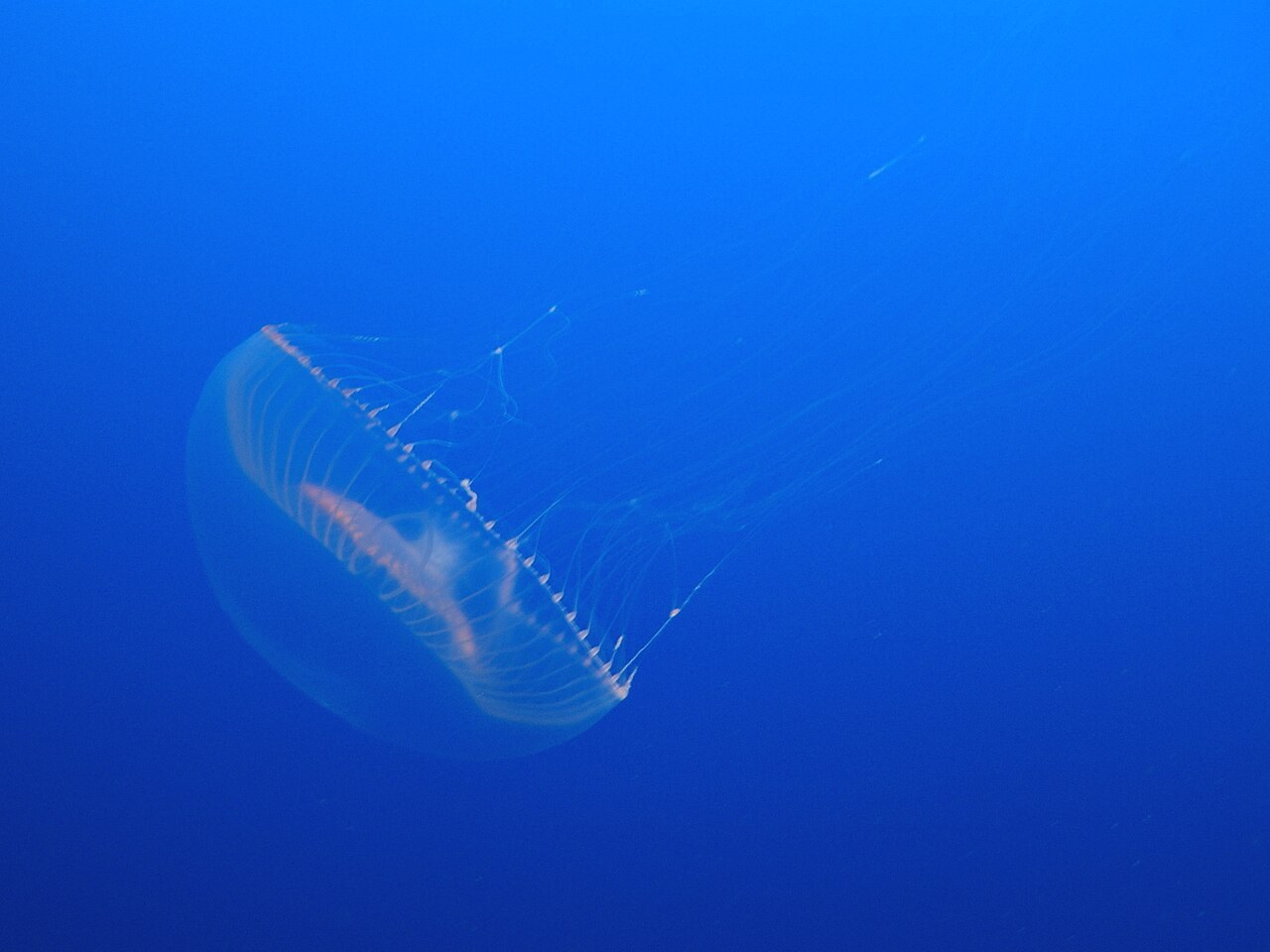
Illustrative stock photograph of a crystal jelly (Aequorea victoria), the jellyfish species in which green fluorescent protein was first found.
Photo: Mnolf, via Wikimedia Commons, licence Creative Commons Attribution-ShareAlike 3.0 (https://creativecommons.org/licenses/by-sa/3.0/). File page: https://commons.wikimedia.org/wiki/File:Aequorea_victoria.jpg
What it is
Proteins are long chains of building blocks called amino acids, and the order of those blocks decides a protein’s shape and what it can do. ESM3 is a language model for proteins: just as a text model learns from words, it learns from the sequences, three-dimensional shapes and known functions of billions of natural proteins. It can be given a partial description of a protein, such as part of a shape or a wanted function, and fill in the rest. EvolutionaryScale, a public benefit company, built the model and tested it on fluorescent proteins, the kind that make jellyfish and corals glow. Selected designs were made in the laboratory, and one bright protein matched the closest known fluorescent protein at 58 percent of its positions. A smaller version of the model, with 1.4 billion parameters (the adjustable numbers a model learns during training), has been released openly for anyone to use.
Why it matters
Fluorescent proteins are everyday laboratory tools. Attached to another protein, they let researchers watch where it goes inside a living cell, and their discovery and development was honoured with the Nobel Prize in Chemistry in 2008. Nature produced them in only a few branches of the tree of life, and most known variants were found by searching nature. A design tool that reaches far from every known protein could widen the search for new research tools, medicines and enzymes, which is the aim EvolutionaryScale states for ESM3.
How to read it
A sequence identity of 58 percent means that, lined up against the closest natural fluorescent protein, 58 of every 100 positions in the chain hold the same building block. The new protein differs at 96 of its 229 positions. The figure of 500 million years is the authors’ estimate: natural fluorescent proteins that differ by a similar amount are separated by hundreds of millions of years of evolution, so the gap is described as equivalent to that span. The model wrote the sequence directly, and the time span is a way to express the distance. For comparison, earlier laboratory and machine-learning searches reached variants that differ in up to 20 percent of positions. According to the EvolutionaryScale announcement, the experiment was small: a first round of 96 designs and a second round of 96 designs built on the best result of the first.
Limits
The laboratory test covers one protein family, fluorescent proteins. In the first round the most distant protein that glowed was about 50 times dimmer than natural fluorescent proteins, and its glowing centre took about a week to form, where natural ones need less than a day; only the second round gave several designs with brightness similar to natural ones. Other examples in the announcement, such as a proposed scaffold for an enzyme that breaks down plastic, are computer designs. The figure of 500 million years is an estimate based on how fast natural fluorescent proteins diverge. The open model is the version with 1.4 billion parameters, and larger models of the family are offered through the company’s online service.
Sources
- Europe PubMed Central: Simulating 500 million years of evolution with a language model (Science, 16 January 2025)
- EvolutionaryScale: ESM3: Simulating 500 million years of evolution with a language model (announcement with the January 2025 update)
- Hugging Face: ESM3 open model, model card
- Nobel Prize: Press release, The Nobel Prize in Chemistry 2008
- Wikimedia Commons: Aequorea victoria (photo)
