

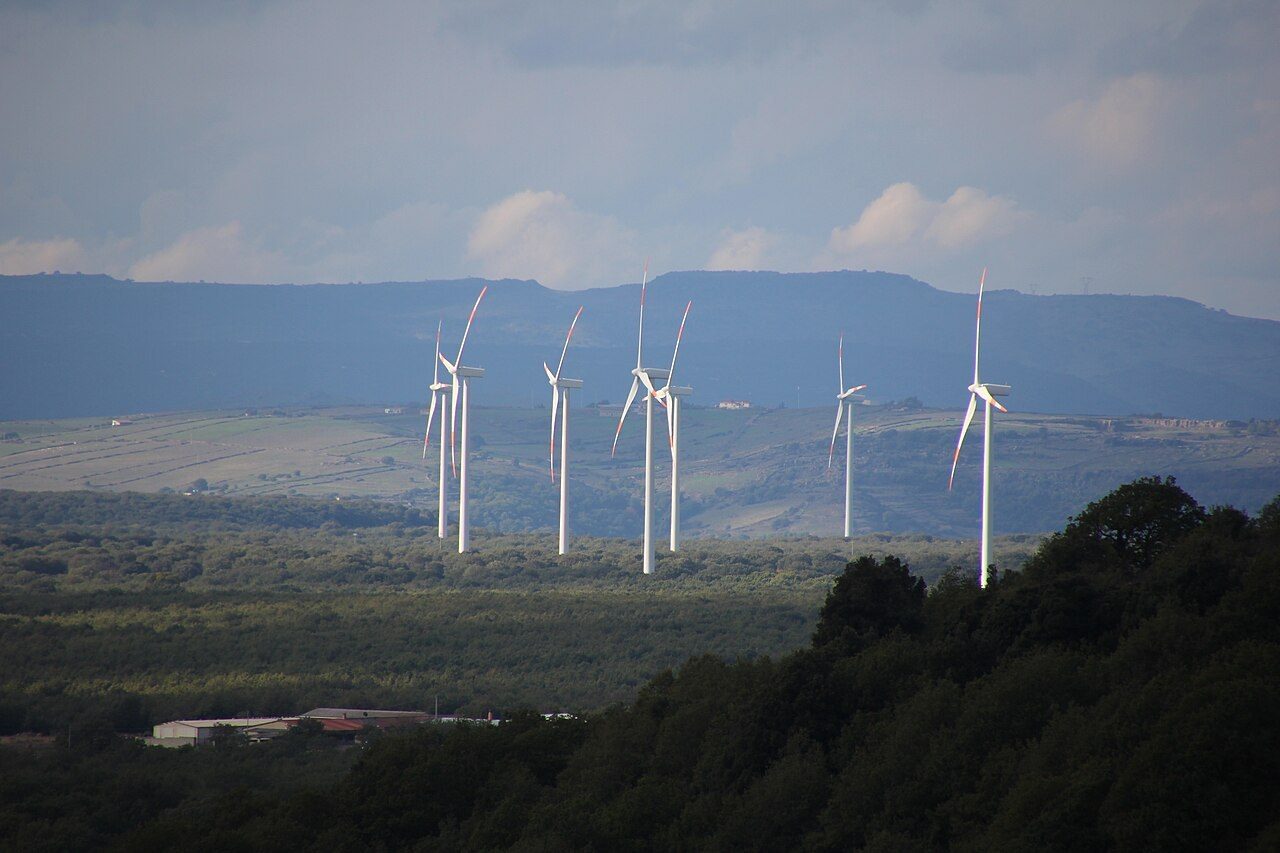
Wind turbines of the Campeda wind farm near Bonorva in Sardinia, Italy, seen from a hillside.
Photo: Gianni Careddu, via Wikimedia Commons, Creative Commons Attribution-ShareAlike 4.0 International licence .
What it is
Energy Dome is a company based in Milan, Italy, that calls its storage system a “CO2 Battery”. It works in a closed loop. When the grid has spare electricity, a compressor squeezes carbon dioxide gas from a large dome to about 55 times atmospheric pressure, the gas is cooled and turned into a liquid, and the liquid is kept in pressure vessels. When the grid needs power, the liquid is evaporated and heated, and the gas expands through a turbine that drives a generator before returning to the dome. IEEE Spectrum, the magazine of the Institute of Electrical and Electronics Engineers, reports that the dome at Ottana holds 2,000 tonnes of carbon dioxide bought from a gas supplier, and that charging takes about 10 hours.
Why it matters
IEEE Spectrum reports that Energy Dome began operating its 20-megawatt facility in Ottana in July 2025, and that it produces 200 megawatt-hours of electricity, or 20 megawatts over 10 hours. The magazine says the best new grid batteries on the market, mainly lithium-ion, provide only about 4 to 8 hours of storage, and it calls storage that lasts more than 8 hours long-duration. It also reports that the Indian power company NTPC Limited expected to complete a plant at Kudgi in Karnataka in 2026, that the Wisconsin utility Alliant Energy had been cleared to begin construction of one in 2026 to supply power to 18,000 homes, and that Google plans to deploy the plants at its key data-center locations in Europe, the United States and the Asia-Pacific region. In June and July 2026 Energy Dome announced a 23-megawatt, 200-megawatt-hour project with Google in County Offaly, Ireland, and a 20-megawatt, 200-megawatt-hour plant with SEC, a state-owned renewable energy company, in Victoria, Australia.
How to read it
Ottana is the one full-size grid-connected plant that IEEE Spectrum describes, and the other plants are projects with expected or announced dates. The 200 megawatt-hours is the plant’s capacity, which is 20 megawatts delivered for 10 hours. Energy Dome’s own page states a round-trip efficiency of 70 percent or more net, the share of stored electricity that comes back out, and a life of more than 30 years. IEEE Spectrum also reports Energy Dome’s expectation that its systems will cost 30 percent less than lithium-ion. Those figures are the company’s own.
Limits
IEEE Spectrum reports that the facility takes up about twice as much land as a lithium-ion battery of comparable capacity, that the rest of the plant needs about 5 hectares of flat land and less than two years to build, and that the dome is about the height of a sports stadium and could draw objections from neighbors. Energy Dome’s chief executive says the dome can withstand wind up to 160 kilometers per hour, and that if the dome were punctured the 2,000 tonnes of carbon dioxide would enter the atmosphere and people would need to stay back 70 meters or more until the air clears.
Sources
- IEEE Spectrum: Grid-Scale Bubble Batteries Will Soon Be Everywhere, online as CO2 Batteries That Store Grid Energy Take Off Globally (Emily Waltz, 21 December 2025)
- Energy Dome: CO2 Battery technology page
- Energy Dome: Google and Energy Dome Advance Multi-Continent Energy Storage Buildout with First Bilateral Project in Ireland (23 June 2026)
- Energy Dome: Energy Dome to Deliver Victoria’s First 10-hour Battery in Partnership with SEC (10 July 2026)
- Wikimedia Commons: Bonorva - Parco eolico di Campeda (01) (photo)
