

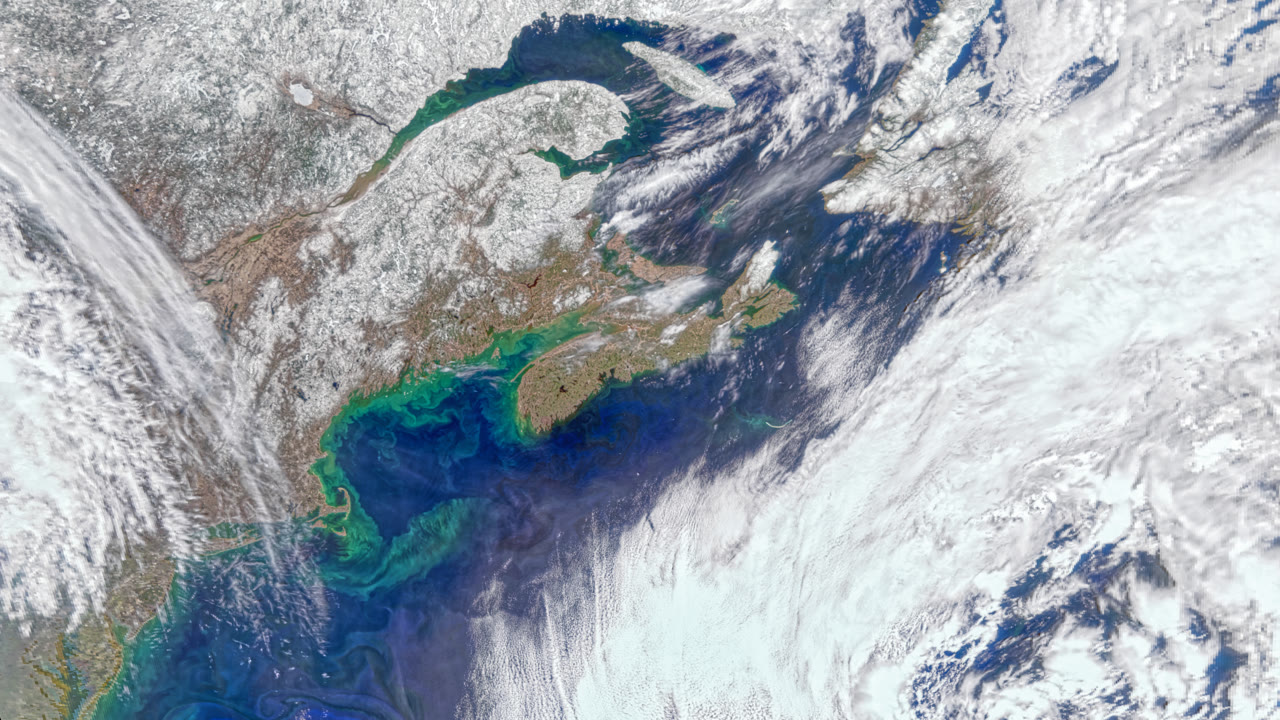
Image: NASA Scientific Visualization Studio ( Public domain )

What it is
PACE (Plankton, Aerosol, Cloud, ocean Ecosystem) is a NASA Earth science satellite launched 8 February 2024 from Cape Canaveral. It carries a hyperspectral Ocean Color Instrument (OCI) and two multi-angle polarimeters (HARP2 and SPEXone) so ocean biology and atmospheric particles are observed together.
Problem it targets
Ocean colour satellites long saw a blur of green. Managers needed daily global maps of which phytoplankton communities are present, and how aerosols and clouds couple to that biology.
How it works
OCI measures water-leaving reflectance across many narrow bands, so scientists can separate phytoplankton community types rather than bulk chlorophyll alone. The polarimeters constrain aerosol and cloud properties that also shape climate and air quality. Public science-quality data began 11 April 2024.
Status and players
NASA, in global Earth orbit, with open data distribution. Uses include harmful algal bloom tracking, fisheries-relevant ocean-health research, and climate process studies.
Risks and limits
Coastal waters that are optically complex, and clouds, still challenge the retrievals. PACE improves discrimination of plankton communities. It is not a fisheries management system by itself and not a plastic inventory. Management decisions still need in-situ networks beside the satellite.
Sources
NASA PACE mission page, the 8 February 2024 launch release, and the NASA Science mission page. Public data from 11 April 2024. Not forest biomass radar and not a plastic inventory.