
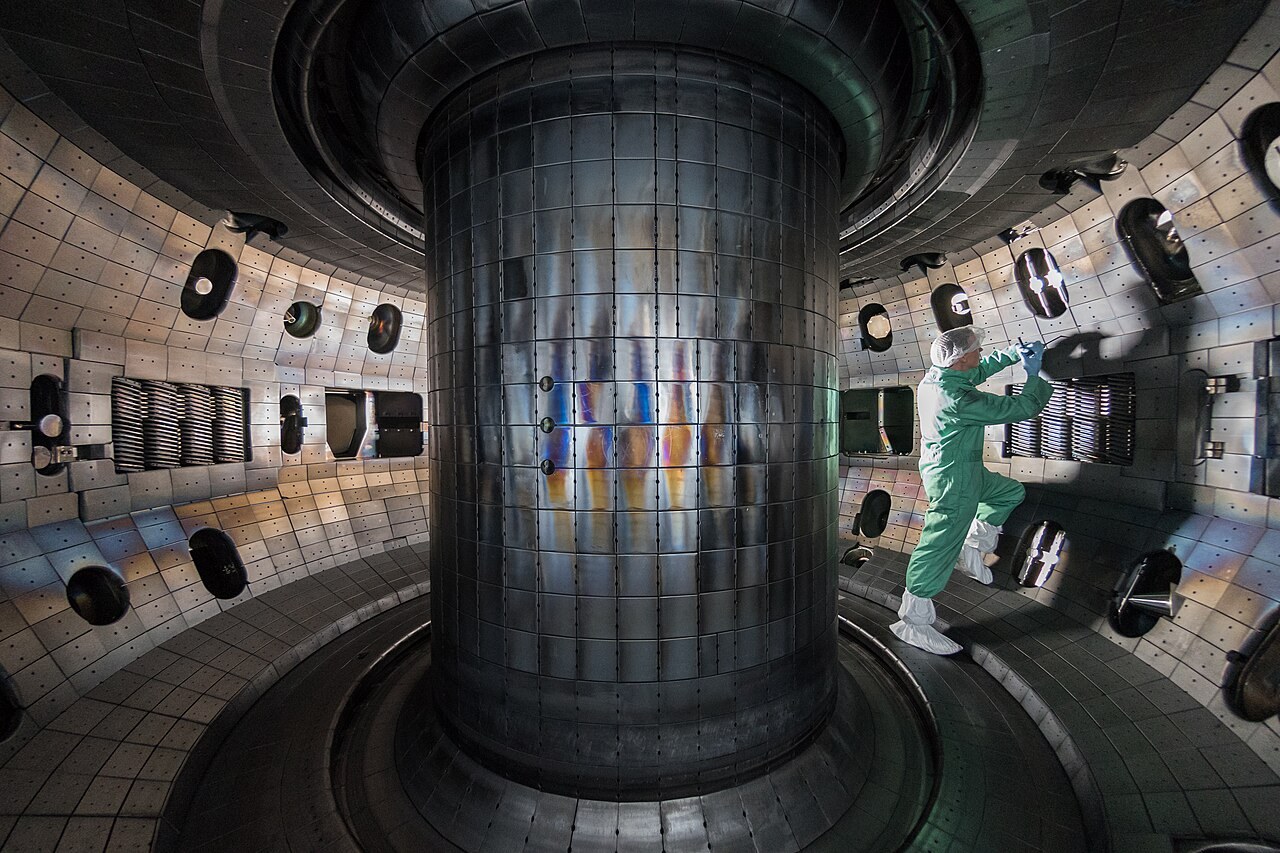
Illustrative stock photograph of a worker inside the DIII-D vacuum vessel during a maintenance period in 2017. It was taken years before the experiment described here.
Photo: Rswilcox, via Wikimedia Commons, licence Creative Commons Attribution-ShareAlike 4.0 (https://creativecommons.org/licenses/by-sa/4.0/). File page: https://commons.wikimedia.org/wiki/File:2017_TOCAMAC_Fusion_Chamber_N0689.jpg
What it is
A tokamak holds an extremely hot gas, called a plasma, inside a doughnut-shaped magnetic field. Sometimes the magnetic field lines inside the plasma break and reconnect, forming ring-shaped bubbles called magnetic islands. This is called a tearing instability, and it is the leading cause of disruptions, sudden collapses of the plasma that end the experiment and can damage the machine’s walls. A team from Princeton University and the DIII-D National Fusion Facility, a United States Department of Energy research facility located at General Atomics in San Diego, trained a controller using reinforcement learning, a method in which a program learns by trying actions and being rewarded. The program was trained on a computer model that predicts, 25 milliseconds ahead, the plasma pressure and a tearing risk score between 0 and 1. It learned to change two things, the heating power of the neutral beams and the shape of the plasma, so as to keep the pressure high while the predicted risk stays under a chosen limit.
Why it matters
A power plant based on a tokamak needs a high plasma pressure to produce energy, and it needs to avoid disruptions, which can damage the walls. Earlier methods mainly tried to suppress tearing after it had formed, which often came too late, so the aim here was to avoid it from the start. The Nature paper reports that the controller kept the predicted risk under its limit even in difficult conditions of the kind planned for the International Thermonuclear Experimental Reactor (ITER), the large international fusion project under construction in France, where the plasma rotates only slowly and tearing is especially hard to avoid. In one comparison run, a traditional controller held a fixed pressure target, a large tearing event began and the plasma collapsed.
How to read it
The tearing risk score is a prediction from a trained model, running from 0 (no risk expected) to 1 (high risk), for 25 milliseconds ahead. The controller was trained with three different limits: 0.2, 0.5 and 0.7. A lower limit makes it more cautious. With 0.5 and 0.7 the plasma lasted until the end of the planned period; with the most cautious limit of 0.2 the plasma collapsed at about 5.5 seconds. The cautious controller had reduced the heating to a pre-set lower bound and could not reduce it further, an interaction that was not part of its training. So a stricter limit was not always the better choice. Compare this with the traditional controller in the same experiment: it kept a fixed pressure target, a large tearing event began after 2.6 seconds, and the plasma collapsed 0.5 seconds later.
Limits
The authors call the work a proof of concept at an early stage of fine-tuning. It was tested on one machine with two controls (heating power and plasma shape), and the other controls, including the plasma current, were held fixed to keep the conditions close to those planned for ITER. The prediction model is a black box: it can say that tearing is likely but cannot explain the cause. The authors note that the controller will need to be tested with more controls, such as the radio-wave heating that ITER plans to use, and with the more limited sensors that a power plant will have. In one test with added radio-wave heating, the plasma was disrupted after an unplanned loss of plasma current, though the controller handled a brief spike in risk. The authors also report that the controller’s shape changes were large, and they checked by calculation that ITER’s coils could produce them.
