

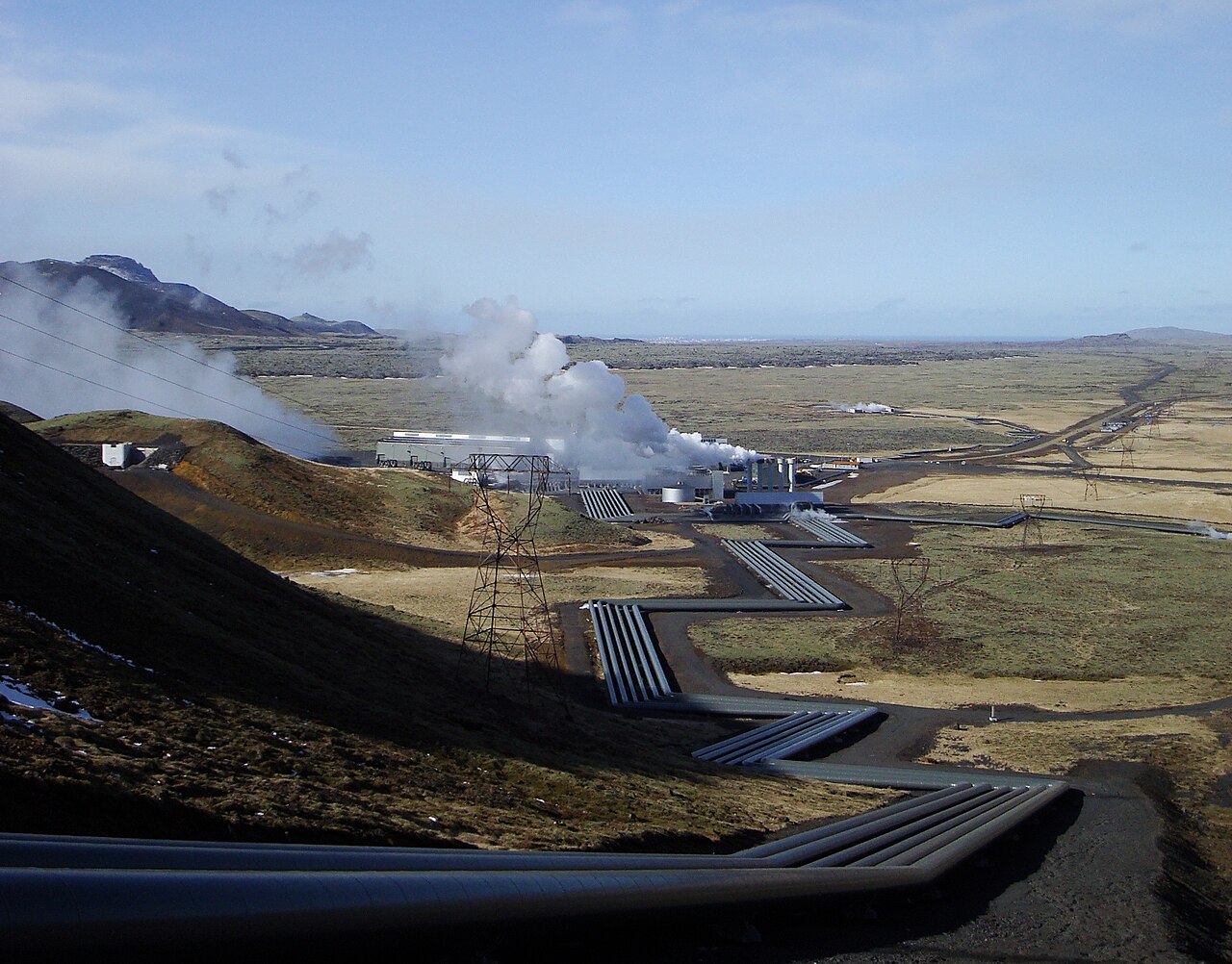
Image: ThinkGeoEnergy ( CC BY 2.0 )

What it is
Direct air capture (DAC) runs outdoor air through chemical filters, then heats the filters to release a concentrated CO₂ stream. Climeworks, a Swiss firm, built Orca in Iceland in 2021 and Mammoth beside it. Mammoth began capturing CO₂ in May 2024. Nameplate capacity is up to about 36,000 tonnes a year once all collector containers are in: a rounding error next to global emissions, and early years ran well below that figure.
Problem it targets
Some CO₂ will still be emitted after we cut what we can: cement, long-haul fuel, leftover power. Pulling carbon already in the air is one way to shrink the stock, but only if the energy is clean and the CO₂ stays stored.
How it works
Collectors use solid amine filters and low-temperature heat: in Iceland, geothermal steam from ON Power. Released CO₂ is dissolved and injected into basalt by Carbfix, where it mineralizes. The chain is real. The limit is cost, energy, and how fast modules can be built without pretending a few thousand tonnes is climate-scale.
Status and players
Climeworks (Switzerland) operates Orca and Mammoth in Iceland with ON Power and Carbfix. The U.S. Department of Energy has also funded much larger DAC “hub” concepts (including Project Cypress with Climeworks, Battelle, and Heirloom); those are plans, not operating megaton plants.
Risks and limits
DAC is energy-hungry. If the heat and power are fossil, the net removal shrinks or vanishes. Credits can be sold faster than tonnes are stored. Mammoth’s first year showed that “online” is not the same as nameplate. This is a pilot industry, not a substitute for cutting emissions.
Sources
Official Mammoth plant page and 8 May 2024 start release; IEA DAC tracking. Nameplate is not tonnes delivered.