

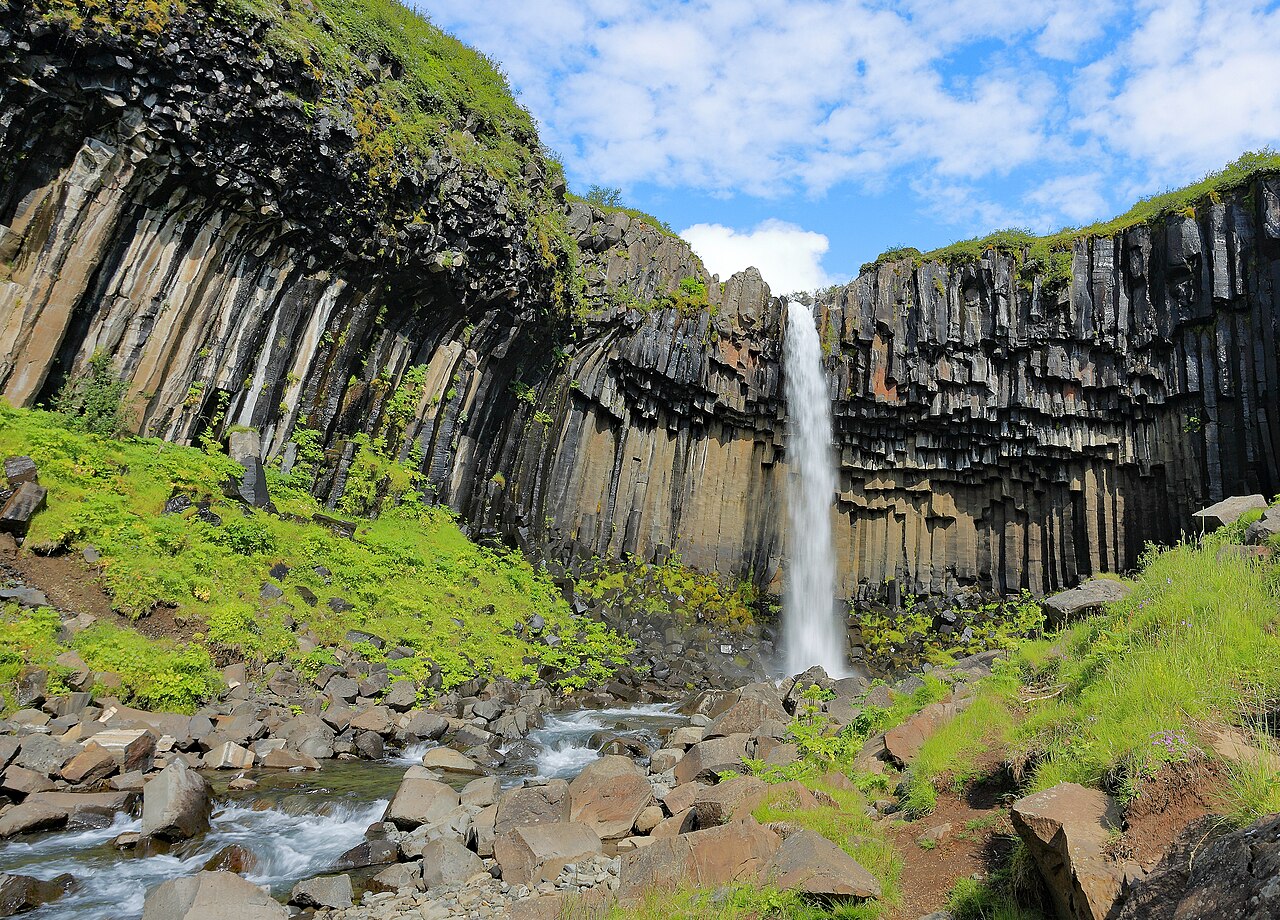
Image: Martin Falbisoner ( CC BY-SA 4.0 )

What it is
Carbfix is an Icelandic method: CO₂ is dissolved in water and injected into reactive basaltic rock, where it forms stable carbonate minerals. Field results from Hellisheiði showed a large share of injected carbon mineralizing on a timescale of years, not geologic ages.
Problem it targets
Storage is the other half of capture. A tank or a depleted field can leak in principle. Mineralization aims to lock carbon in rock so the store is a stone, not a pressurized bubble.
How it works
CO₂ is dissolved before or during injection, which also lowers the risk of a free CO₂ plume. In Iceland the water and the rock are available next to geothermal plants. The same geology does not exist everywhere; other basalt provinces (for example in the U.S. Northwest or India) are being studied, not copied overnight.
Status and players
Carbfix (Reykjavík Energy / ON Power lineage) at Hellisheiði; storage partner for Climeworks Orca and Mammoth. Research papers by Matter, Oelkers, Gíslason and colleagues documented the early injections.
Risks and limits
Needs a lot of water and the right rock. Scaling beyond Iceland is a geology problem as much as an engineering one. It stores carbon that has already been captured: it does not pull CO₂ from the sky by itself.
Sources
Carbfix project site; Matter et al., Science, 2016: more than 95% of injected CO₂ mineralized in under two years at Hellisheiði.